


Mixed metals exposure and cognitive function in Bangladeshi adolescents
- PMID: 35131582
- PMCID: PMC10045507
- DOI: 10.1016/j.ecoenv.2022.113229
Mixed metals exposure and cognitive function in Bangladeshi adolescents
Abstract
Background: Over 57 million people in Bangladesh have been chronically exposed to arsenic-contaminated drinking water. They also face environmental exposure to elevated levels of cadmium (Cd), manganese (Mn), and lead (Pb), all of which have been previously observed in environmental and biological samples for this population. These metals have been linked to adverse neurocognitive outcomes in adults and children, though their effects on adolescents are not yet fully characterized. Additionally, previous studies have linked selenium (Se) to protective effects against the toxicity of these other metals.
Objectives: To examine the associations between mixed metals exposure and cognitive function in Bangladeshi adolescents.
Methods: The Metals, Arsenic, & Nutrition in Adolescents study (MANAs) is a cross-sectional study of 572 Bangladeshi adolescents aged 14-16 years, whose parents were enrolled in the Health Effects of Arsenic Longitudinal Study (HEALS). Biosamples were collected from these adolescents for measurement of whole blood metalloid/metal levels of As, Cd, Mn, Pb, and Se. Participants also completed an abbreviated version of The Cambridge Neuropsychological Test Automated Battery (CANTAB), a cognitive function test designed to measure performance across several aspects of executive function. Linear regression was used to examine associations for each metal while controlling for the other metals. Bayesian Kernel Machine Regression (BKMR) assessed the overall mixture effect in addition to confirming the effects of individual metal components observed via linear regression.
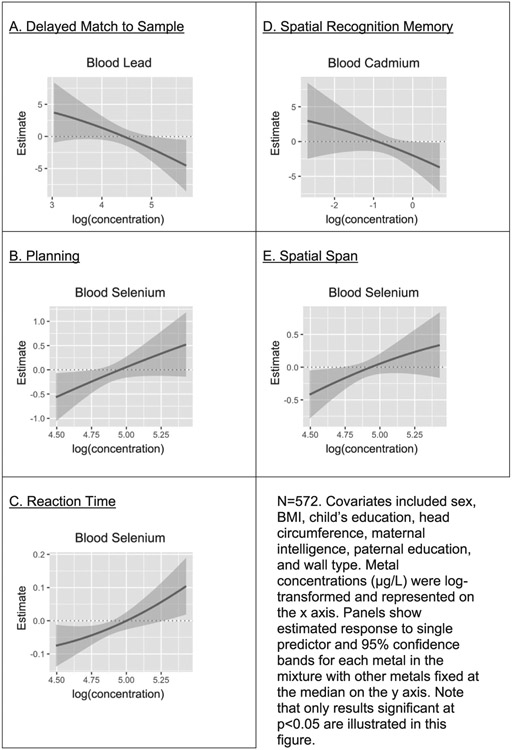
Results: Linear regression revealed negative associations for Spatial Working Memory and both As and Mn (As B=-2.40, Mn B=-5.31, p < 0.05). We also observed negative associations between Cd and Spatial Recognition Memory (B=-2.77, p < 0.05), and Pb and Delayed Match to Sample, a measure of visual recognition and memory (B=-3.67, p < 0.05). Finally, we saw a positive association for Se and Spatial Span Length (B=0.92, p < 0.05). BKMR results were largely consistent with the regression analysis, showing meaningful associations for individual metals and CANTAB subtests, but no overall mixture effect. Via BKMR, we observed negative associations between Pb and Delayed Match to Sample, and Cd and Spatial Recognition Memory; this analysis also showed positive associations for Se and the Planning, Reaction Time, and Spatial Span subtests. BKMR posterior inclusion probability consistently reported that Se, the only component of the mixture to show a positive association with cognition, was the most important member of the mixture.
Conclusions: Overall, we found Se to be positively associated with cognition, while Mn and As were linked to poorer working memory, and Cd and Pb were associated with poorer visual recognition and memory. Our observations are consistent with previous reports on the effects of these metal exposures in adults and children. Our findings also suggest agreement between linear regression and BKMR methods for analyzing metal mixture exposures. Additional studies are needed to evaluate the impact of mixed metals exposure on adverse health and poorer cognition later in life for those exposed during adolescence. Findings also suggest that metal exposure mitigation efforts aimed at adolescents might influence lifelong cognitive outcomes in regions where environmental exposure to metals is endemic.
Keywords: Adolescents; Arsenic; Cadmium; Cognitive function; Environmental metal exposures; Lead; Manganese; Metal mixtures; Selenium; The Cambridge Neuropsychological Test Automated Battery (CANTAB).
Copyright © 2022 The Authors. Published by Elsevier Inc. All rights reserved.
Figures
References
-
- Agency for Toxic Substances Disease Registry (ATSDR), In: US Department of Health & Human Services PHS, (Ed.), Toxicological Profile for Arsenic, ⟨https://www.atsdr.cdc.gov/toxguides/toxguide-2.pdf⟩. 2007.
-
- , 2012Agency for Toxic Substances and Disease Registry (ATSDR), 2012a. In: U.S. Department of Health and Human Services PHS, (Ed.), Toxicological Profile for Manganese, Atlanta, GA.
-
- Agency for Toxic Substances Disease Registry (ATSDR), In: US Department of Health & Human Services PHS, (Ed.), Toxicological Profile for Cadmium. ⟨https://www.atsdr.cdc.gov/toxguides/toxguide-5.pdf⟩. 2012b.
-
- Akbaraly TN, Hininger-Favier I, Carri, et al., 2007. Plasma selenium over time andcognitive decline in the elderly. Epidemiology 18 (1), 52–58. - PubMed
MeSH terms
Substances
Grants and funding
LinkOut - more resources
Full Text Sources
Research Materials
