. 2023 Aug;32(e2):e145-e152.
doi: 10.1136/tobaccocontrol-2021-056901. Epub 2022 Feb 7.

Effectiveness of e-cigarettes as aids for smoking cessation: evidence from the PATH Study cohort, 2017-2019

Affiliations

Effectiveness of e-cigarettes as aids for smoking cessation: evidence from the PATH Study cohort, 2017-2019

Ruifeng Chen et al. Tob Control. 2023 Aug.

Abstract

Objective: To assess the effectiveness of e-cigarettes in smoking cessation in the USA from 2017 to 2019, given the 2017 increase in high nicotine e-cigarette sales.

Methods: In 2017, the PATH Cohort Study included data on 3578 previous year smokers with a recent quit attempt and 1323 recent former smokers. Respondents reported e-cigarettes or other products used to quit cigarettes and many covariates associated with e-cigarette use. Study outcomes were 12+ months of cigarette abstinence and tobacco abstinence in 2019. We report weighted unadjusted estimates and use propensity score matched analyses with 1500 bootstrap samples to estimate adjusted risk differences (aRD).

Results: In 2017, 12.6% (95% CI 11.3% to 13.9%) of recent quit attempters used e-cigarettes to help with their quit attempt, a decline from previous years. Cigarette abstinence for e-cigarette users (9.9%, 95% CI 6.6% to 13.2%) was lower than for no product use (18.6%, 95% CI 16.0% to 21.2%), and the aRD for e-cigarettes versus pharmaceutical aids was -7.3% (95% CI -14.4 to -0.4) and for e-cigarettes versus any other method was -7.7% (95% CI -12.2 to -3.2). Only 2.2% (95% CI 0.0% to 4.4%) of recent former smokers switched to a high nicotine e-cigarette. Subjects who switched to e-cigarettes appeared to have a higher relapse rate than those who did not switch to e-cigarettes or other tobacco, although the difference was not statistically significant.

Conclusions: Sales increases in high nicotine e-cigarettes in 2017 did not translate to more smokers using these e-cigarettes to quit smoking. On average, using e-cigarettes for cessation in 2017 did not improve successful quitting or prevent relapse.

Keywords: Surveillance and monitoring; addiction; cessation; electronic nicotine delivery devices.


Conflict of interest statement

Competing interests: None declared.

Figures
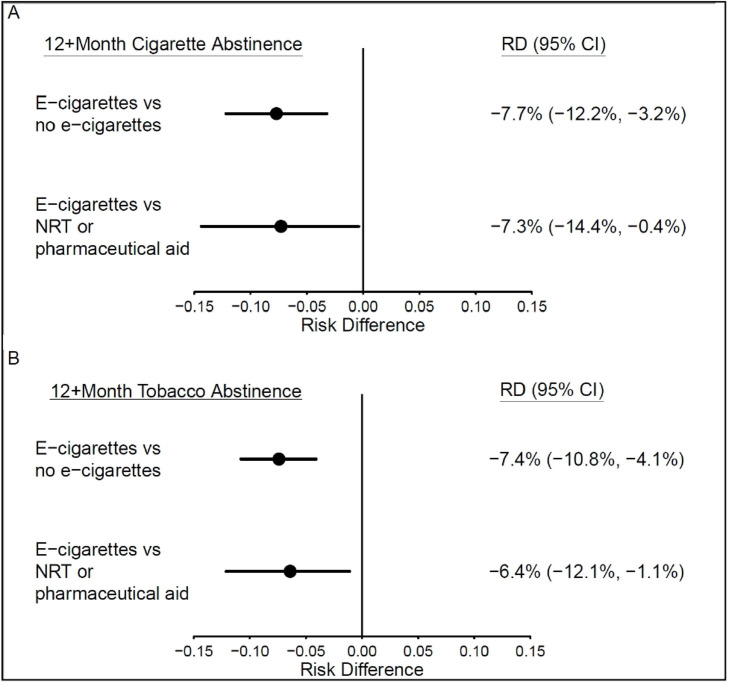
Figure 1
Figure 1
The adjusted risk difference (RD) in the rate of 12+ months of cigarette/tobacco abstinence for quit attempters by comparing the use of e-cigarettes versus no product use and the use of e-cigarettes versus use of nicotine replacement therapy (NRT) or pharmaceutical aid only during the last quit attempt in the year prior to Wave 4. (A) 12+ months of cigarette abstinence; (B) 12+ months of tobacco abstinence. Analyses using propensity score matching followed by logistic regression adjustment. Bootstrap samples were created to make statistical inference (details given in the section on Statistical Analyses). Covariates used for propensity score matching include: age, sex, education, race, ethnicity, income, cigarette smoking status at W3, time since last quit attempt, tobacco dependence index, cigarette consumption at W3, duration of previous quit attempt reported at W4, interest in quitting cigarettes, self-efficacy about quitting, smoke-free home, exposure to smoking, perceived harm of cigarettes and e-cigarettes, cigarette pack-years, age began regular smoking, insurance status, external mental health symptoms, internal mental health symptoms and existence of smoking-related disease. Missing data were imputed using simple imputation for each bootstrap sample. Cigarette abstinence does not include abstinence from e-cigarettes or other tobacco products. Tobacco abstinence includes no use of e-cigarette, cigar, cigarillo, filtered cigar, pipe, hookah, snus and smokeless tobacco.

References

    1. Caraballo RS, Shafer PR, Patel D, et al. Quit methods used by US adult cigarette smokers, 2014-2016. Prev Chronic Dis 2017;14:E32. 10.5888/pcd14.160600 - DOI - PMC - PubMed
    1. Rigotti NA. Randomized trials of e-cigarettes for smoking cessation. JAMA 2020;324:1835–7. 10.1001/jama.2020.18967 - DOI - PubMed
    1. Romberg AR, Miller Lo EJ, Cuccia AF, et al. Patterns of nicotine concentrations in electronic cigarettes sold in the United States, 2013-2018. Drug Alcohol Depend 2019;203:1–7. 10.1016/j.drugalcdep.2019.05.029 - DOI - PMC - PubMed
    1. Miech R, Johnston L, O'Malley PM, et al. Adolescent vaping and nicotine use in 2017–2018: U.S. national estimates. N Engl J Med 2019;380:192–3. 10.1056/NEJMc1814130 - DOI - PMC - PubMed
    1. Hartmann-Boyce J, McRobbie H, Lindson N, et al. Electronic cigarettes for smoking cessation. Cochrane Database Syst Rev 2020;10:CD010216. 10.1002/14651858.CD010216.pub - DOI - PMC - PubMed

Publication types