


Higher Leptin Levels Are Associated with Coronary Artery Calcium Progression: the Multi-Ethnic Study of Atherosclerosis (MESA)
- PMID: 35132401
- PMCID: PMC8817736
- DOI: 10.1016/j.deman.2021.100047
Higher Leptin Levels Are Associated with Coronary Artery Calcium Progression: the Multi-Ethnic Study of Atherosclerosis (MESA)
Abstract
Background: Adipokines play a role in cardiometabolic pathways. Coronary artery calcium (CAC) progression prognosticates cardiovascular disease (CVD) risk. However, the association of adipokines with CAC progression is not well established. We examined the association of adipokines with CAC progression in a multi-ethnic cohort free of CVD at baseline.
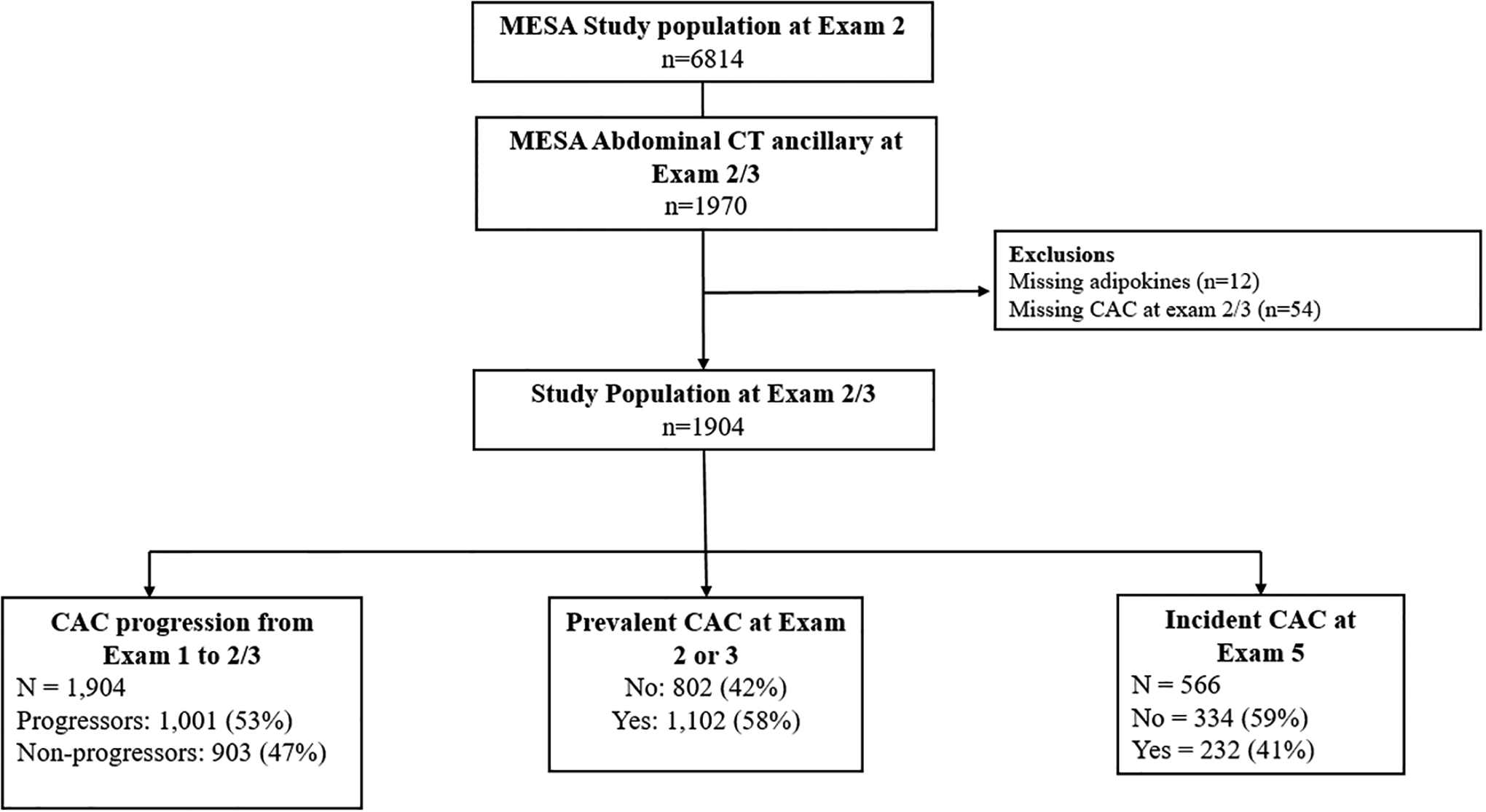
Methods: We included 1,904 randomly-selected adults enrolled in the Multi-Ethnic Study of Atherosclerosis who had both adipokine levels [leptin, resistin, adiponectin] and CAC by CT measured at either exam 2 (2002-2004) or exam 3 (2004-2005). CAC was previously measured at exam 1 (2000-2002) and a subset (n=566) had CAC measured at exam 5 (2010-2012). We used logistic regression to examine odds of CAC progression between exam 1 and 2/3 (defined as >0 Agatston units of change/year). We used linear mixed effect models to examine CAC progression from exam 2/3 to 5.
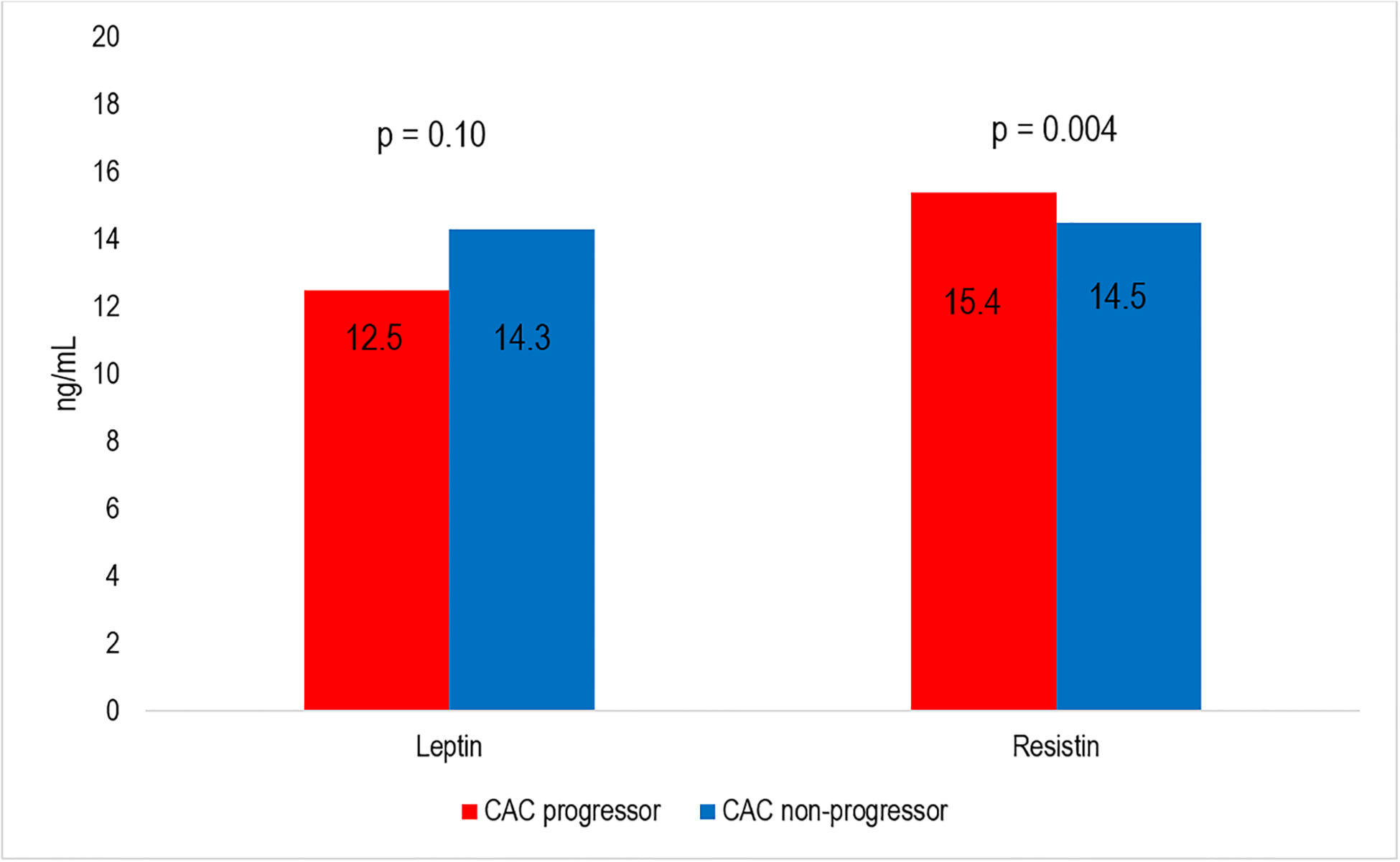
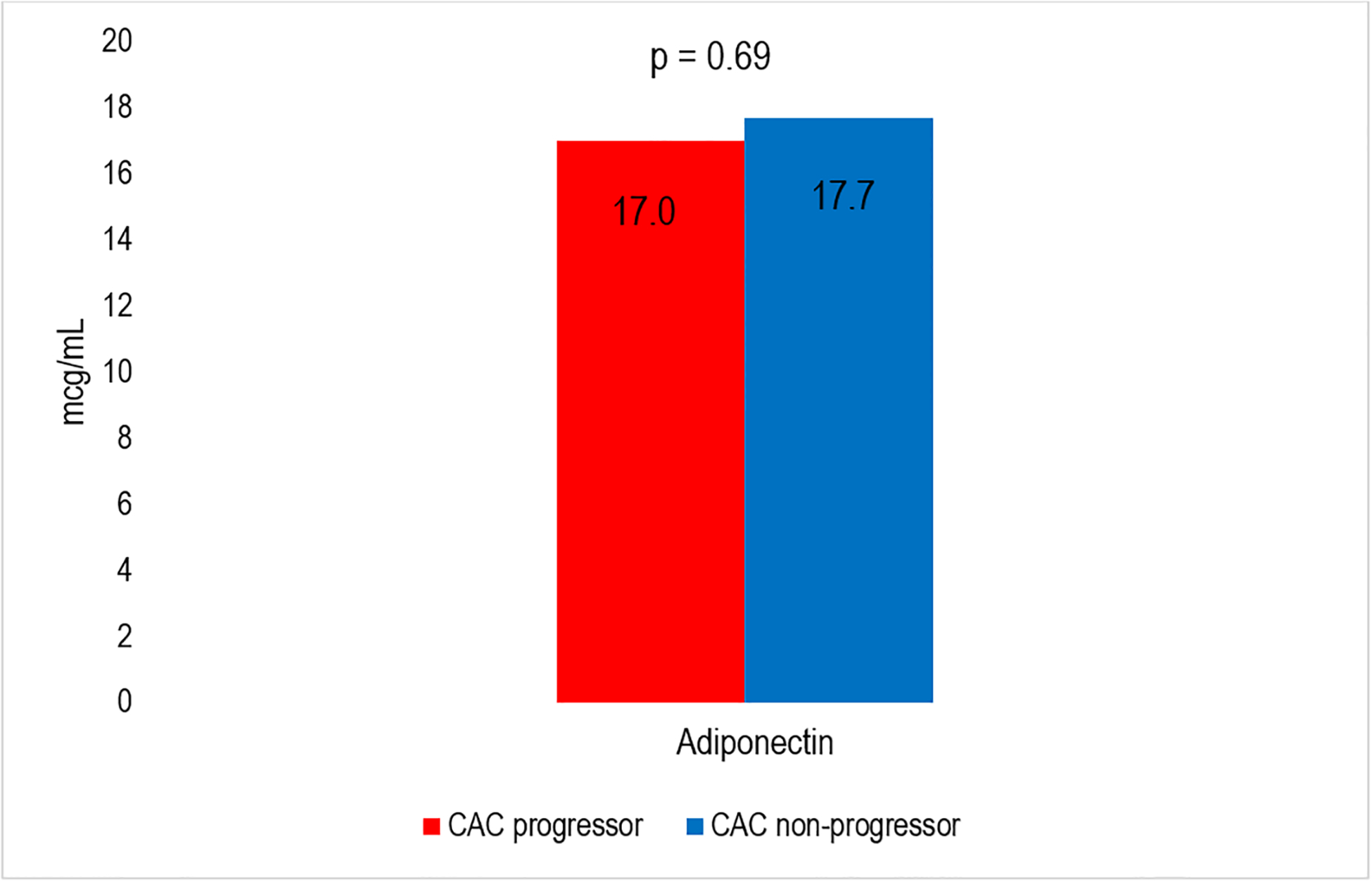
Results: At exam 2/3, the mean age was 65(10) yrs; 50% women. In models adjusted for sociodemographic factors and BMI, the highest tertile of leptin, compared to lowest, was associated with an increased odds of CAC progression over the preceding 2.6yrs [OR 1.60 (95% CI: 1.10-2.33)]. In models further adjusted for visceral fat and CVD risk factors, the highest tertile of leptin was statistically significantly associated with a 4% (1-7%) greater CAC progression over an average of 7yrs. No associations were seen for resistin and adiponectin.
Conclusions: Higher leptin levels were independently, but modestly, associated with CAC progression. Atherosclerosis progression may be one mechanism through which leptin confers increased CVD risk.
Keywords: adipokines; atherosclerosis; cardiovascular risk; coronary artery calcium; leptin.
Figures
References
-
- Bays HE. Adiposopathy is “sick fat” a cardiovascular disease? J Am Coll Cardiol 2011;57:2461–2473. - PubMed
-
- Bays HE, Gonzalez-Campoy JM, Bray GA, Kitabchi AE, Bergman DA, Schorr AB, Rodbard HW, Henry RR. Pathogenic potential of adipose tissue and metabolic consequences of adipocyte hypertrophy and increased visceral adiposity. Expert Rev Cardiovasc Ther 2008;6:343–368. - PubMed
-
- Hughes-Austin JM, Wassel CL, Jimenez J, Criqui MH, Ix JH, Rasmussen-Torvik LJ, Budoff MJ, Jenny NS, Allison MA. The relationship between adiposity-associated inflammation and coronary artery and abdominal aortic calcium differs by strata of central adiposity: The Multi-Ethnic Study of Atherosclerosis (MESA). Vasc Med 2014;19:264–271. - PMC - PubMed
Grants and funding
- HHSN268201500003C/HL/NHLBI NIH HHS/United States
- N01 HC095161/HL/NHLBI NIH HHS/United States
- N01 HC095168/HL/NHLBI NIH HHS/United States
- R01 HL088451/HL/NHLBI NIH HHS/United States
- N01 HC095167/HL/NHLBI NIH HHS/United States
- N01 HC095159/HL/NHLBI NIH HHS/United States
- UL1 TR001420/TR/NCATS NIH HHS/United States
- N01 HC095163/HL/NHLBI NIH HHS/United States
- HHSN268201500003I/HL/NHLBI NIH HHS/United States
- UL1 TR000040/TR/NCATS NIH HHS/United States
- N01 HC095166/HL/NHLBI NIH HHS/United States
- N01 HC095162/HL/NHLBI NIH HHS/United States
- N01 HC095160/HL/NHLBI NIH HHS/United States
- UL1 TR001079/TR/NCATS NIH HHS/United States
- N01 HC095169/HL/NHLBI NIH HHS/United States
- R01 HL146907/HL/NHLBI NIH HHS/United States
- N01 HC095165/HL/NHLBI NIH HHS/United States
- N01 HC095164/HL/NHLBI NIH HHS/United States