


Prevalence of human papillomavirus in head and neck cancers at tertiary care centers in the United States over time
- PMID: 35132635
- PMCID: PMC9007835
- DOI: 10.1002/cncr.34124
Prevalence of human papillomavirus in head and neck cancers at tertiary care centers in the United States over time
Abstract
Background: Human papillomavirus (HPV) is responsible for a growing proportion of oropharyngeal squamous cell carcinomas (OPSCCs) among men and White individuals. Whether similar trends apply to women, non-Whites, and non-oropharyngeal squamous cell carcinomas (non-OPSCCs) is unknown.
Methods: This is a cross-sectional analysis combining 2 multi-institutional case series of incident head and neck squamous cell carcinoma (HNSCC) cases. Incident HNSCCs from 1995 to 2012 were enrolled retrospectively using banked tumor samples and medical record abstraction. Incident HNSCCs from 2013 to 2019 were enrolled prospectively. The prevalence of tumor HPV biomarkers was tested over 3 time periods (1995-2003, 2004-2012, and 2013-2019). Centralized testing was done for p16 immunohistochemistry (p16) and oncogenic HPV in situ hybridization (ISH).
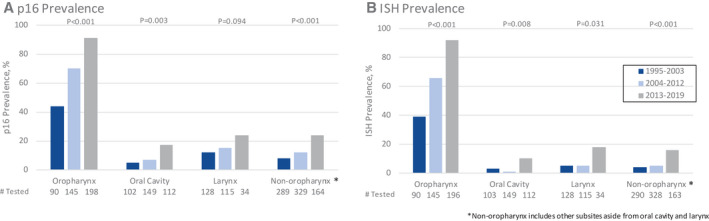
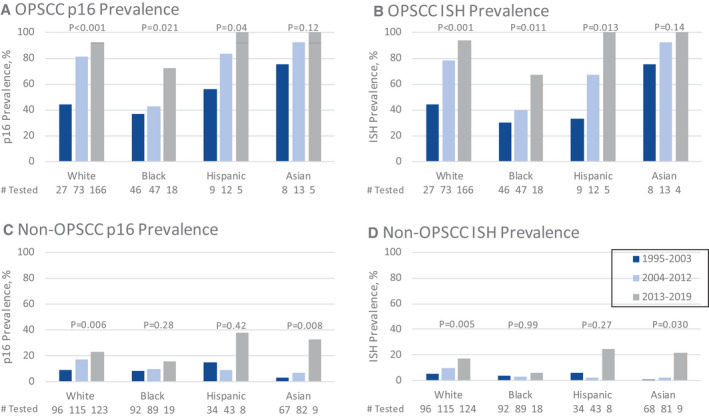
Results: A total of 1209 incident cases of HNSCC were included. Prevalence of p16- and ISH-positive tumors increased significantly for oropharynx cancers over time. The majority were positive after 2013 for White patients (p16, 92%; P < .001; ISH 94%; P < .001), Black patients (p16, 72%; P = .021; ISH 67%; P = .011), and Hispanic patients (p16, 100%; P = .04; ISH 100%; P = .013). For women with OPSCC, the prevalence of p16- and ISH-positive tumors increased significantly to 82% (P < .001) and 78% (P = .004), respectively. For non-OPSCCs, there was increased p16 and ISH positivity overall with 24% p16 and 16% ISH positivity in the most recent time period (P < .001 for both).
Conclusions: The majority of OPSCCs in US tertiary care centers are now p16 and ISH positive for all sex and race groups. In some populations in the United States, 91% of OPSCCs are now caused by HPV. Few non-OPSCCs are p16 and ISH positive.
Keywords: head and neck cancer; human papillomavirus; oropharyngeal cancer; prevalence; race; sex.
© 2022 The Authors. Cancer published by Wiley Periodicals LLC on behalf of American Cancer Society.
Conflict of interest statement
William R. Ryan is advisor for Olympus and Medtronic and a consultant for Rakuten Medical. Patrick K. Ha is on the advisory boards of Rakuten Medical and Loxo Oncology and received educational funding from Stryker, Medtronic, Axogen, and Johnson & Johnson.
Figures
References
-
- Ryerson AB, Peters ES, Coughlin SS, et al. Burden of potentially human papillomavirus‐associated cancers of the oropharynx and oral cavity in the US, 1998‐2003. Cancer. 2008;113(suppl):2901‐2909. - PubMed
-
- Patel MA, Blackford AL, Rettig EM, Richmon JD, Eisele DW, Fakhry C. Rising population of survivors of oral squamous cell cancer in the United States. Cancer. 2016;122:1380‐1387. - PubMed
-
- Rettig EM, D'Souza G. Epidemiology of head and neck cancer. Surg Oncol Clin N Am. 2015;24:379‐396. - PubMed
Publication types
MeSH terms
Substances
Grants and funding
LinkOut - more resources
Full Text Sources
Medical
