Evaluation of hypoparathyroidism following laryngectomy
- PMID: 35132880
- PMCID: PMC9773242
- DOI: 10.1308/rcsann.2021.0276
Evaluation of hypoparathyroidism following laryngectomy
Abstract
Background: Hypoparathyroidism is a recognised complication following laryngectomy; it is associated with significant short-and long-term morbidity. This study aimed to further characterise this condition, identify risk factors and describe preventative and management strategies in a large cohort.
Materials and methods: This was a retrospective study at a tertiary referral centre for head and neck cancers. All consecutive patients who had total laryngectomy over an eight-year period were included.
Results: A total of 140 patients were included. Rates of transient and long-term hypoparathyroidism were 14.3% and 10.1%, respectively. The following factors were significantly associated with transient post-surgical hypocalcaemia or hypoparathyroidism: total thyroidectomy (relative risk, RR, 4.33; 95% confidence interval, CI, 1.86-10.10), oesophagectomy (RR 6.05; 95% CI 2.92-12.53) and female sex (RR 3.23; 95% CI 1.45-7.19). In addition, total thyroidectomy (RR 5.89; 95% CI 1.94-17.86), central neck dissection (RR 3.97; 95% CI 1.42-11.10), oesophagectomy (RR 9.38; 95% CI 4.13-21.3), pharyngectomy (RR 7.14; 95% CI 2.08-24.39) and female sex (RR 5.52; 95% CI 1.95-15.63) were risk factors for long-term hypoparathyroidism. There was variability in the use of preventative measures, monitoring and management of hypocalcaemia and hypoparathyroidism following total laryngectomy.
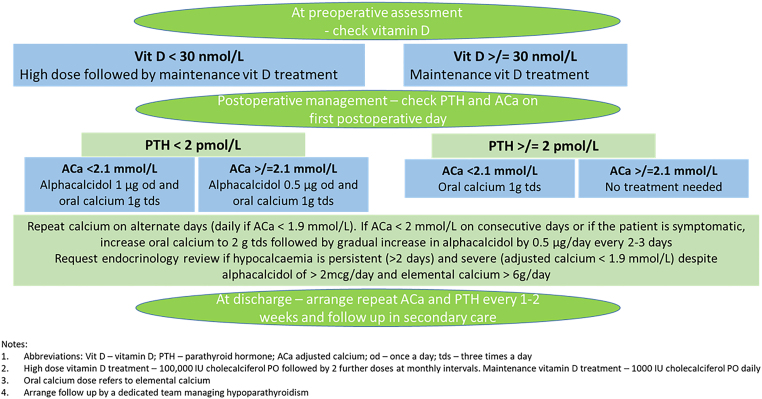
Conclusions: Transient hypocalcaemia and long-term hypoparathyroidism occur in a significant proportion of patients after laryngectomy. A standard protocol is required to improve care.
Keywords: Hypocalcaemia; Hypoparathyroidism; Laryngectomy; Thyroidectomy.
Figures
References
-
- Kumar R, Drinnan M, Robinson Met al. Thyroid gland invasion in total laryngectomy and total laryngopharyngectomy: a systematic review and meta-analysis of the English literature. Clin Otolaryngol 2013; 38: 372–378. - PubMed
-
- Edafe O, Antakia R, Laskar Net al. Systematic review and meta-analysis of predictors of post-thyroidectomy hypocalcaemia. Br J Surg 2014; 101: 307–320. - PubMed
-
- Hannan FM, Thakker RV. Investigating hypocalcaemia. BMJ 2013; 346: f2213. - PubMed
-
- Underbjerg L, Sikjaer T, Mosekilde L, Rejnmark L. Cardiovascular and renal complications to postsurgical hypoparathyroidism: a Danish nationwide controlled historic follow-up study. J Bone Miner Res 2013; 28: 2277–2285. - PubMed
-
- Underbjerg L, Sikjaer T, Mosekilde L, Rejnmark L. Postsurgical hypoparathyroidism: risk of fractures, psychiatric diseases, cancer, cataract, and infections. J Bone Miner Res 2014; 29: 2504–2510. - PubMed
MeSH terms
LinkOut - more resources
Full Text Sources