


Self-reported sexually transmitted infections among adolescent girls and young women in sub-Saharan Africa
- PMID: 35134172
- PMCID: PMC9623488
- DOI: 10.1093/inthealth/ihab088
Self-reported sexually transmitted infections among adolescent girls and young women in sub-Saharan Africa
Abstract
Background: Sexually transmitted infections (STIs) affect individuals of all ages, but adolescent girls and young women are disproportionately affected. We examined the prevalence and factors associated with self-reported STIs (SR-STIs) among adolescent girls and young women in sub-Saharan Africa (SSA).
Methods: Demographic and Health Survey data of 27 sub-Saharan African countries were used for the study. The sample size comprised 68944 adolescent girls and young women (15-24 y of age). The outcome variable was SR-STIs. Multilevel binary logistic regression analysis was performed to identify factors associated with SR-STIs.
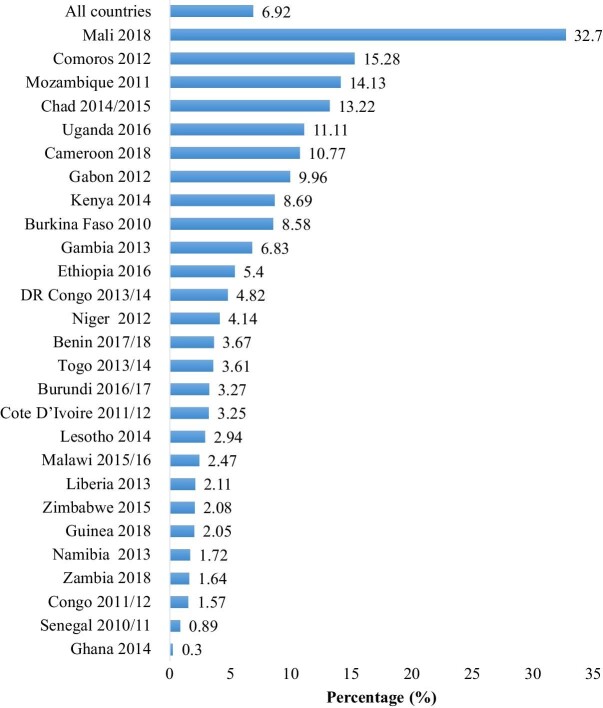
Results: On average, the prevalence of SR-STIs among adolescent girls and young women in SSA was 6.92%. The likelihood of SR-STIs was higher among young women aged 20-24 y (adjusted odds ratio [aOR] 1.36 [confidence interval {CI} 1.27 to 1.46]), those not married (aOR 1.64 [CI 1.51 to 1.79]), those working (aOR 1.20 [CI 1.12 to 1.27]), those whose age at first sex was ≤19 y (aOR 1.99 [CI 1.80 to 2.20]), those with two or more sex partners (aOR 1.56 [CI 1.35 to 1.80]), those who listened to radio (aOR 1.26 [CI 1.17 to 1.35]), those in urban areas (aOR 1.42 [CI 1.30 to 1.51]) and those with a wealth index of rich (aOR 1.28 [CI 1.17 to 1.40]) compared with their counterparts. In contrast, those with a primary (aOR 0.86 [CI 0.78 to 0.94]) or secondary/higher level of education (aOR 0.83 [CI 0.75 to 0.92]) compared with those with no formal education and those who were exposed to television (aOR 0.90 [CI 0.84 to 0.98]) compared with those who were not exposed were less likely to report STIs.
Conclusions: Our findings demonstrate the need for countries in SSA to commit towards reducing the incidence of STIs. Community-based health educational programs are required to intensify the awareness of STIs and their prevention in various sub-Saharan African countries considering the factors that expose adolescent girls and young women to STIs.
Keywords: adolescent girls; prevalence; self-reported sexually transmitted infections; sub-Saharan Africa; young women.
© The Author(s) 2022. Published by Oxford University Press on behalf of Royal Society of Tropical Medicine and Hygiene.
References
-
- World Health Organization . Global prevalence and incidence of selected curable sexually transmitted infections: overview and estimates. Geneva: World Health Organization; 2001.
-
- Williamson DA, Chen MY. Emerging and reemerging sexually transmitted infections. N Engl J Med. 2020;382(21):2023–32. - PubMed
-
- Scott-Sheldon LA, Chan PA.. Increasing sexually transmitted infections in the US: a call for action for research, clinical, and public health practice. Arch Sex Behav. 2020;49(1):13–7. - PubMed
MeSH terms
LinkOut - more resources
Full Text Sources
Medical
Research Materials
