. 2022 Mar 28;38(7):1972-1979.
doi: 10.1093/bioinformatics/btac049.

Vivarium: an interface and engine for integrative multiscale modeling in computational biology

Affiliations

Vivarium: an interface and engine for integrative multiscale modeling in computational biology

Eran Agmon et al. Bioinformatics. .

Abstract

Motivation: This article introduces Vivarium-software born of the idea that it should be as easy as possible for computational biologists to define any imaginable mechanistic model, combine it with existing models and execute them together as an integrated multiscale model. Integrative multiscale modeling confronts the complexity of biology by combining heterogeneous datasets and diverse modeling strategies into unified representations. These integrated models are then run to simulate how the hypothesized mechanisms operate as a whole. But building such models has been a labor-intensive process that requires many contributors, and they are still primarily developed on a case-by-case basis with each project starting anew. New software tools that streamline the integrative modeling effort and facilitate collaboration are therefore essential for future computational biologists.

Results: Vivarium is a software tool for building integrative multiscale models. It provides an interface that makes individual models into modules that can be wired together in large composite models, parallelized across multiple CPUs and run with Vivarium's discrete-event simulation engine. Vivarium's utility is demonstrated by building composite models that combine several modeling frameworks: agent-based models, ordinary differential equations, stochastic reaction systems, constraint-based models, solid-body physics and spatial diffusion. This demonstrates just the beginning of what is possible-Vivarium will be able to support future efforts that integrate many more types of models and at many more biological scales.

Availability and implementation: The specific models, simulation pipelines and notebooks developed for this article are all available at the vivarium-notebooks repository: https://github.com/vivarium-collective/vivarium-notebooks. Vivarium-core is available at https://github.com/vivarium-collective/vivarium-core, and has been released on Python Package Index. The Vivarium Collective (https://vivarium-collective.github.io) is a repository of freely available Vivarium processes and composites, including the processes used in Section 3. Supplementary Materials provide with an extensive methodology section, with several code listings that demonstrate the basic interfaces.

Supplementary information: Supplementary data are available at Bioinformatics online.


Figures

Fig. 1.
Fig. 1.
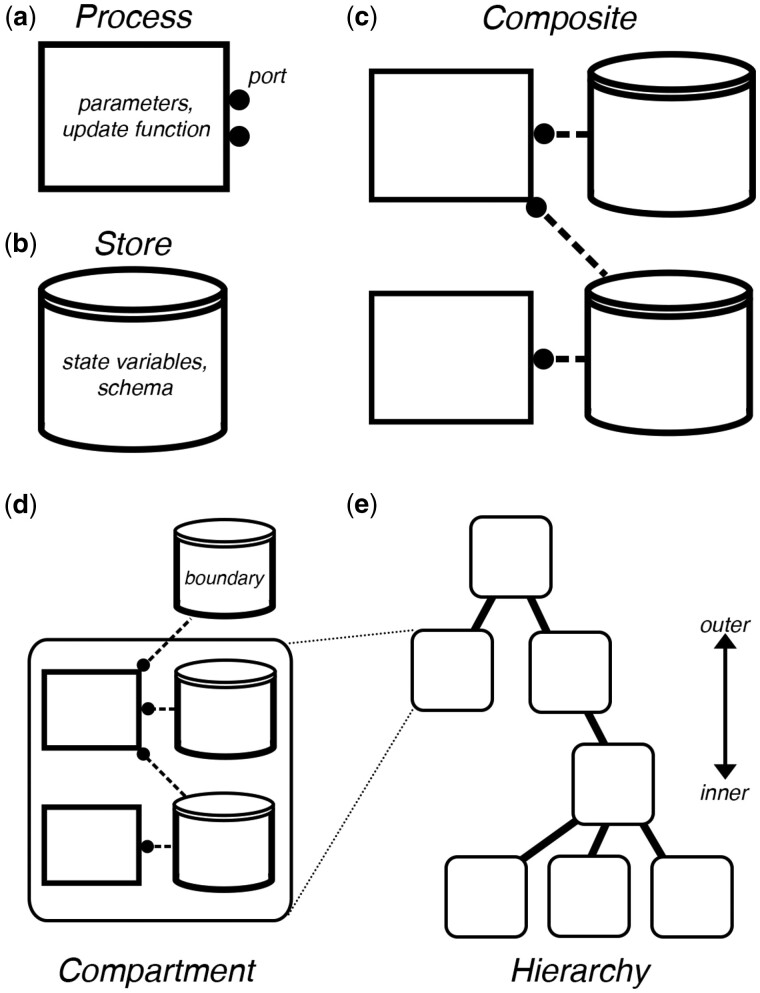
Vivarium’s model interface, illustrating the formal structure of the framework. (a) A Process, shown as a rectangular flowchart symbol, is a modular models that contain the parameters, an update function and ports. (b) A Store, shown as the flowchart symbol for a database, holds the state variables and schemas that determines how to handle updates. (c) Composites are bundles of processes and stores wired together by a bipartite network called a topology, with processes connecting to stores through their ports. (d) Compartments are processes and stores connected across a single level. Processes can be wired across compartments through boundary stores. (e) Compartments are embedded in a hierarchy—depicted as a hierarchical network with discrete layers. Outer compartments are shown above and inner compartments below
Fig. 2.
Fig. 2.
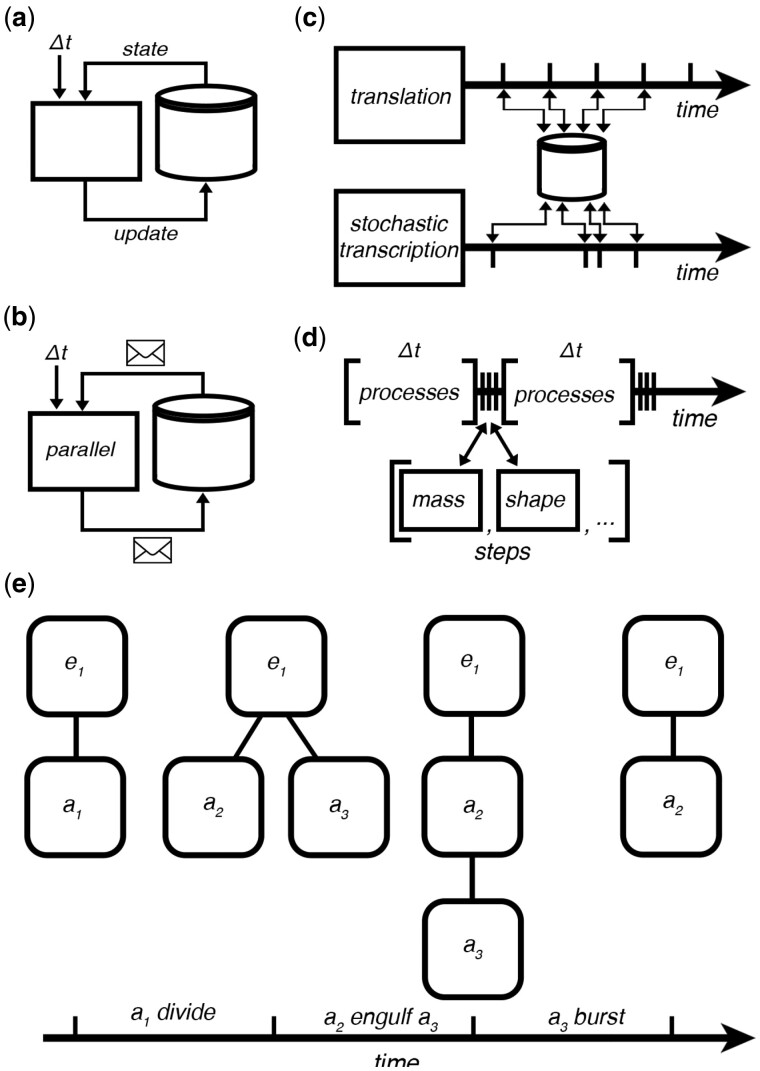
The vivarium engine takes the system and runs it forward in time. (a) A basic simulation loop has processes view the states through their ports, run their update function for a given time step, and return an update. (b) Any process can run in parallel on an OS process, which is placed on a long-running CPU thread, with state views and updates handled by message-passing. This allows for scalable simulation on computers with many CPUs. (c) Processes can run at different time scales, and using variable time steps. Here, a translation process is shown operating at fixed time steps, and stochastic transcription is operating at variable time steps determined based on the state of the system at each time step’s start. (d) Steps are a subclass of Process, used for models that are not time-step-dependent. Steps run at the end of every time step, in an order determined by a directed acyclic graph (DAG) which we call a flow. Steps calculate additional states from the states updated by the dynamic processes. In this figure a dynamic process runs for Δt, followed by a mass step and a shape step. (e) A series of hierarchy updates depicts a compartment added by a divide update, then a compartment subsumed into a neighbor by an engulf update, then the engulfed compartment is deleted with a burst update. Other hierarchy updates include merge, add or delete
Fig. 3.
Fig. 3.
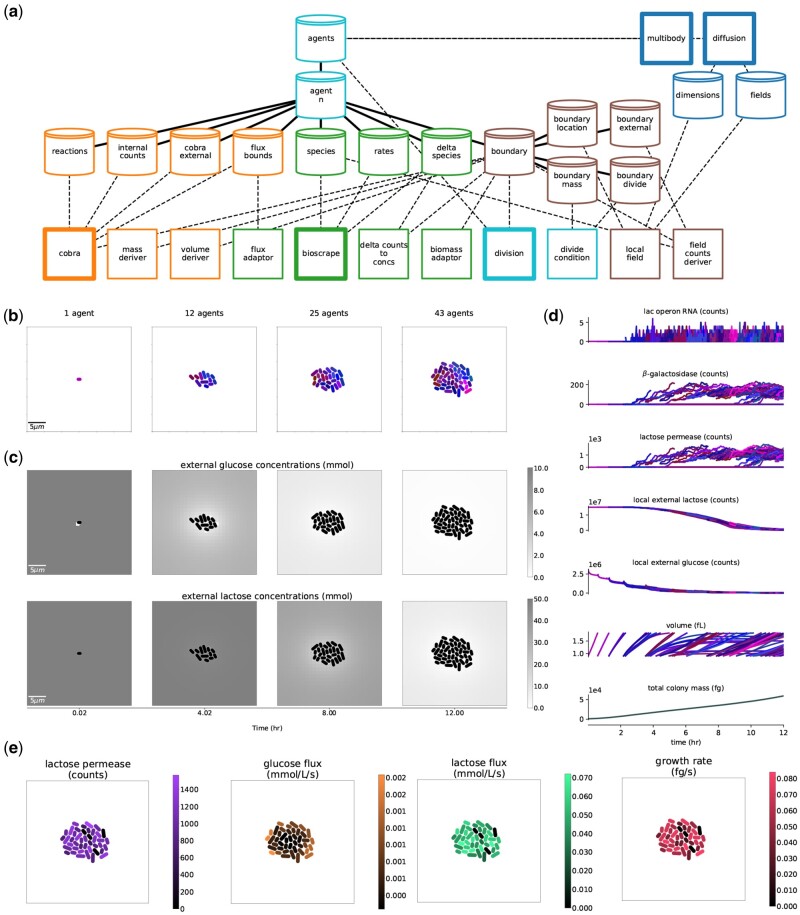
The full, integrated, stochastic version of the model in the Lattice environment. (a) Hierarchy and topology of the full composite model. The processes and stores are colored by paradigm, with orange nodes associated with COBRA, green nodes associated with Bioscrape, light blue with division, dark blue with multicell physics and chemical diffusion in the environment, and brown nodes associated with the boundary between cell and environment. Main processes are highlighted with a thicker outline. (b) Snapshots of the colony throughout a simulation. Cells colored according to phylogeny with similar colors indicating more closely related cells. (c) The external lactose and glucose concentration fields over the course of the simulation. (d) Multigenerational timeseries, with variables from all cells shown over time. These colors correspond to the phylogeny colors of (b). (e) Snapshots of the final simulation state (12.0 h), with various cell states tagged

References

    1. Agmon E., Spangler R.K. (2020) A multi-scale approach to modeling E. coli chemotaxis. Entropy, 22, 1101. - PMC - PubMed
    1. Andrews S.S. et al. (2010) Detailed simulations of cell biology with Smoldyn 2.1. PLoS Comput. Biol., 6, e1000705. - PMC - PubMed
    1. Arjunan S., Tomita M. (2009) Modeling reaction-diffusion of molecules on surface and in volume spaces with the E-Cell system. Nat. Precedings, 1–1.
    1. Arkin A. et al. (1998) Stochastic kinetic analysis of developmental pathway bifurcation in phage λ-infected Escherichia coli cells. Genetics, 149, 1633–1648. - PMC - PubMed
    1. Bartley B. et al. (2015) Synthetic biology open language (SBOL) version 2.0. 0. J. Integrative Bioinf., 12, 902–991. - PubMed

Publication types