Review
. 2021 Dec 31;12(2):601-615.
doi: 10.1080/21645698.2021.2021724. Epub 2022 Feb 9.

Genome editing techniques in plants: a comprehensive review and future prospects toward zero hunger

Affiliations
Review

Genome editing techniques in plants: a comprehensive review and future prospects toward zero hunger

Naglaa A Abdallah et al. GM Crops Food. .

Abstract

Promoting sustainable agriculture and improving nutrition are the main united nation sustainable development goals by 2030. New technologies are required to achieve zero hunger, and genome editing technology is the most promising one. In the last decade, genome editing (GE) using the CRISPR/Cas system has attracted researchers as a safer and easy tool for genome editing in several living organisms. GE has revolutionized the field of agriculture by improving biotic and abiotic stresses and yield improvement. GE technologies were developed fast lately to avoid the obstacles that face GM crops. GE technology, depending on site directed nuclease (SDN), is divided into three categories according to the modification methods. Developing transgenic-free edited plants without introducing foreign DNA meet the acceptance and regulatory ratification of several countries. There are several ongoing efforts from different countries that are rapidly expanding to adopt the current technological innovations. This review summarizes the different GE technologies and their application as a way to help in ending hunger.

Keywords: CRISPR/Cas; base editing; crop improvenet; food security; prime editing.


Conflict of interest statement

The authors declare that they have no conflict of interest.

Figures
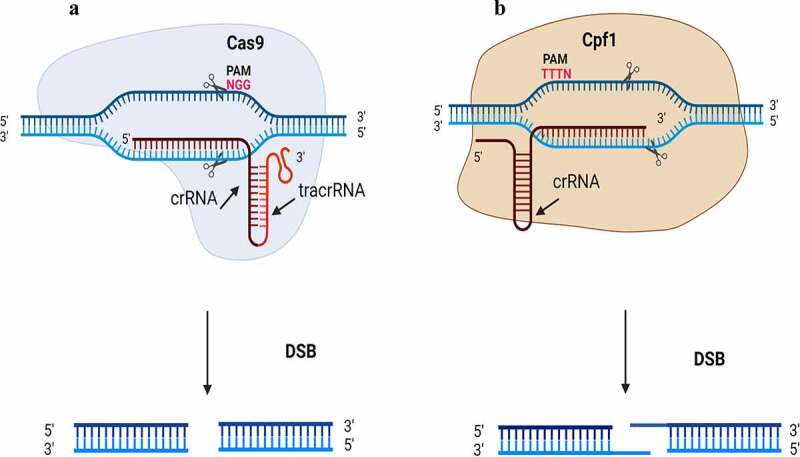
Figure 1.
Figure 1.
CRISPR-Cas9 versus CRISPR-Cpf1; Cas9, crRNA and tracrRNA represent a fused single-guide RNA, while Cpf1 needs crRNA only. The PAM sequence is trinucleotide 5′-NGG-3′for Cas9 while is 5ʹ-TTN for Cpf1. Cas9 cleavage dsDNA with blunt ends ends 3 nt upstream of the PAM site, while Cpf1 cleaves in a 5ʹ overhang sticky ends 18–23 bases apart from the PAM. Complementary sequence to the target DNA is linked to 5′ crRNA end of Cas9 and to 3′ ends of crRNA.
Figure 2.
Figure 2.
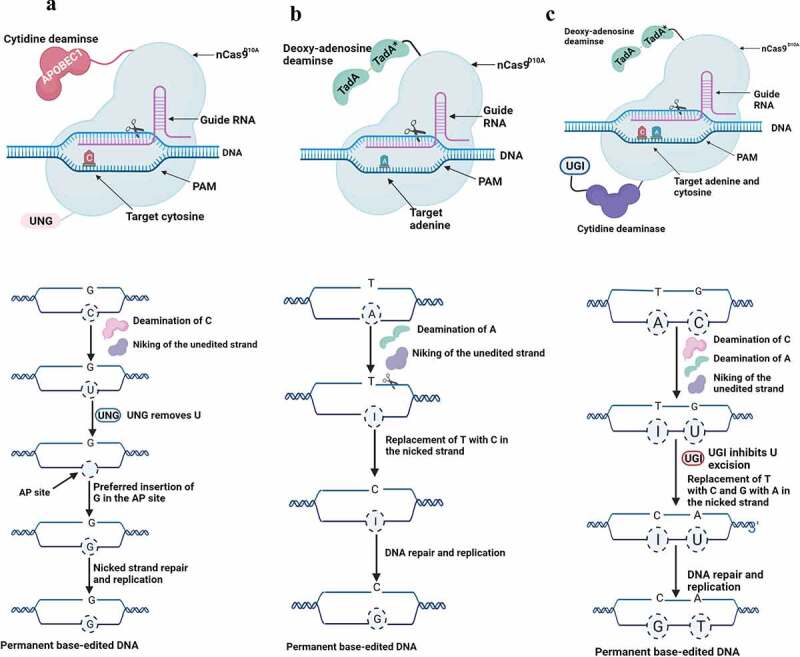
Nuclear base editing mechanism: a) Cytosine base editing (CBE) consisting of cytidine deaminase, nCas9 and UGI. The cytosine deaminase converts the desired “C” to “U,” the resulted mismatch can be corrected by base editing repair or cellular mismatch repair. The nick produced by nCas9 in the guanidine “G”-containing unedited DNA strand remove the “G” by cellular mismatch repair using uracil as a template for repair leading to the targeted “T•A.” Uracil is removed from the DNA by uracil DNA N-glycosylase, thus, reverting to the original “C•G” binding. The rate of obtaining “T•A” is enhanced through the increase of UGI protein b) Adenine base editing (ABE) contains a heterodimeric deaminase linked to nCas9. ABE is composed of wild-type TadA monomer and engineered TadA (TadA*) monomer. The target base “A” is deaminated to inosine (i) leading to converting “A•T” pair to an “I•T” bp. Inosine pairs with “C” during the replication. c) Dual-base editor converts “C-to-T” and “A-to-G.” The complex nucleoprotein is composed of nCas9, adenosine deaminase, cytidine deaminase and UGI. In the dual-base editing, deamination of “C” and “A” is performed by cytidine and adenosine deaminase, respectively. The dual base editors has the same mode of action of that of both CBE and ABE.
Figure 3.
Figure 3.
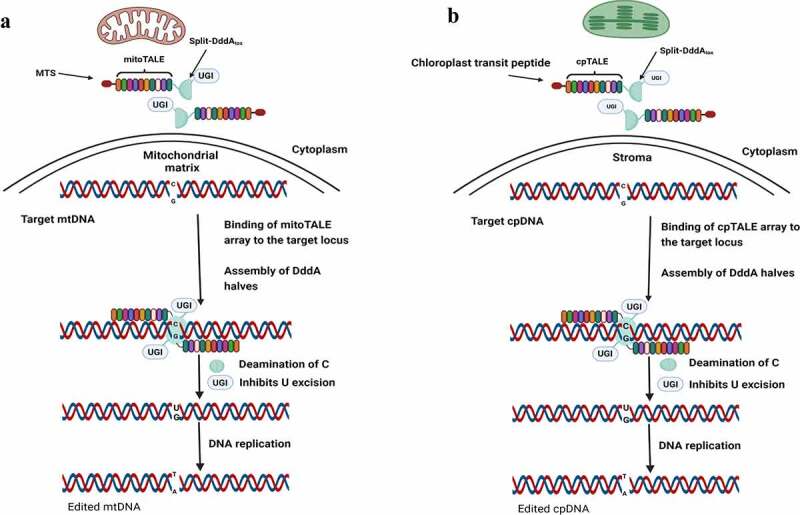
Mechanism of Organelle base editing involves TALE array, a DddA cytidine deaminase (DdCBE), a UGI to catalyze cytosine deamination, inducing “C-to-T” conversions and mitochondrial targeting signal (MTS) for editing mitochondrial DNA (a) or Chloroplast transit peptide (CTP) for editing Chloroplast DNA (b). The MTS transports the two halves of TALE into the mitochondrial matrix. The chloroplast transit peptide target the TALE array to chloroplast matrix. Two TALE arrays bind to the desired DNA sequence bringing the two DssA inactive halves into proximity. After reconstitution of active DddAtox, it deaminate “C” in the double-stranded DNA.
Figure 4.
Figure 4.
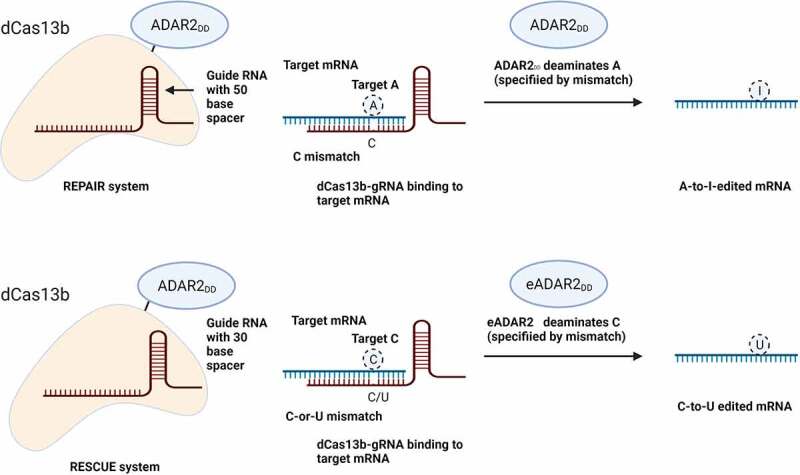
Mechanism of base editing in RNA. A) In the REPAIR system, “A-to-I” editing is using dCas13 fused to ADAR2. REPAIR use 50-nucleotide RNA with a 50-nucleotide mRNA-gRNA duplex. “A–C” mismatch in the RNA–gRNA duplex determines the target A. RESCUE system editing “C-to-U.” The optimum results are to be achieved with a gRNA of 30-nucleotide spacer. The target “C” is specified by an induced “C–C” or “C–U” mismatch in the mRNA–gRNA duplex.
Figure 5.
Figure 5.
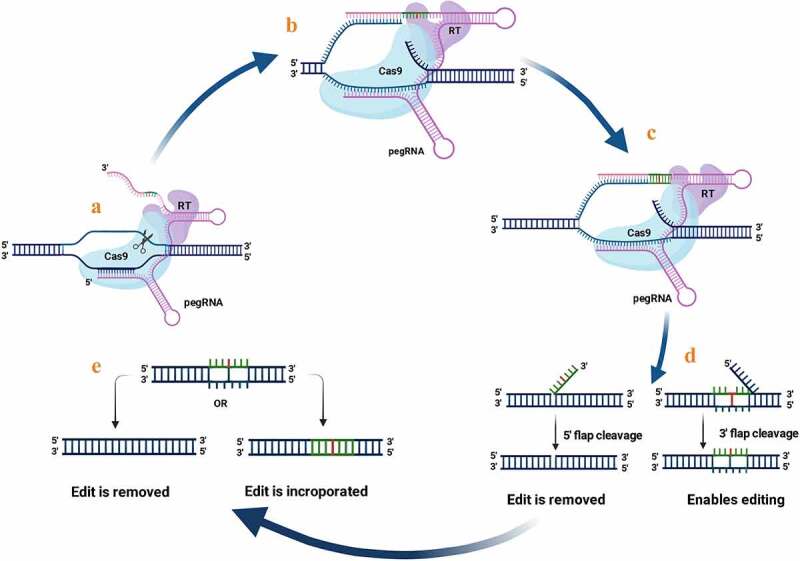
Prime editing mechanism: a) Nicking the desired DNA sequence at the PAM strand by the fusion protein, b) the exposed 3ʹ-hydroxyl group prime the reverse transcription of the RT template of the pegRNA, c) reverse transcription, d) the branched intermediate form containing two flaps of DNA: a 3ʹ flap (containing the edited sequence), and a 5ʹ flap (containing the dispensable, unedited DNA sequence) followed by flap cleavage, and e) ligation and mismatch repair; either the incorporating edite strand or remove it.
Figure 6.
Figure 6.
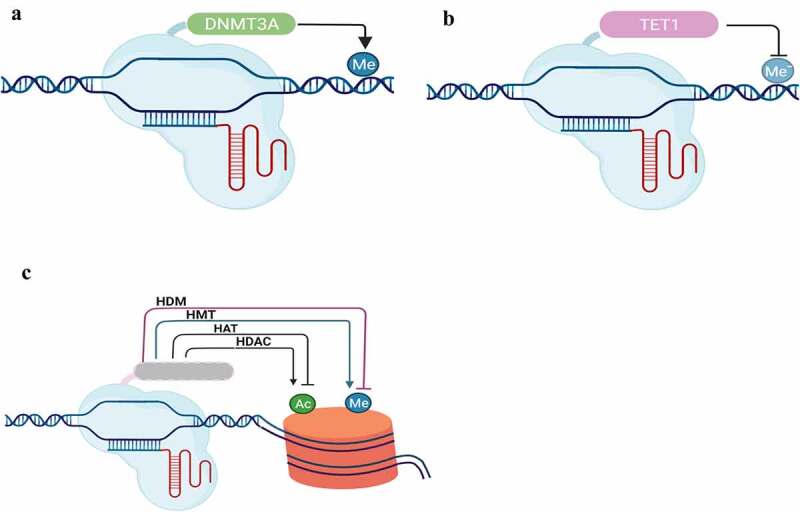
CRISPR/dCas9-based engineering of the epigenome. The techniques are based on using inactive-Cas (dCas) to allocate the desired protein to the target sequence. For DNA methylation, cytosine methylation could be used by linking dCas with DNMT3A or MQ1 (a), while demethylation of cytosine could be edited by linking Tet1 with dCas (b). Chromatin modifiers could be edited either by acetylation/deacetylation using HDAC/HAT or methylation/demethylation using HMT/HDM with dCas9.
Figure 7.
Figure 7.
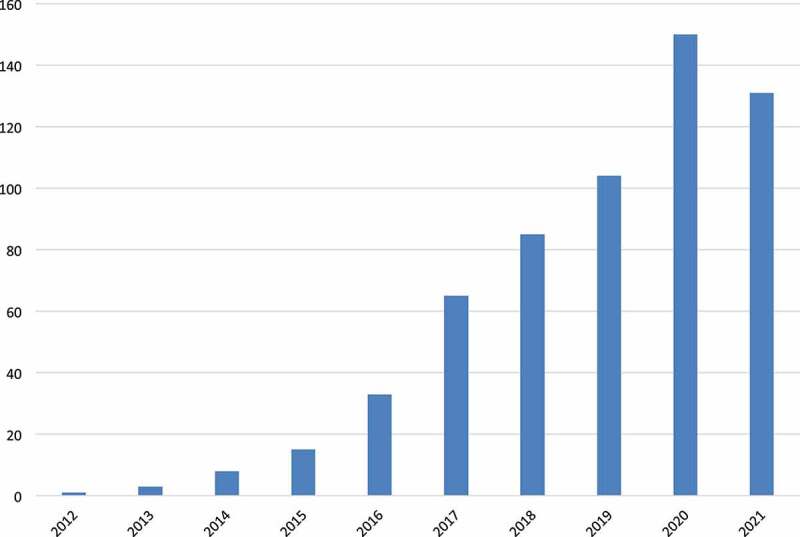
Number of CRISPR-based plant genome-editing publications over the last 10 years.
Figure 8.
Figure 8.
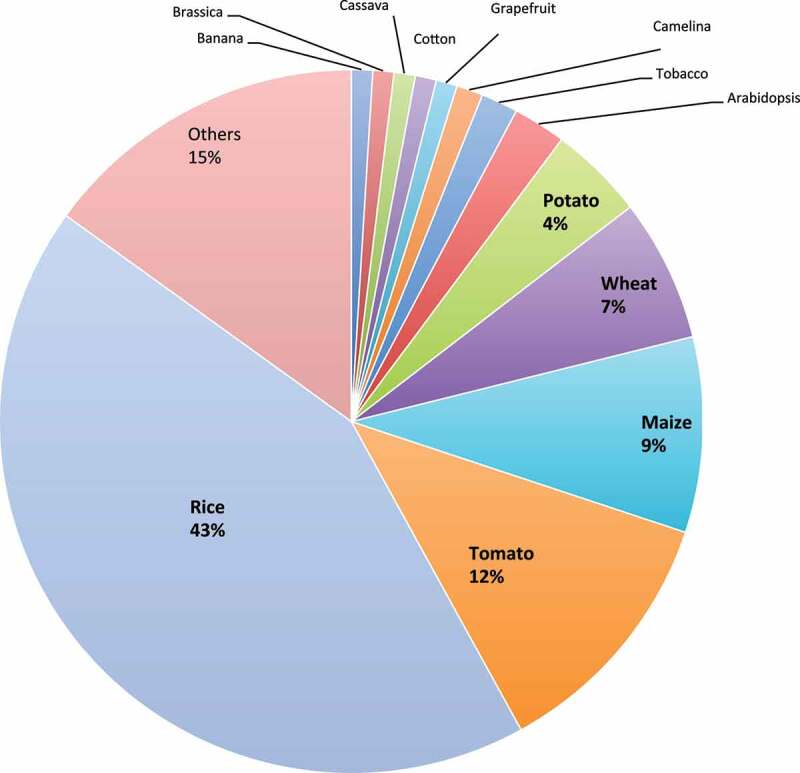
Percentage of major crops modified by CRISPR system with the aim of crop improvement.

References

    1. Khan AW, Garg V, Roorkiwal M, Golicz AA, Edwards D, Varshney RK.. Super-pangenome by integrating the wild side of a species for accelerated crop improvement. Trends Plant Sci. 2020;25:148–58. doi:10.1016/j.tplants.2019.10.012. - DOI - PMC - PubMed
    1. Singh RK, Prasad A, Muthamilarasan M, Parida SK, Prasad M. Breeding and biotechnological interventions for trait improvement: status and prospects. Planta. 2020;252:1–18. doi:10.1007/s00425-020-03465-4. - DOI - PMC - PubMed
    1. Voytas DF, Gao C. Precision genome engineering and agriculture: opportunities and regulatory challenges. PLoS Biol. 2014;12(6):e1001877. doi:10.1371/journal.pbio.1001877. - DOI - PMC - PubMed
    1. Ma X, Zhang Q, Zhu Q, Liu W, Chen Y, Qiu R, Wang B, Yang Z, Li H, Lin Y. A robust CRISPR/Cas9 system for convenient, high-efficiency multiplex genome editing in monocot and dicot plants. Mol Plant. 2015;8:1274–84. doi:10.1016/j.molp.2015.04.007. - DOI - PubMed
    1. Wang J, Meng X, Hu X, Sun T, Li J, Wang K, Yu H. xCas9 expands the scope of genome editing with reduced efficiency in rice. Plant Biotechnol J. 2019;17(6):709–11. doi:10.1111/pbi.13053. - DOI - PMC - PubMed