


An ecological study on the association between International Health Regulations (IHR) core capacity scores and the Universal Health Coverage (UHC) service coverage index
- PMID: 35135576
- PMCID: PMC8822741
- DOI: 10.1186/s12992-022-00808-6
An ecological study on the association between International Health Regulations (IHR) core capacity scores and the Universal Health Coverage (UHC) service coverage index
Abstract
Background: The pandemic situation due to COVID-19 highlighted the importance of global health security preparedness and response. Since the revision of the International Health Regulations (IHR) in 2005, Joint External Evaluation (JEE) and States Parties Self-Assessment Annual Reporting (SPAR) have been adopted to track the IHR implementation stage in each country. While national IHR core capacities support the concept of Universal Health Coverage (UHC), there have been limited studies verifying the relationship between the two concepts. This study aimed to investigate empirically the association between IHR core capacity scores and the UHC service coverage index.
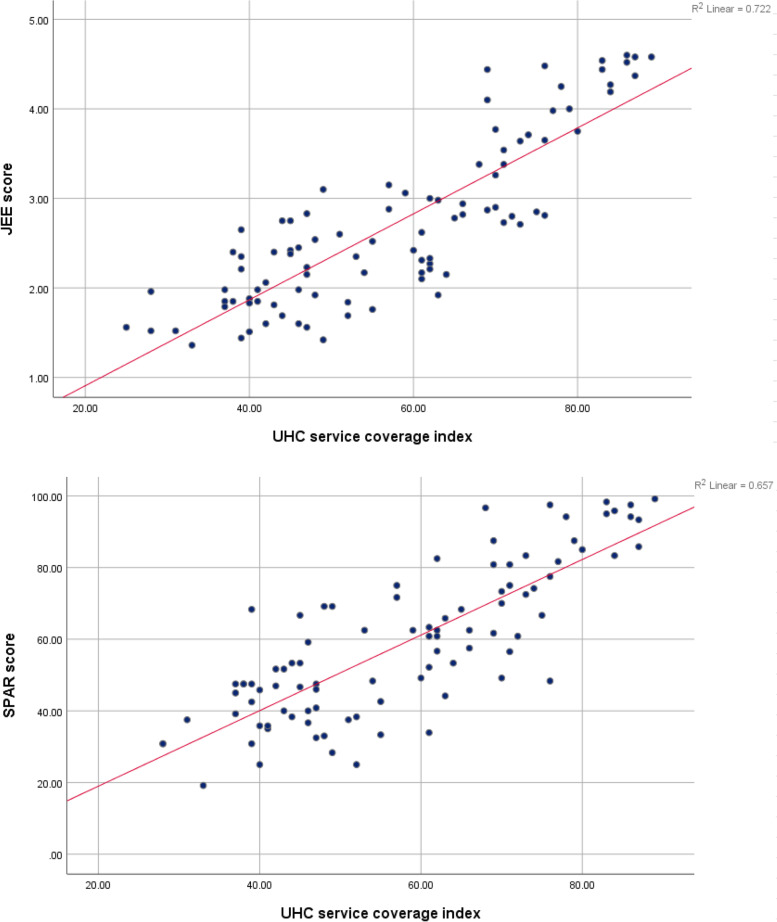
Method: JEE score, SPAR score and UHC service coverage index data from 96 countries were collected and analyzed using an ecological study design. The independent variable was IHR core capacity scores, measured by JEE 2016-2019 and SPAR 2019 from the World Health Organization (WHO) and the dependent variable, UHC service coverage index, was extracted from the 2019 UHC monitoring report. For examining the association between IHR core capacities and the UHC service coverage index, Spearman's correlation analysis was used. The correlation between IHR core capacities and UHC index was demonstrated using a scatter plot between JEE score and UHC service coverage index, and the SPAR score and UHC service coverage index were also presented.
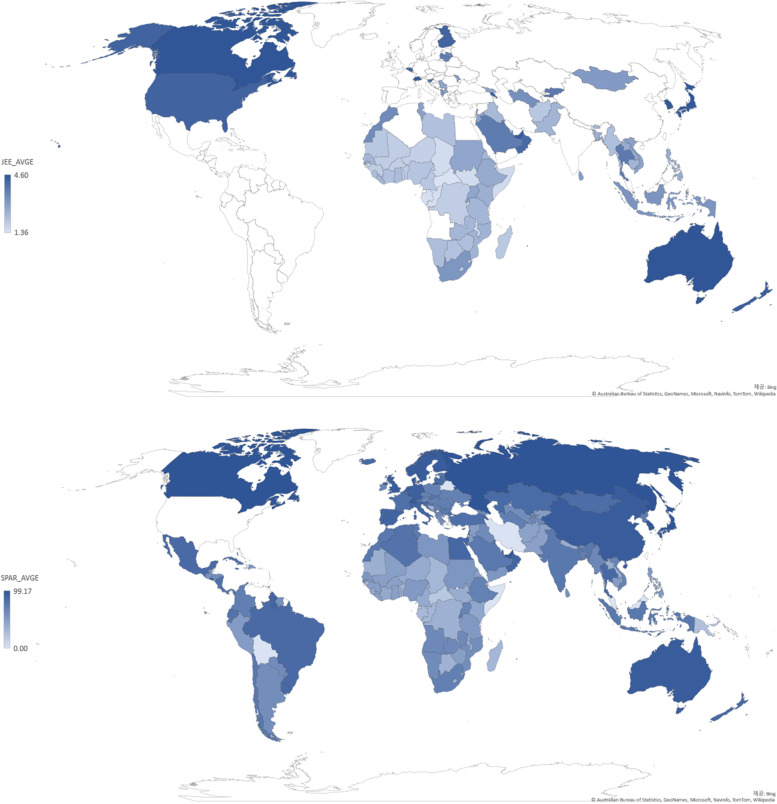
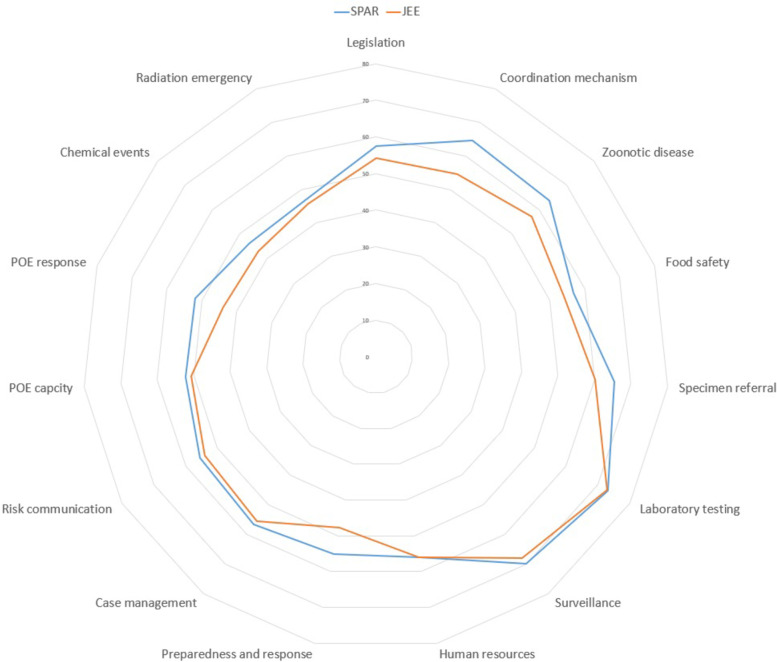
Result: While the correlation value between JEE and SPAR was 0.92 (p < 0.001), the countries' external evaluation scores were lower than their self-evaluation scores. Some areas such as available human resources and points of entry were mismatched between JEE and SPAR. JEE was associated with the UHC score (r = 0.85, p < 0.001) and SPAR was also associated with the UHC service coverage index (r = 0.81, p < 0.001). The JEE and SPAR scores showed a significant positive correlation with the UHC service coverage index after adjusting for several confounding variables.
Conclusion: The study result supports the premise that strengthening national health security capacities would in turn contribute to the achievement of UHC. With the help of the empirical result, it would further guide each country for better implementation of IHR.
Keywords: International Health Regulations (2005); Joint External Evaluation; States Parties Self-Assessment Annual Reporting; Universal Health Coverage.
© 2022. The Author(s).
Conflict of interest statement
The authors declare that they have no competing interest.
Figures
References
-
- Pan American Health Organization (PAHO). International Health Regulations (IHR) - PAHO/WHO [Internet]. [cited 11 Aug 2021]. Available from: https://www.paho.org/en/international-health-regulations-ihr.
-
- Razavi A, Collins S, Wilson A, Okereke E. Evaluating implementation of International Health Regulations core capacities: using the Electronic States Parties Self-Assessment Annual Reporting Tool (e-SPAR) to monitor progress with Joint External Evaluation indicators. Globalization and Health. 2021;17(1):1–7. - PMC - PubMed
-
- World Health Organization (WHO). International Health Regulations (2005) - IHR Monitoring and Evaluation Framework [Internet]. World Health Organization; 2018 [cited 11 Aug 2021].
-
- World Health Statistics 2017: Monitoring health for the SDGs, sustainable development goals [Internet]. World Health Organization; 2017 [cited 11 Aug 2021]. Available from: https://apps.who.int/iris/handle/10665/255336.
Publication types
MeSH terms
Grants and funding
LinkOut - more resources
Full Text Sources
Medical
