Comparative Study
. 2022 Feb 8;12(1):2122.
doi: 10.1038/s41598-022-06245-0.

Evaluation of different strains of Saccharomyces cerevisiae for ethanol production from high-amylopectin BRS AG rice (Oryza sativa L.)

Affiliations
Comparative Study

Evaluation of different strains of Saccharomyces cerevisiae for ethanol production from high-amylopectin BRS AG rice (Oryza sativa L.)

Isabela C Almeida et al. Sci Rep. .

Abstract

Ethanol is the main biofuel produced by fermentation route and the search for new feedstocks to produce fuel ethanol is still a great challenge. This work aims to compare the ethanol production from a new irrigated rice cultivar BRS AG to the conventional cultivar BRS PAMPA applied in Brazil. Six different commercial strains of Saccharomyces cerevisiae (BG-1, CAT-1, FT-858, JP-1, PE-2, and SA-1) were applied in fermentation reactions. Fermentations performed with BRS PAMPA rice revealed that the highest yields were achieved with strain SA-1, corresponding to 93.0% of the theoretical maximum and final ethanol concentration of 58.92 g L-1, and with CAT-1, a yield of 92.7% and final ethanol concentration of 58.93 g L-1. For the fermentations with BRS AG rice, the highest yields were obtained with strain FT-858, exhibiting a 89.6% yield and final ethanol concentration of 62.45 g L-1, and with CAT-1, 87.9% yield and final ethanol concentration of 61.25 g L-1 were achieved. The most appropriate microorganism for ethanol production using BRS PAMPA rice and BRS AG rice was CAT-1. Comparatively, the ethanol yield and productivity using BRS AG were higher than those observed for BRS PAMPA for all strains, except for PE-2 and SA-1 that led to very similar results. The experimental results showed that the giant rice BRS AG is an excellent feedstock for fuel ethanol production in lowland fields.


Conflict of interest statement

The authors declare no competing interests.

Figures
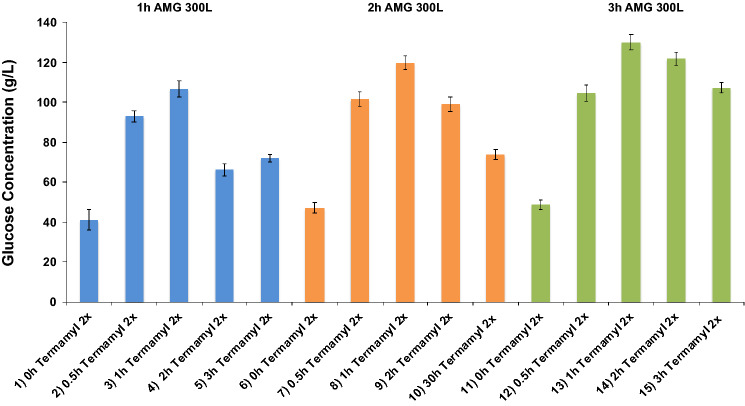
Figure 1
Figure 1
Glucose concentrations during enzymatic hydrolysis reactions with the enzymes Termamyl 2X and AMG 300L. The error bar represents the standard deviation from the essays carried out in triplicate.
Figure 2
Figure 2
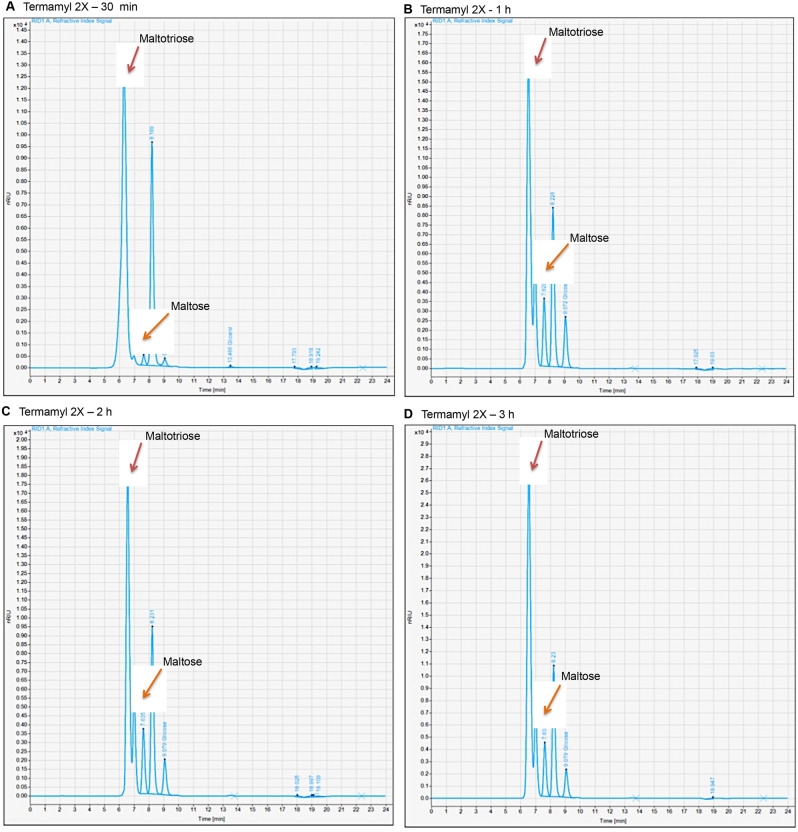
Chromatograms of the samples of the hydrolysis reactions with: (A) 30 min of action of Termamyl 2X; (B) 1 h of action of Termamyl 2X; (C) 2 h of action of Termamyl 2X and (D) 3 h of action of Termamyl 2X.
Figure 3
Figure 3
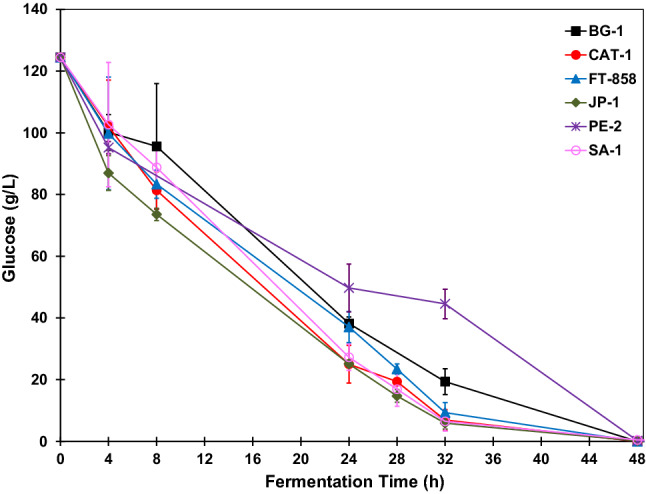
Glucose concentration profiles during BRS PAMPA rice fermentations with S. cerevisiae strains. The error bar represents the standard deviation from the essays carried out in triplicate.
Figure 4
Figure 4
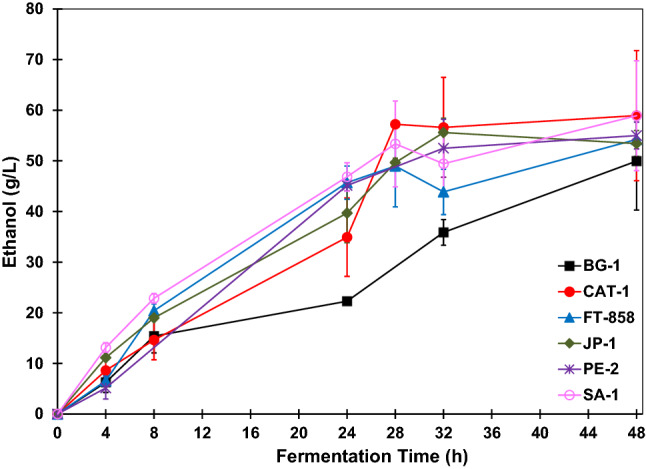
Ethanol concentration profiles during BRS PAMPA rice fermentations with S. cerevisiae strains. The error bar represents the standard deviation from the essays carried out in triplicate.
Figure 5
Figure 5
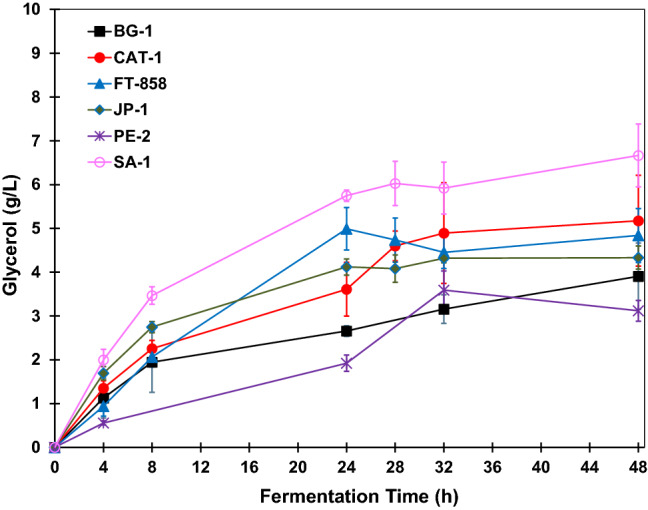
Glycerol concentration profiles during BRS PAMPA rice fermentations with S. cerevisiae strains. The error bar represents the standard deviation from the essays carried out in triplicate.
Figure 6
Figure 6
Box charts and means comparison using Tukey mean-difference plot for (A) ethanol production and (B) glycerol production related to BRS PAMPA rice fermentations with S. cerevisiae strains.
Figure 7
Figure 7
Glucose concentration profiles during BRS AG rice fermentations with S. cerevisiae strains. The error bar represents the standard deviation from the essays carried out in triplicate.
Figure 8
Figure 8
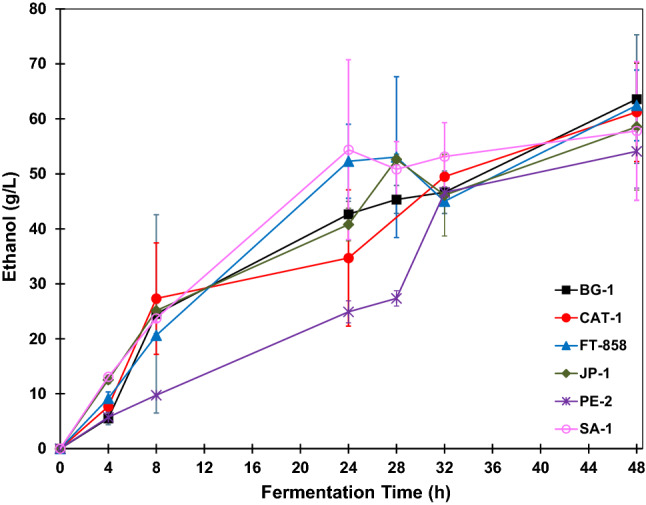
Ethanol concentration profiles during BRS AG rice fermentations with S. cerevisiae strains. The error bar represents the standard deviation from the essays carried out in triplicate.
Figure 9
Figure 9
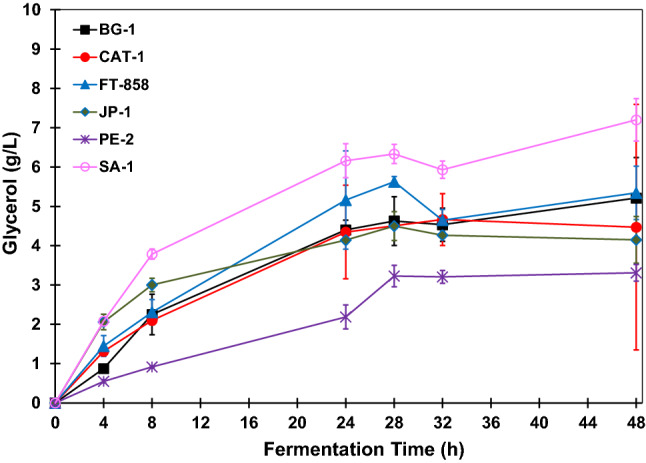
Glycerol concentration profiles during BRS AG rice fermentations with S. cerevisiae strains. The error bar represents the standard deviation from the essays carried out in triplicate.
Figure 10
Figure 10
Box charts and means comparison using Tukey mean-difference plot for (A) ethanol production and (B) glycerol production related to BRS AG rice fermentations with S. cerevisiae strains.

References

    1. Chen X, Zhao Y, Chen B, Su W, Zhang Z, Liu Y, Xu X, Tang J, Hou P, Han W. Effects of enzyme volumes on hydrolysis and fermentation for ethanol production from leftover cooked rice. Front. Bioeng. Biotechnol. 2021 doi: 10.3389/fbioe.2021.631089. - DOI - PMC - PubMed
    1. Pasha MK, Dai L, Liu D, Guo M, Du W. An overview to process design, simulation and sustainability evaluation of biodiesel production. Biotechnol. Biofuels. 2021;14(1):129. doi: 10.1186/s13068-021-01977-z. - DOI - PMC - PubMed
    1. Chen LW. N2 periodic pulsation process intensification to improve ethanol productivity in solid state fermentation of steam-exploded corn stalk. Renew. Energy. 2021;169:1058–1065. doi: 10.1016/j.renene.2021.01.082. - DOI
    1. Hans M, Lugani Y, Chandel AK, Rai R, Kumar S. Production of first- and second-generation ethanol for use in alcohol-based hand sanitizers and disinfectants in India. Biomass Convers. Biorefin. 2021 doi: 10.1007/s13399-021-01553-3. - DOI - PMC - PubMed
    1. Guden B, Erdurmus C, Erdal S, Uzun B. Evaluation of sweet sorghum genotypes for bioethanol yield and related traits. Biofuels Bioprod. Biorefin. 2021;15(2):545–562. doi: 10.1002/bbb.2169. - DOI

Publication types

LinkOut - more resources