


Minimal invasive approaches in lymph node management of carcinoma of penis: A review
- PMID: 35136290
- PMCID: PMC8796758
- DOI: 10.4103/iju.iju_387_21
Minimal invasive approaches in lymph node management of carcinoma of penis: A review
Abstract
Introduction: Inguinal lymph node dissection (ILND) is an integral part in the management of carcinoma penis. The concerns about the postoperative morbidity associated with open ILND led to modification in the template of dissection and adoption of minimally invasive techniques such as video endoscopic inguinal lymphadenectomy (VEIL) and robotic-assisted VEIL (R-VEIL). In this review, we aim to describe the techniques, case selection, perioperative outcomes, and oncological outcomes of VEIL and R-VEIL and to compare it with open ILND.
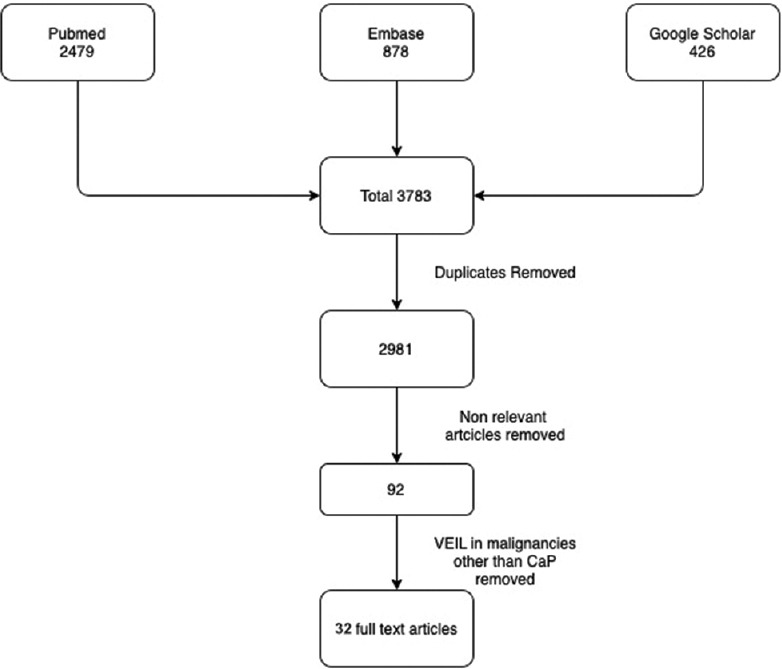
Methods: Databases of PubMed, Embase, and Google Scholar were searched to identify the articles for VEIL and R-VEIL. Using PRISMA guidelines, literature search yielded 3783 articles, of which 32 full-text articles relevant to the topic were selected and reviewed, after consensus from authors.
Results: After the first description of VEIL, various modifications in port placements and approaches were described. Several studies have shown, VEIL and R VEIL are safe and feasible in both node-negative and node-positive Ca penis patients. Compared to open ILND, VEIL had fewer wound infections and skin necrosis, minimal blood loss, shorter mean hospital stays, and reduced duration of drain kept. There is no difference in mean lymph node yield and recurrence rates between open ILND, VEIL, R-VEIL.
Conclusion: VEIL and R-VEIL are safe and have comparable oncological outcomes with open ILND.
Copyright: © 2022 Indian Journal of Urology.
Conflict of interest statement
Conflicts of interest: There are no conflicts of interest.
Figures
Comment in
-
Re: Kandasamy SG, Chandran KR, Pooleri GK. Minimal invasive approaches in lymph node management of carcinoma of penis: A review. Indian J Urol 2022;38:15-21.Indian J Urol. 2022 Jul-Sep;38(3):240-241. doi: 10.4103/iju.iju_88_22. Epub 2022 Jul 1. Indian J Urol. 2022. PMID: 35983105 Free PMC article. No abstract available.
References
-
- [Accessed Sept 11, 2020];Global Cancer Observatory. International Agency for Research on Cancer2020. Available from: http://globocan.iarc.fr/Pages/fact_sheets_population.aspx .
-
- Stuiver MM, Djajadiningrat RS, Graafland NM, Vincent AD, Lucas C, Horenblas S. Early wound complications after inguinal lymphadenectomy in penile cancer: A historical cohort study and risk-factor analysis. Eur Urol. 2013;64:486–92. - PubMed
Publication types
LinkOut - more resources
Full Text Sources