


Changing scenario of C-section delivery in India: Understanding the maternal health concern and its associated predictors
- PMID: 35136786
- PMCID: PMC8797113
- DOI: 10.4103/jfmpc.jfmpc_585_21
Changing scenario of C-section delivery in India: Understanding the maternal health concern and its associated predictors
Abstract
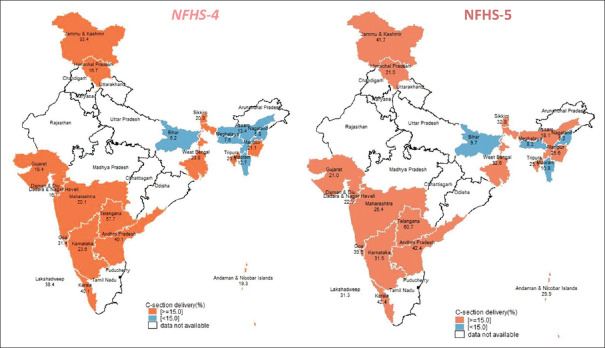
Background: Caesarean section (C-section) delivery is a serious maternal health concern in the long run. Notedly, there is a lack of studies dealing with understanding the ways and reasons of C-section deliveries becoming a public health issue in today's time in India and the measures to reduce the unnecessary caesarean sections. We have conducted this study to study the changes in the state-wise prevalence of C-section deliveries in India and understand C-section delivery's socioeconomic and biomedical predictors.
Materials and methods: The study uses data from the fourth and fifth rounds of the National Family Health Surveys (NFHS). The per cent differences in the C-section deliveries from NFHS-4 to NFHS-5 across the states were measured through relative changes. The association between the C-section delivery and socioeconomic and biomedical factors were assessed using multiple logistic regression.
Results: This study revealed that the C-section deliveries are higher in the southern states than in the other parts of India. Literacy plays a vital role in C-section deliveries. The probabilities of C-section deliveries are more in 30-40 and 40 + years. The women belonging to the median wealth index category were more likely (OR-CI, 1.62 [1.55-1.66]) to undergo the C-section followed by the women from wealthy households (OR-CI, 1.46 [1.41-1.52]).
Conclusion: The Government's health policymakers should take the initiative to reduce the C-section section delivery by means of building maternal health literacy and awareness among women and the community so that its future implications can be minimised. It is crucial to formulate a mandate and implement it in the states where C-sections are too high through community health workers and primary care providers.
Keywords: C-section; maternal health; multiple logistic regression; out-of-pocket expenditure; private health facility; socio-economic status.
Copyright: © 2021 Journal of Family Medicine and Primary Care.
Conflict of interest statement
There are no conflicts of interest.
Figures

References
-
- Betrán AP, Merialdi M, Lauer JA, Bing-Shun W, Thomas J, Van Look P, et al. Rates of caesarean section: Analysis of global, regional and national estimates. Paediatr Perinat Epidemiol. 2007;21:98–113. - PubMed
-
- Ronsmans C, Holtz S, Stanton C. Socioeconomic differentials in caesarean rates in developing countries: A retrospective analysis. Lancet. 2006;368:1516–23. - PubMed
-
- Belizán JM, Althabe F, Cafferata ML. Health consequences of the increasing caesarean section rates. Epidemiology. 2007;18:485–6. - PubMed
-
- Villar J, Valladares E, Wojdyla D, Zavaleta N, Shah A, Campodónico L, et al. Caesarean delivery rates and pregnancy outcomes: The 2005 WHO global survey on maternal and perinatal health in Latin America. Lancet. 2006;367:1819–29. - PubMed
-
- WHO. Informed decisions and maternal health literacy could reduce caesarean section numbers. Maternal and newborn health. Regional office for Europe. January 16. 2019. Available from URL: https://www.euro.who.int/en/health-topics/Life-stages/maternal-and-newbo... .
LinkOut - more resources
Full Text Sources