


Neuropsychological Performance in Autoimmune Limbic Encephalitis: Evidence from an Immunotherapy-Naïve Cohort
- PMID: 35136904
- PMCID: PMC9113452
- DOI: 10.1093/arclin/acac001
Neuropsychological Performance in Autoimmune Limbic Encephalitis: Evidence from an Immunotherapy-Naïve Cohort
Abstract
Objective: Autoimmune limbic encephalitis (ALE) is characterized by memory impairment, psychiatric symptoms, and epileptic seizures. Though, the neuropsychological profile of ALE is not yet well defined. However, there is some evidence that neuropsychological impairments might exceed those related to the limbic system and that different autoantibodies (AABs) are associated with distinguishable pattern of neuropsychological impairments. We provide a comprehensive presentation of neuropsychological performance of ALE in an immune therapy-naïve sample.
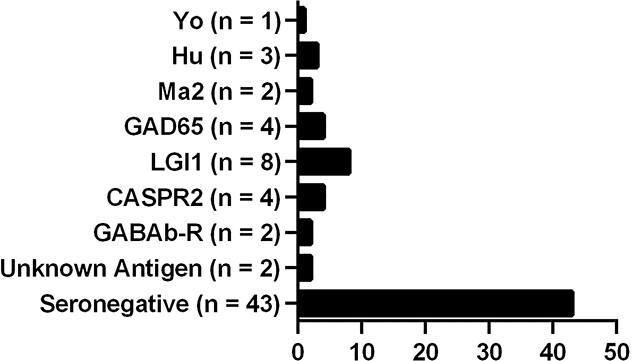
Methods: We retrospectively analyzed 69 immunotherapy-naïve ALE-patients (26 seropositive-[8 LGI1-, 4 CASPR2-, 2 GABAB-R-, 3 Hu-, 4 GAD65-, 2 Ma2-, 2 unknown antigen, and 1 Yo-AABs] and 43 seronegative patients, mean age 56.0 years [21.9-78.2], mean disease duration 88 weeks [0-572]). Neuropsychological evaluations comprised of the domains memory, attention, praxis, executive functions, language, social cognition, and psychological symptoms. We compared these functions between seronegative -, seropositive patients with AABs against intracellular neural antigens and seropositive patients with AABs against surface membrane neural antigens.
Results: No effect of AAB group on neuropsychological performance could be detected. Overall, ALE predominantly presents with deficits in long-term memory and memory recognition, autobiographical-episodic memory loss, impairment of emotion recognition, and depressed mood. Furthermore, deficits in praxis of pantomimes and imitations, visuo-construction, and flexibility may occur.
Conclusion: ALE shows a wide spectrum of neuropsychological impairments, which might exceed the limbic system, with no evidence of differences between AAB groups. Neuropsychological assessment for diagnosing ALE should include long-term memory, memory recognition, autobiographical-episodic memory, emotion recognition, and a detailed investigation of depression.
Keywords: Autoimmune limbic encephalitis; Cognition; Emotion recognition; Memory; Neuropsychological profile; Praxis.
© The Author(s) 2022. Published by Oxford University Press. All rights reserved. For permissions, please e-mail: journals.permission@oup.com.
Figures
References
-
- Adolphs, R. (2002). Neural systems for recognizing emotion. Current Opinion in Neurobiology, 12(2), 169–177. - PubMed
-
- Alves P, Maruta C, Albuquerque L, Martins IP. (2017). Dissociation findings between short-term and long-term memory in autoimmune limbic encephalitis. Journal of the Neurological Sciences [Internet] 381:126–127. Available from: 10.1016/j.jns.2017.08.016Adolphs, R. (2002). Neural systems for recognizing emotion. Current Opinion in Neurobiology, 12(2), 169–177. 10.1016/S0959-4388(02)00301-X - DOI - PubMed
MeSH terms
Substances
Supplementary concepts
LinkOut - more resources
Full Text Sources
Medical
