. 2022 Feb 28;50(4):2334-2349.
doi: 10.1093/nar/gkac040.

RNA modifications stabilize the tertiary structure of tRNAfMet by locally increasing conformational dynamics

Affiliations

RNA modifications stabilize the tertiary structure of tRNAfMet by locally increasing conformational dynamics

Thomas Biedenbänder et al. Nucleic Acids Res. .

Abstract

A plethora of modified nucleotides extends the chemical and conformational space for natural occurring RNAs. tRNAs constitute the class of RNAs with the highest modification rate. The extensive modification modulates their overall stability, the fidelity and efficiency of translation. However, the impact of nucleotide modifications on the local structural dynamics is not well characterized. Here we show that the incorporation of the modified nucleotides in tRNAfMet from Escherichia coli leads to an increase in the local conformational dynamics, ultimately resulting in the stabilization of the overall tertiary structure. Through analysis of the local dynamics by NMR spectroscopic methods we find that, although the overall thermal stability of the tRNA is higher for the modified molecule, the conformational fluctuations on the local level are increased in comparison to an unmodified tRNA. In consequence, the melting of individual base pairs in the unmodified tRNA is determined by high entropic penalties compared to the modified. Further, we find that the modifications lead to a stabilization of long-range interactions harmonizing the stability of the tRNA's secondary and tertiary structure. Our results demonstrate that the increase in chemical space through introduction of modifications enables the population of otherwise inaccessible conformational substates.


Figures

Figure 1.
Figure 1.
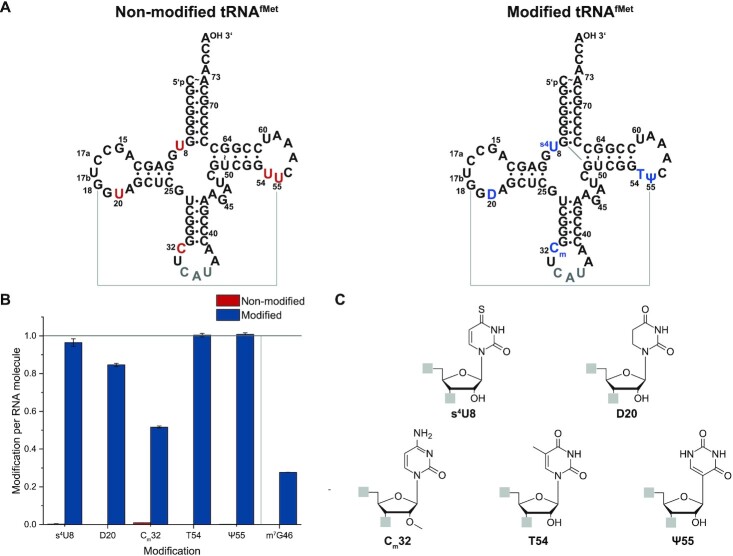
Quantification of modified nucleosides levels in the non-modified (red) and modified (blue) tRNAfMet constructs. (A) Secondary structure of non-modified and modified tRNAfMet. (B) LC–MS based quantification of modified nucleosides levels in tRNAfMet. Both tRNAfMet constructs were digested to nucleosides and analyzed via LC-MS. The amount of each modification was normalized to the amount of injected RNA molecules. The occurrence of one modified nucleoside per RNA molecule is highlighted with a black line. The modified nucleosides are s4U8 (thiouridine 8), D20 (5,6-dihydrouridine 20), Cm32 (2′O-methylcytidine 32), T54 (ribothymidine 54), Ψ55 (pseudouridine 55), and m7G46 (7-methylguanosine 46). The measured relative abundance for m7G46 is based on the endogenous isoacceptor of tRNAfMet in E. coli. In E. coli K strains, the initiator tRNAfMet is encoded by four genes that differ by a single nucleotide at position 46 resulting in two tRNAfMet species (79,80): metZ, metW and metV encode tRNAfMet1 with m7G46 and metY encode tRNAfMet2 with A46. Therefore, the cellular tRNAfMet pool consists of 75% tRNAG46fMet1, and 25% of tRNAA46fMet2 due to the presence of three genes encoding for m7G46 and only one gene encoding for A46 (80,81). In contrast, the results here show only a relative abundance of 27.7% and thus, the second isoacceptor reflecting the tRNAA46fMet2 of interest is successfully overexpressed. (C) Chemical structure of analyzed modified nucleosides.
Figure 2.
Figure 2.
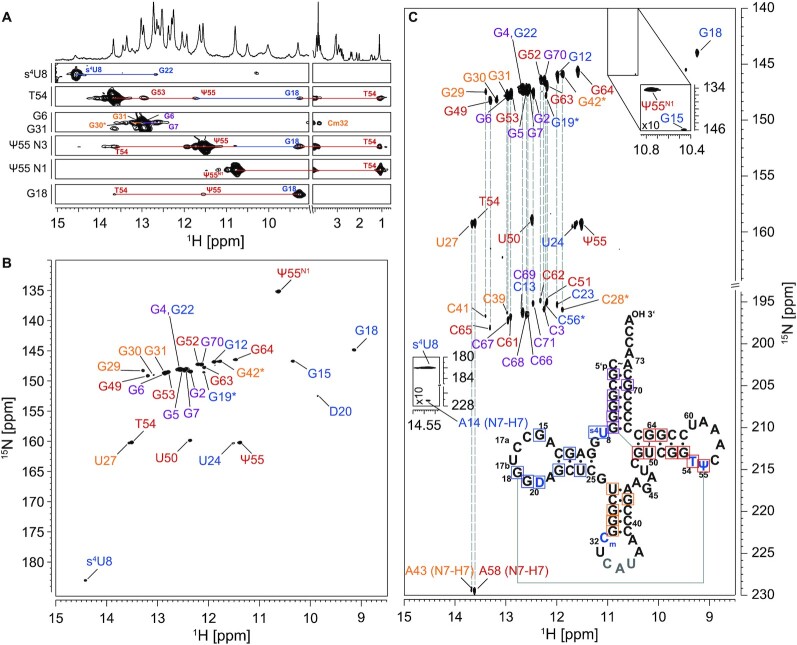
Selected [1H,1H]-strips of a 3D-[1H,15N,1H]-SOFAST-HMQC-NOESY (A), 2D-[1H,15N]-BEST-TROSY (B) and 2D-[1H,15N]-BEST-TROSY-HNN-COSY experiment (C) of modified tRNAfMet at 25°C. Secondary structure of the modified tRNAfMet is shown in (C). Unambiguously assigned imino peaks are highlighted in either purple (acceptor stem), blue (D-arm), yellow (ACSL), or red (TΨC-arm). Experimental details are provided in an extended figure caption in SI.
Figure 3.
Figure 3.
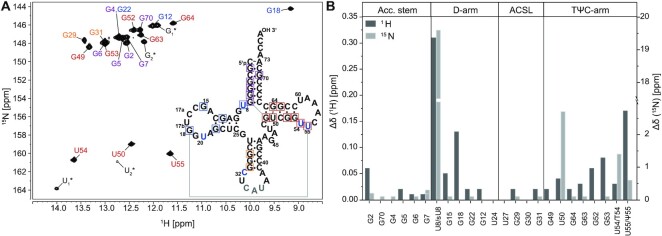
2D-[1H,15N]-BEST-TROSY experiment of unmodified tRNAfMet with secondary structure (A) and analysis of chemical shift differences between modified and non-modified tRNA (B). (A) The BEST-TROSY spectrum of the non-modified tRNAfMet was acquired at 25°C. The secondary structure of the non-modified tRNAfMet is shown. Unambiguously assigned imino peaks are highlighted in either purple (acceptor stem), blue (D-arm), orange (ACSL) or red (TΨC-arm). (B) Chemical shift difference between the imino resonances of the non-modified and modified tRNAfMet construct was calculated as absolute values of the difference between corresponding imino signals (Supplementary Table S1 and Supplementary Table S2). Experimental details are provided in an extended figure caption in SI.
Figure 4.
Figure 4.
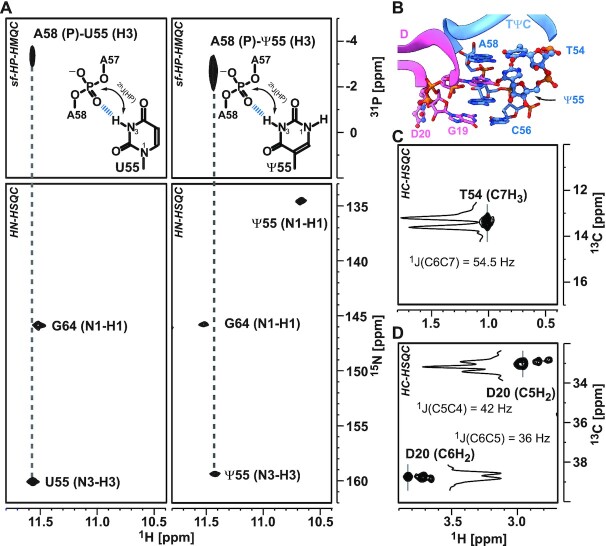
NMR spectroscopic signatures of modified residues. (A) Characterization of N3H3-phosphate group hydrogen bonds through sofast-1H,31P HMQC experiments. The H3 atom of residues U55 (left panel) and Ψ55 (right panel) with the phosphate group of residues A58 is correlated and related to the according HN cross peaks of the corresponding 1H15N HSQC, which are given in the panels below. (B) Placement of modified residues within the core region, which are establishing the interaction between D- (pink) and TΨC-loop (blue) as mapped by crystal structure (PDB: 3CW6). (C) The C7H3 cross peak of T54 detected in 1H,13C HSQC and (D) the methylene-group cross peaks of D20 C5H2 and C6H2 in 1H,13C HSQC. The inserts in (C) and (D) reflect the traces along the 13C-dimension to highlight the multiplet structure and reveal the respective 1JCC couplings. Experimental details are provided in an extended figure caption in SI.
Figure 5.
Figure 5.
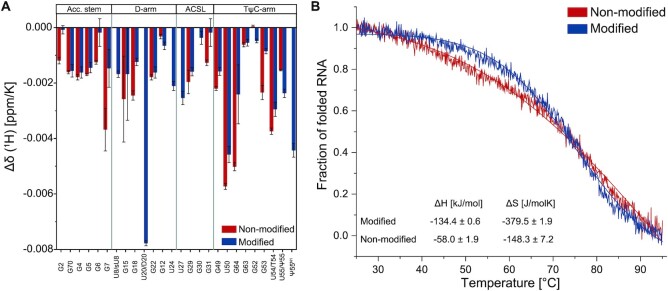
Temperature coefficients of the proton chemical shifts (A) and CD melting profiles of the non-modified (blue) and modified (grey) tRNAfMet. (A) Temperature coefficients of the proton chemical shifts for the non-modified tRNA ((1H), blue bars) and for the modified tRNAfMet construct ((1H), red bars). The temperature coefficients were determined through a linear fit of the measured chemical shifts at temperatures ranging from 5 to 45°C (Supplementary Figure S4–S5). (B) CD melting profiles were measured and analyzed as described in the method section. The resulting fitting parameters are shown.
Figure 6.
Figure 6.
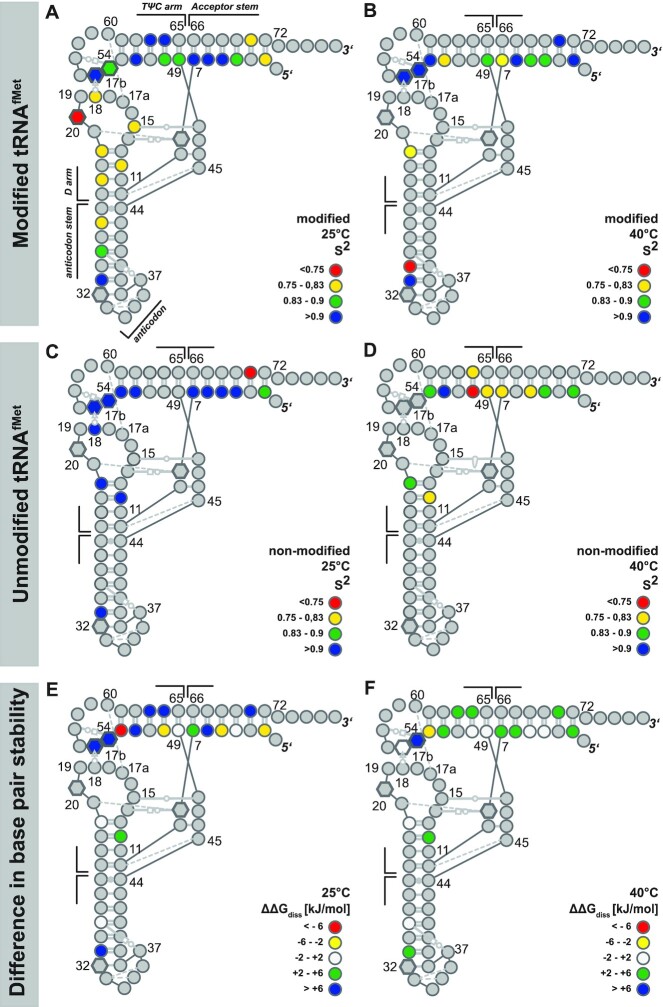
Comparison of local dynamics and base pair stabilities for modified and unmodified tRNAfMet. Nucleotide-resolved representation of the L-shaped structure that is color coded to represent the S2 order parameter for (A) native tRNA at 25°C and (B) at 40°C; (C) unmodified tRNA at 25°C and (D) at 40°C. The base interactions are annotated according to the nomenclature of Leontis and Westhof (112), modified residues are represented by hexagons instead of circles. The differences in the stabilities of corresponding base pairs (formula image) are given for (E) 25°C and (F) 40°C. Positive values shown in blue and green mean that modified tRNA is more stable than unmodified tRNA. In contrast, negative formula image values shown in yellow and red show that unmodified tRNA is more stable than modified tRNA. White highlighted nucleotides represent only a minor difference in formula image between both tRNAs. All data is summarized in Supplementary Tables S9-S12 and S15-S16.

References

    1. Dunin-Horkawicz S., Czerwoniec A., Gajda M.J., Feder M., Grosjean H., Bujnicki J.M.. MODOMICS: a database of RNA modification pathways. Nucleic Acids Res. 2006; 34:D145–D149. - PMC - PubMed
    1. Czerwoniec A., Dunin-Horkawicz S., Purta E., Kaminska K.H., Kasprzak J.M., Bujnicki J.M., Grosjean H., Rother K.. MODOMICS: a database of RNA modification pathways. 2008 update. Nucleic Acids Res. 2009; 37:D118–D121. - PMC - PubMed
    1. Machnicka M.A., Milanowska K., Oglou O.O., Purta E., Kurkowska M., Olchowik A., Januszewski W., Kalinowski S., Dunin-Horkawicz S., Rother K.M.et al.. MODOMICS: a database of RNA modification pathways - 2013 update. Nucleic Acids Res. 2013; 41:D262. - PMC - PubMed
    1. Boccaletto P., MacHnicka M.A., Purta E., Pitkowski P., Baginski B., Wirecki T.K., De Crécy-Lagard V., Ross R., Limbach P.A., Kotter A.et al.. MODOMICS: a database of RNA modification pathways. 2017 update. Nucleic Acids Res. 2018; 46:D303–D307. - PMC - PubMed
    1. Suzuki T. The expanding world of tRNA modifications and their disease relevance. Nat. Rev. Mol. Cell Biol. 2021; 22:375–392. - PubMed

Publication types

LinkOut - more resources