


Acceptance of Saliva-Based Specimen Collection for SARS-CoV-2 Testing Among K-12 Students, Teachers, and Staff
- PMID: 35137643
- PMCID: PMC9109545
- DOI: 10.1177/00333549221074395
Acceptance of Saliva-Based Specimen Collection for SARS-CoV-2 Testing Among K-12 Students, Teachers, and Staff
Abstract
Objective: Saliva specimens collected in school populations may offer a more feasible, noninvasive alternative to nasal swabs for large-scale COVID-19 testing efforts in kindergarten through 12th grade (K-12) schools. We investigated acceptance of saliva-based COVID-19 testing among quarantined K-12 students and their parents, teachers, and staff members who recently experienced a SARS-CoV-2 exposure in school.
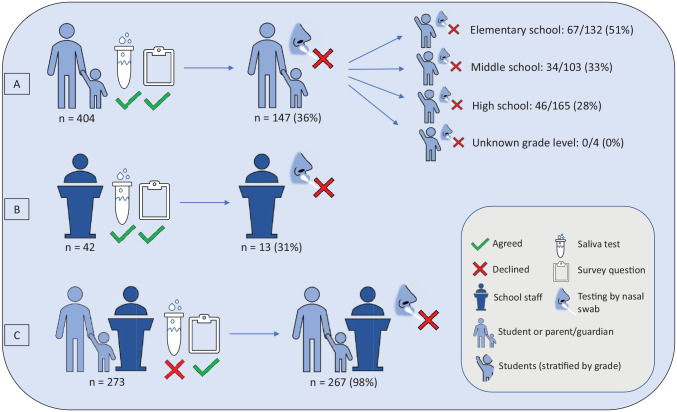
Methods: We surveyed 719 participants, in person or by telephone, who agreed to or declined a free saliva-based COVID-19 reverse-transcription polymerase chain reaction test as part of a surveillance investigation about whether they would have consented to testing if offered a nasal swab instead. We conducted this investigation in 6 school districts in Greene County (n = 3) and St. Louis County (n = 3), Missouri, from January 25 through March 23, 2021.
Results: More than one-third (160 of 446) of K-12 students (or their parents or guardians), teachers, and staff members who agreed to a saliva-based COVID-19 test indicated they would have declined testing if specimen collection were by nasal swab. When stratified by school level, 51% (67 of 132) of elementary school students or their parents or guardians would not have agreed to testing if a nasal swab was offered.
Conclusions: Some students, especially those in elementary school, preferred saliva-based COVID-19 testing to nasal swab testing. Use of saliva-based testing might increase voluntary participation in screening efforts in K-12 schools to help prevent the spread of SARS-CoV-2.
Keywords: COVID-19; K-12 schools; saliva-based testing; school health; screening.
Conflict of interest statement
The authors declared no potential conflicts of interest with respect to the research, authorship, and/or publication of this article.
Figures
References
-
- Centers for Disease Control and Prevention. Guidance for COVID-19 prevention in K-12 schools. Updated August 5, 2021. Accessed September 7, 2021. https://www.cdc.gov/coronavirus/2019-ncov/community/schools-childcare/k-...
Publication types
MeSH terms
LinkOut - more resources
Full Text Sources
Medical
Miscellaneous
