. 2022 Feb 4:116:e210227.
doi: 10.1590/0074-02760210227. eCollection 2022.

Antigenicity and adhesiveness of a Plasmodium vivax VIR-E protein from Brazilian isolates

Affiliations

Antigenicity and adhesiveness of a Plasmodium vivax VIR-E protein from Brazilian isolates

Ana Paula Schappo et al. Mem Inst Oswaldo Cruz. .

Abstract

Background: Plasmodium vivax, the major cause of malaria in Latin America, has a large subtelomeric multigene family called vir. In the P. vivax genome, about 20% of its sequences are vir genes. Vir antigens are grouped in subfamilies according to their sequence similarities and have been shown to have distinct roles and subcellular locations. However, little is known about vir subfamilies, especially when comes to their functions.

Objective: To evaluate the diversity, antigenicity, and adhesiveness of Plasmodium vivax VIR-E.

Methods: Vir-E genes were amplified from six P. vivax isolates from Manaus, North of Brazil. The presence of naturally acquired antibodies to recombinant PvBrVIR-E and PvAMA-1 was evaluated by ELISA. Binding capacity of recombinant PvBrVIR-E was assessed by adhesion assay to CHO-ICAM1 cells.

Findings: Despite vir-E sequence diversity, among those identified sequences, a representative one was chosen to be expressed as recombinant protein. The presence of IgM or IgG antibodies to PvBrVIR-E was detected in 23.75% of the study population while the presence of IgG antibodies to PvAMA-1 antigen was 66.25% in the same population. PvBrVIR-E was adhesive to CHO-ICAM1.

Main conclusions: PvBrVIR-E was antigenic and adhesive to CHO-ICAM1.


Figures
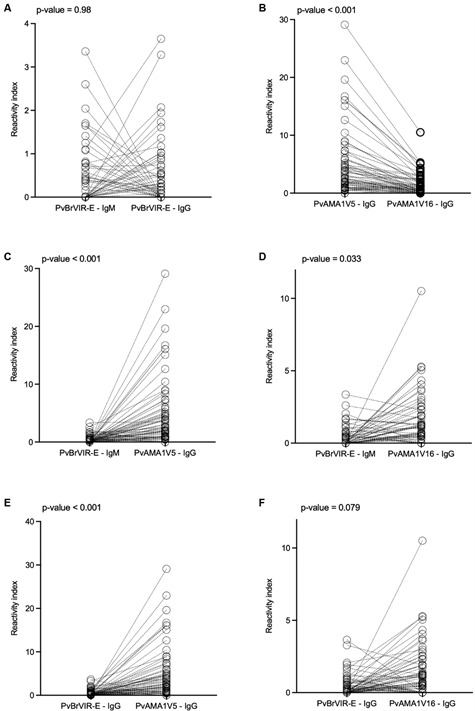
Fig. 1:
Fig. 1:. naturally acquired antibodies against Plasmodium vivax antigens. Human IgG and IgM antibody responses to PvBrVIR-E and IgG to PvAMA1 variants were detected in individuals infected with P. vivax (n = 80) and pairwise compared: reactivity index to PvBrVIR-E (A). Reactivity index to PvAMA1 variants (B). Reactivity index to PvBrVIR-E IgM compared to PvAMA1V5 (C) and PvAMA1V16 (D). Reactivity index to PvBrVIR-E IgG compared to PvAMA1V5 (E) and PvAMA1V16 (F). Significant differences were calculated by Friedman test, followed by pairwise comparisons using Nemenyi post-hoc test. p-values are indicating in the figures.
Fig. 2:
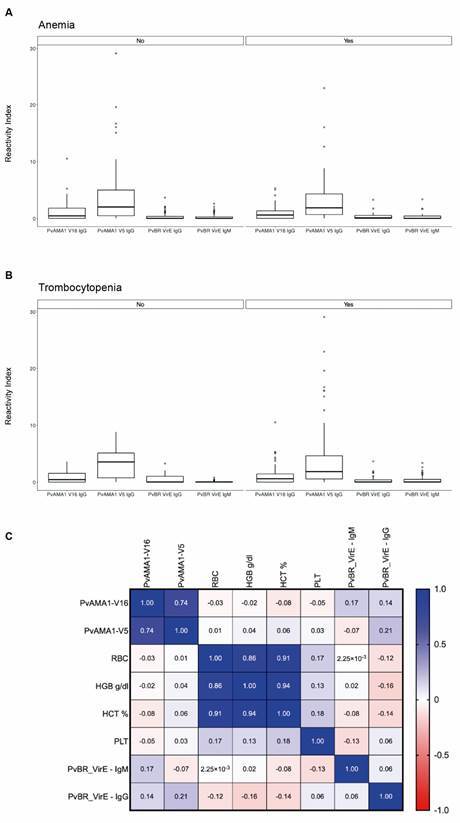
Fig. 2:. antibody response and their relationship with haematological parameters. Naturally acquired antibody response to PvBrVIR-E and PvAMA1variants and haematological parameters were evaluated in individuals infected with Plasmodium vivax (n = 80). (A) PvBrVIR-E and PvAMA1 reactivity index distribution in anaemic/ non-anaemic individuals. (B) PvBrVIR-E and PvAMA1 reactivity index distribution in individuals with/without thrombocytopenia. (C) Spearman’s correlation coefficient (rho) between antibody response and haematological parameters.
Fig. 3:
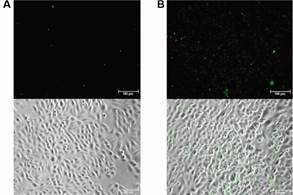
Fig. 3:. binding of PvBrVIR-E on CHO-ICAM1. Recombinant GST (A) or recombinant PvBrVIR-E (B) were incubated with CHO-ICAM1 cells and binding was detected by anti-GST on Leica DMI6000 fluorescence microscopy. Green spots represent the protein binding to CHO-ICAM1 cells detected by the fluorescent antibody.

Similar articles

Cited by

References

    1. WHO World Malaria Report. 2020. https://www.who.int/publications/i/item/9789240015791
    1. Gething PW, Elyazar IR, Moyes CL, Smith DL, Battle KE, Guerra CA. A long neglected world malaria map Plasmodium vivax endemicity in 2010. PLoS Negl Trop Dis. 2012;6(9):e1814. doi: 10.1371/journal.pntd.0001814. - DOI - PMC - PubMed
    1. Howes RE, Battle KE, Mendis KN, Smith DL, Cibulskis RE, Baird JK, et al. Global epidemiology of Plasmodium vivax. Am J Trop Med Hyg. 2016;95 - PMC - PubMed
    1. Kojom Foko LP, Arya A, Sharma A, Singh V. Epidemiology and clinical outcomes of severe Plasmodium vivax malaria in India. J Infect. 2021;82(6):231–246. doi: 10.1016/j.jinf.2021.03.028. - DOI - PubMed
    1. Lacerda MV, Mourão MP, Alexandre MA, Siqueira AM, Magalhães BM, Martinez-Espinosa FE. Understanding the clinical spectrum of complicated Plasmodium vivax malaria a systematic review on the contributions of the Brazilian literature. Malar J. 2012;11:12–12. doi: 10.1186/1475-2875-11-12. - DOI - PMC - PubMed