


Effectiveness of Unguided Internet-Based Cognitive Behavioral Therapy and the Three Good Things Exercise for Insomnia: 3-Arm Randomized Controlled Trial
- PMID: 35138259
- PMCID: PMC8867295
- DOI: 10.2196/28747
Effectiveness of Unguided Internet-Based Cognitive Behavioral Therapy and the Three Good Things Exercise for Insomnia: 3-Arm Randomized Controlled Trial
Abstract
Background: The treatment of insomnia with sleep medication causes problems such as long-term use, dependence, and significant economic losses, including medical expenses. Evidence-based lifestyle guidance is required to improve insomnia symptoms not only in person but also in easy-to-use web-based formats.
Objective: This study aims to clarify whether unguided internet-based cognitive behavioral therapy (ICBT) or the Three Good Things (TGT) exercise, both administered as self-help internet interventions without email support, could improve insomnia symptoms compared with a waiting list control (WLC) group.
Methods: A 4-week program was implemented, and participants were randomly allocated to 1 of the 3 groups. The primary outcome measure was the Pittsburgh Sleep Questionnaire (PSQI) score at 4 weeks compared with baseline.
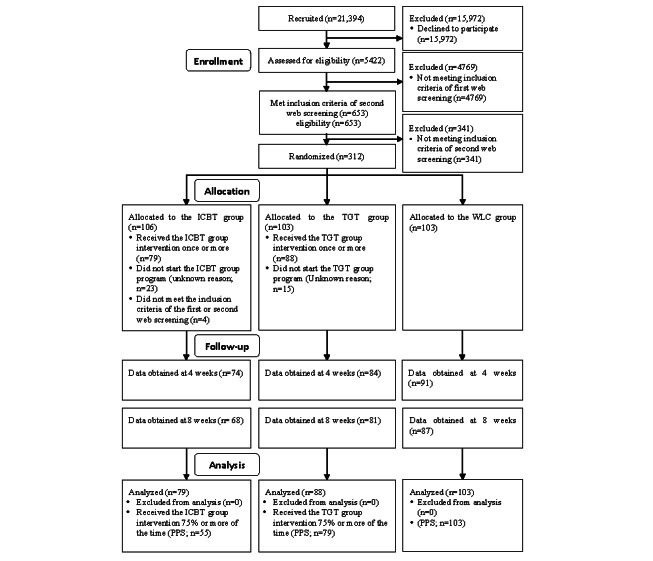
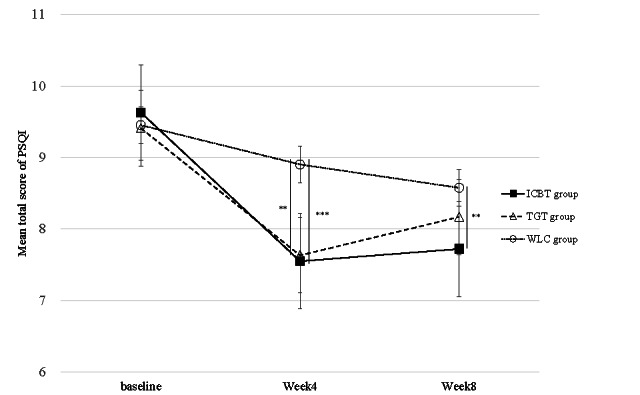
Results: Of the 21,394 individuals invited to participate, 312 (1.46%) met the eligibility criteria and were randomly assigned to 1 of the 3 groups. Of these 312 individuals, 270 (86.5%; ICBT 79/270, 29.3%; TGT 88/270, 32.6%; and WLC 103/270, 38.1%) completed a postintervention survey at 4 and 8 weeks. The adjusted mean changes of the primary outcome measure (PSQI) in the ICBT (-1.56, 95% CI -2.52 to -0.59; P<.001) and TGT (-1.15, 95% CI -2.08 to -0.23; P=.002) groups at 4 weeks from baseline showed a significant improvement compared with the WLC group. The adjusted mean changes in the secondary outcome measures of sleep onset latency, total sleep time, Athens Insomnia Scale score, and Patient Health Questionnaire-9 score at 4 weeks from baseline, as well as in the PSQI at 8 weeks from baseline, showed significant improvement for ICBT. Moreover, total sleep time, Athens Insomnia Scale, and Patient Health Questionnaire-9 scores at 4 weeks from baseline showed a significant improvement in the TGT group compared with the WLC group.
Conclusions: A total of 4 weeks of unguided ICBT and TGT exercises improved insomnia.
Trial registration: University Hospital Medical Information Network Clinical Trial Registry UMIN000034927; https://center6.umin.ac.jp/cgi-open-bin/ctr_e/ctr_view.cgi?recptno=R000039814.
Keywords: cognitive behavioral therapy; insomnia; internet-based treatment; mobile phone; positive psychology; randomized controlled trial.
©Daisuke Sato, Yoichi Sekizawa, Chihiro Sutoh, Yoshiyuki Hirano, Sho Okawa, Motohisa Hirose, Ryo Takemura, Eiji Shimizu. Originally published in the Journal of Medical Internet Research (https://www.jmir.org), 09.02.2022.
Conflict of interest statement
Conflicts of Interest: SD and ES have developed the web-based treatment but have no commercial interests.
Figures
References
-
- Diagnostic and Statistical Manual of Mental Disorders (DSM-5®) Washington, D.C: American Psychiatric Association; 2013. - PubMed
-
- Komada Y, Nomura T, Kusumi M, Nakashima K, Okajima I, Sasai T, Inoue Y. Correlations among insomnia symptoms, sleep medication use and depressive symptoms. Psychiatry Clin Neurosci. 2011 Feb;65(1):20–9. doi: 10.1111/j.1440-1819.2010.02154.x. doi: 10.1111/j.1440-1819.2010.02154.x. - DOI - DOI - PubMed
-
- Kim K, Uchiyama M, Okawa M, Liu X, Ogihara R. An epidemiological study of insomnia among the Japanese general population. Sleep. 2000 Feb 01;23(1):41–7. - PubMed
-
- Hafner M, Stepanek M, Taylor J, Troxel WM, van Stolk C. Why sleep matters-the economic costs of insufficient sleep: a cross-country comparative analysis. Rand Health Q. 2017 Jan;6(4):11. http://europepmc.org/abstract/MED/28983434 - PMC - PubMed
Publication types
MeSH terms
Associated data
- Actions
LinkOut - more resources
Full Text Sources
Medical
Miscellaneous
