


Effectiveness of a patient-centred sleep study report in the management of obstructive sleep apnoea
- PMID: 35138550
- PMCID: PMC9663392
- DOI: 10.1007/s11325-022-02573-7
Effectiveness of a patient-centred sleep study report in the management of obstructive sleep apnoea
Abstract
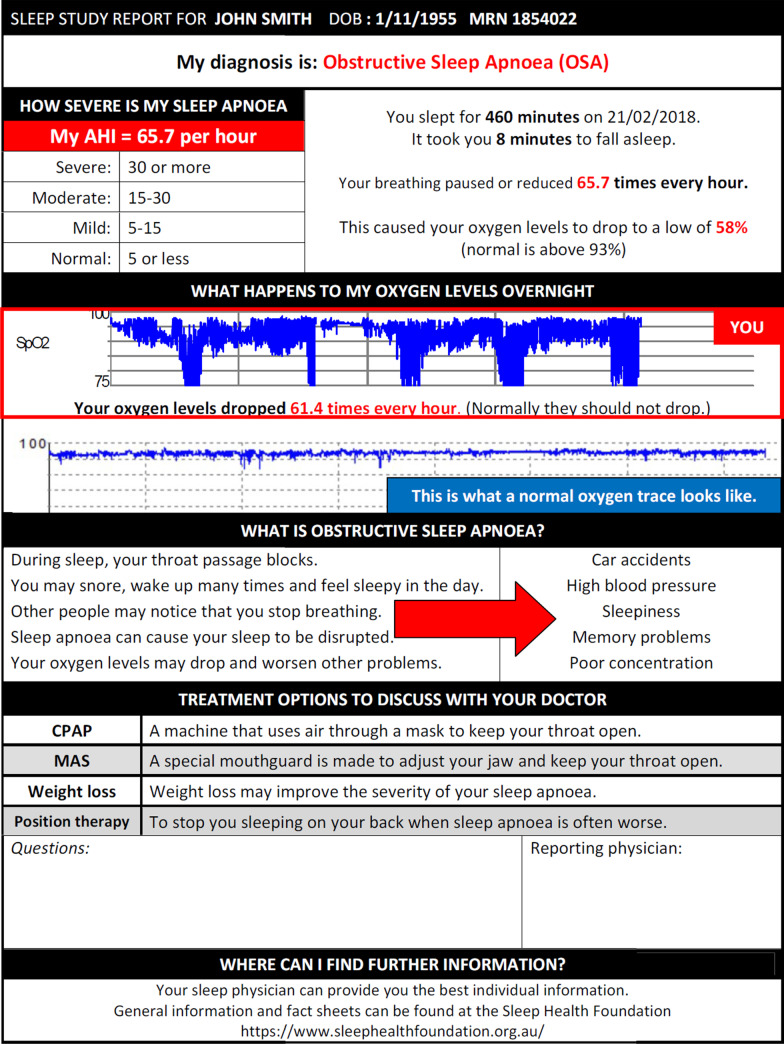
Purpose: Obstructive sleep apnoea (OSA) is a common condition with a range of short- and long-term health implications. Providing patient-centred care is a key principle to ensure patients are well informed and empowered to participate in clinical decision making. This study aimed to develop a patient-centred sleep study report for patients with obstructive sleep apnoea and to determine whether or not its implementation led to improved patient understanding of their disease.
Methods: The study was performed in two phases. The first phase utilised the Delphi-survey technique to develop and critically appraise a patient-centred sleep study report (PCSR) for patients with OSA, to accurately and simply convey key components of the patient's diagnosis and management. The second phase was a prospective, randomised controlled trial to assess the effect of the PCSR on patient knowledge, self-efficacy, and understanding as measured through validated patient questionnaires.
Results: The PCSR was developed on key concepts deemed to be important by the surveyed physicians, senior sleep scientists and patients. This included ensuring the results were customised, highlighting the patient's apnoea-hypopnea index, oxygen desaturation index and arousal index and limiting technical information to a few key pieces. Patients randomised to receive the PCSR had improved understanding and perceived patient-physician interaction compared to those randomised to standard care.
Conclusion: The development and implementation of the PCSR was feasible and improved patient understanding and perceived patient-physician interaction in patients with moderate to severe OSA. Whether or not use of the PCSR will translate to improved compliance with therapy will require further evaluation.
Keywords: Adherence; Continuous positive airway pressure; Education; Obstructive sleep apnoea; Patient-centred care.
© 2022. The Author(s).
Conflict of interest statement
Financial interests: P.A Cistulli has an appointment to an endowed academic chair at the University of Sydney that was created from ResMed funding. He receives no personal fees and this relationship is managed by an Oversight Committee of the University. The remaining authors have no financial interests to declare.
Non-financial interests: P. A. Cistulli has received research support from ResMed, SomnoMed, Zephyr Sleep Technologies, and Bayer. He is a consultant/adviser to Zephyr Sleep Technologies, Signifier Medical Technologies, SomnoMed and ResMed. The remaining authors have no non-financial interests to declare.
Figures
References
Publication types
MeSH terms
LinkOut - more resources
Full Text Sources
