Review
. 2022 Apr 26:40:469-498.
doi: 10.1146/annurev-immunol-101320-011235. Epub 2022 Apr 9.

Innate Sensors Trigger Regulated Cell Death to Combat Intracellular Infection

Affiliations
Review

Innate Sensors Trigger Regulated Cell Death to Combat Intracellular Infection

Kengo Nozaki et al. Annu Rev Immunol. .

Abstract

Intracellular pathogens pose a significant threat to animals. In defense, innate immune sensors attempt to detect these pathogens using pattern recognition receptors that either directly detect microbial molecules or indirectly detect their pathogenic activity. These sensors trigger different forms of regulated cell death, including pyroptosis, apoptosis, and necroptosis, which eliminate the infected host cell niche while simultaneously promoting beneficial immune responses. These defenses force intracellular pathogens to evolve strategies to minimize or completely evade the sensors. In this review, we discuss recent advances in our understanding of the cytosolic pattern recognition receptors that drive cell death, including NLRP1, NLRP3, NLRP6, NLRP9, NLRC4, AIM2, IFI16, and ZBP1.

Keywords: caspase; inflammasome; innate immunity; necroptosis; pattern recognition receptors; pyroptosis.


Figures
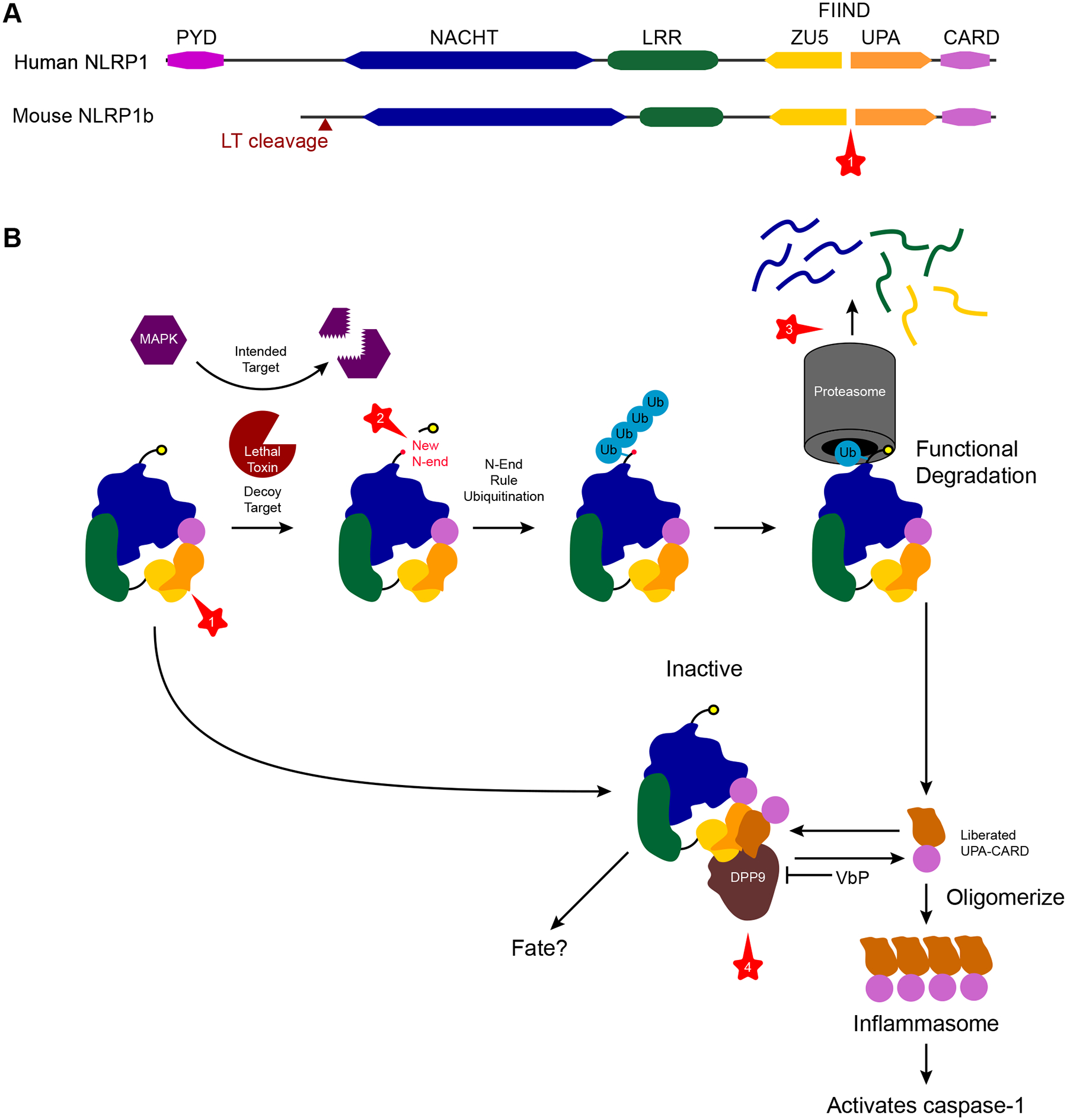
Figure 1
Figure 1
NLRP1 regulation by a series of proteolytic events. NLRP1 is regulated and activated by a series of protease steps (①–④). (a) NLRP1 is composed of NACHT and LRR domains, which are typical of NLR proteins, but it also has a unique FIIND and CARD at its C terminus. Additionally, human NLRP1 has a PYD that is not essential for its function. The FIIND exerts autoproteolytic activity and cleaves itself in the middle (①), generating a ZU5 and an UPA fragment. (b) Bacillus anthracis uses the pathogen protease LT to cleave MAP kinases. However, murine NLRP1b has a decoy sequence that lures LT to cleave NLRP1b in its N terminus (②). This process results in a novel nonmethionine N terminus that is detected by the N-end rule ubiquitinases, which target the protein to the proteasome, leading to functional degradation of NLRP1b (③). The proteasome degrades the NACHT, LRR, and ZU5 domains, but, because of the lack of a peptide bond between ZU5 and UPA, the UPA-CARD C-terminal fragment escapes the proteasome. This UPA-CARD is now free to oligomerize into an inflammasome that activates caspase-1. However, if the UPA-CARD is not generated in sufficient quantities, its activity is quenched. The dipeptidyl protease DPP9 normally cleaves proteins with specificity for cleaving after any amino acid followed by a proline at the N terminus of a protein. DPP9 organizes a ternary complex among itself, an intact NLRP1, and an UPA-CARD. DPP9 binds the intact NLRP1 by its ZU5 and UPA domains, and the UPA-CARD by its UPA domain, preventing the UPA-CARD from forming an inflammasome. Although the protease activity of DPP9 is essential for this inhibition (④), whether DPP9 cleaves the UPA-CARD is unknown. Abbreviations: CARD, caspase activation and recruitment domain; DPP, dipeptyl protease; FFIND, function to find domain; LRR, leucine-rich repeat; LT, lethal toxin; NLR, Nod-like receptor; PYD, pyrin domain; VbP, Val-boroPro.
Figure 2
Figure 2
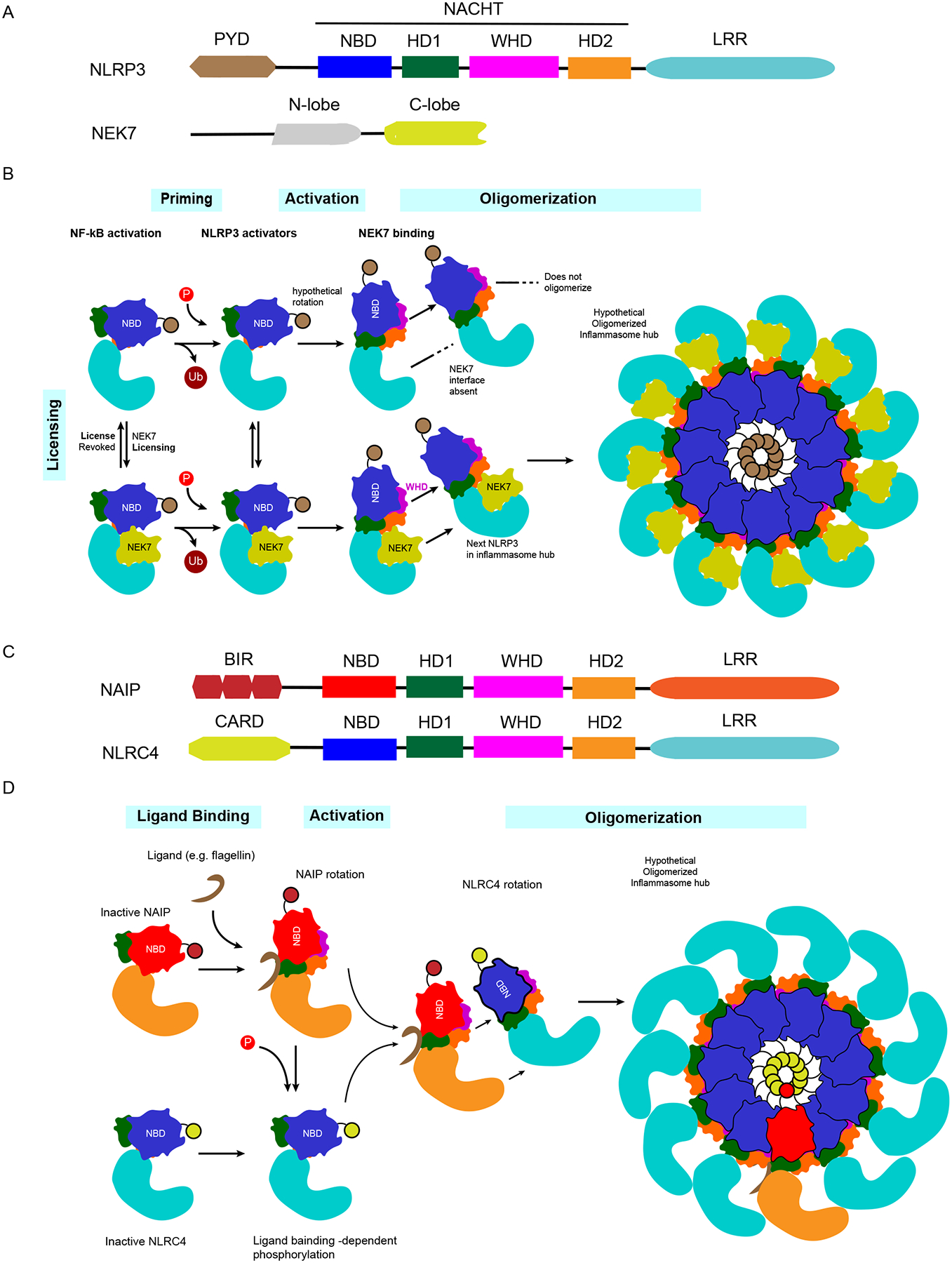
Regulation of NLRP3 and NLRC4 activation. NLRP3 activation requires three distinct stimulatory priming/licensing events, whereas NAIP/NLRC4 activation can proceed from exposure to a single activating agonist. (a) NLRP3 is composed of PYD, NACHT, and LRR domains. The NACHT domain includes four subdomains: NBD, HD1, WHD, and HD2. The licensing partner of NLRP3 is NEK7, which is composed of an N-lobe and a C-lobe. (b) NLRP3 activation requires three steps: priming, activation, and licensing. Under NF-κB signaling, the priming step occurs by multiple posttranslational modifications, whose structural functions and interdependence remain to be elucidated (e.g., deubiquitylation and phosphorylation). After priming, activation occurs by exposure to NLRP3 agonists, followed by (hypothetical) rotation of the NBD-HD1 module. Licensing requires NEK7, whose C-lobe connects two adjacent NLRP3 monomers to enable oligomerization into an inflammasome complex. (c) NAIPs and NLRC4 have closely related structures. Both include similar NACHT-LRR domains; however, NAIPs have BIR domains, while NLRC4 has a CARD in each N terminus. (d) Once bacterial ligands bind their cognate NAIP, the NAIP undergoes rotational activation, followed by NLRC4 phosphorylation by unknown mechanisms. The activated NAIP interacts with an NLRC4 monomer and induces NLRC4 rotational activation, which enables NLRC4 to oligomerize. Only 1 activated NAIP is required to recruit and activate 10 NLRC4 monomers and oligomerize in a domino-like reaction, resulting in the formation of an inflammasome disk complex. Abbreviations: CARD, caspase activation and recruitment domain; LRR, leucine-rich repeat; NAIP, NLR family apoptosis inhibitory protein; NEK7, NIMA-related kinase 7; NF-κB, nuclear factor κB; NLR, Nod-like receptor; NLRC4, NLR family CARD domain–containing 4; PYD, pyrin domain.
Figure 3
Figure 3
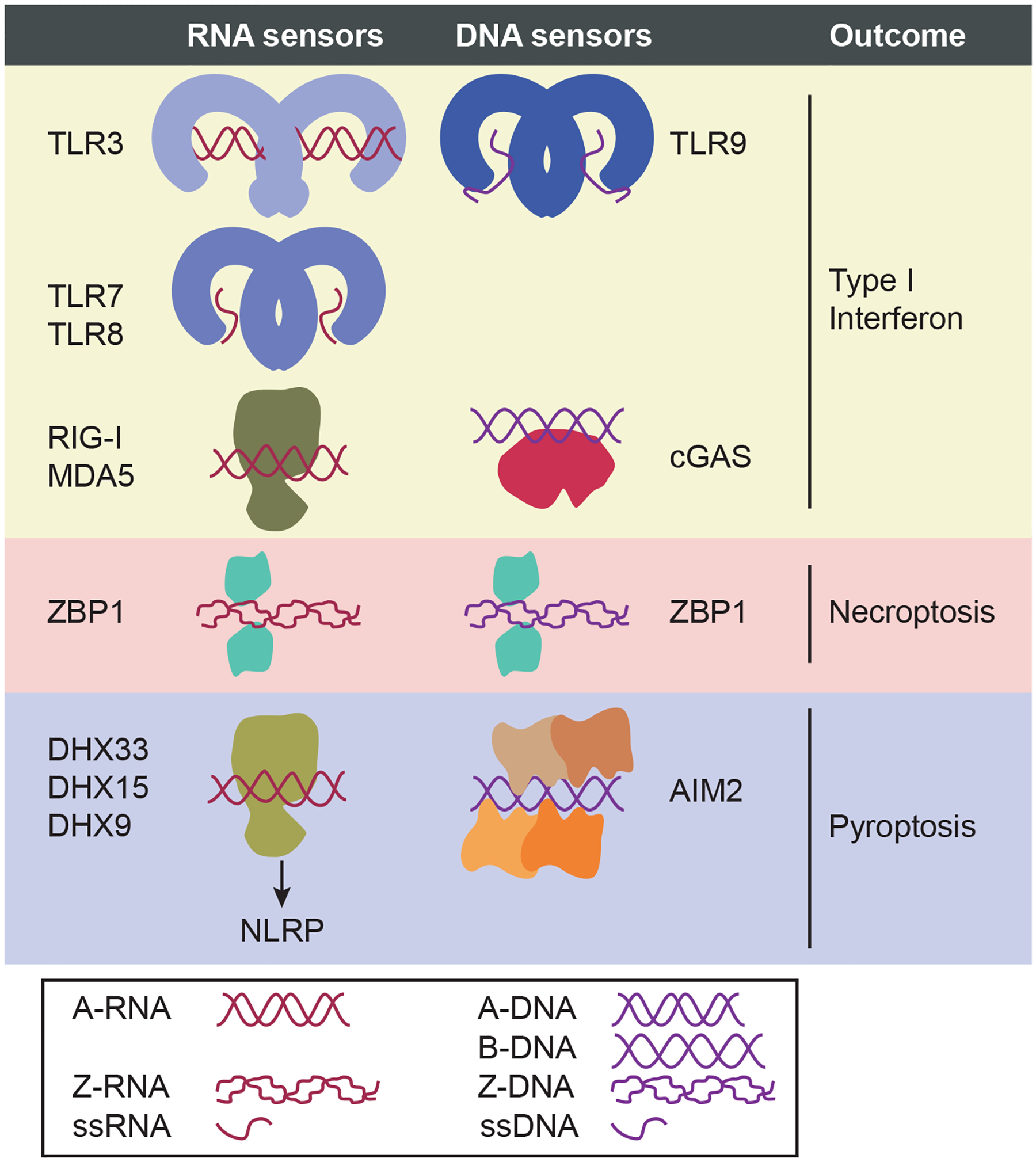
Nucleic acid sensors. Type I IFN–inducing RNA sensors include three TLRs (TLR3, TLR7, and TLR8) and two RLRs (RIG-I and MDA5) (195c). These three RNA-sensing TLRs are localized predominantly to endosomes, where TLR3 recognizes dsRNA (which typically adopts the A-form, A-RNA), while TLR7 and TLR8 recognize ssRNA. The two RLRs are cytosolic RNA sensors that drive IFN responses by sensing A-RNA; RIG-I binds to short A-RNA with 5′ di- or triphosphates, while MDA-5 binds to long A-RNA. Type I IFN–inducing DNA sensors include TLR9 and cGAS. Like the RNA-sensing TLRs, TLR9 is also localized to endosomes; however, its ligand is ssDNA. cGAS recognizes cytosolic B-DNA. ZBP1, a necroptosis-inducing Z-form nucleic acid sensor, recognizes both Z-DNA and Z-RNA as markers of viral infection. Inflammasome sensors that activate caspase-1 also respond to cytosolic DNA and RNA ligands. RNA detection is mediated by three DHX family members (DHX33, DHX15, and DHX9), which are cytosolic A-RNA sensors that activate NLRP inflammasomes (NLRP3, NLRP6, and NLRP9, respectively) to induce pyroptosis by binding with A-RNA. NLRP1 (not shown) also responds to cytosolic RNA, but DHX partnership is not known to be required. The structural relationships between these NLRs and their partners or RNA are not yet established. Finally, the AIM2 inflammasome directly binds to dsDNA. The structures of A-form, B-form, and Z-form nucleic acids are shown. Whereas A-form and B-form are right-handed helices, Z-form adopts a left-handed helix. Genomic DNA exists in B-form, but in contrast, dsRNA does not typically adopt B-form. Z-forms occur during replication or unwinding of nucleic acids that occurs too rapidly for helicases to relax the structure (195a, 195b). Abbreviations: AIM2, absent in melanoma 2; cGAS, cyclic GMP–AMP synthase; DHX, DExD/H-box helicase; dsRNA, double-stranded RNA; NLR, Nod-like receptor; ssRNA, single-stranded RNA; TLR, Toll-like receptor; ZBP1, Z-DNA-binding protein 1.

References

    1. Van Valen L 1973. A new evolutionary law. Evol. Theory 1:1–30
    1. Davis BK, Wen H, Ting JP-Y. 2011. The inflammasome NLRs in immunity, inflammation, and associated diseases. Annu. Rev. Immunol 29:707–35 - PMC - PubMed
    1. Ting JP-Y, Lovering RC, Alnemri ES, Bertin J, Boss JM, et al. 2008. The NLR gene family: a standard nomenclature. Immunity 28(3):285–87 - PMC - PubMed
    1. Lu A, Magupalli VG, Ruan J, Yin Q, Atianand MK, et al. 2014. Unified polymerization mechanism for the assembly of ASC-dependent inflammasomes. Cell 156(6):1193–206 - PMC - PubMed
    1. Cai X, Chen J, Xu H, Liu S, Jiang Q-X, et al. 2014. Prion-like polymerization underlies signal transduction in antiviral immune defense and inflammasome activation. Cell 156(6):1207–22 - PMC - PubMed

Publication types

LinkOut - more resources