. 2022 Feb 9;17(2):e0263001.
doi: 10.1371/journal.pone.0263001. eCollection 2022.

The impact of the COVID-19 pandemic on scientific research in the life sciences

Affiliations

The impact of the COVID-19 pandemic on scientific research in the life sciences

Massimo Riccaboni et al. PLoS One. .

Abstract

The COVID-19 outbreak has posed an unprecedented challenge to humanity and science. On the one side, public and private incentives have been put in place to promptly allocate resources toward research areas strictly related to the COVID-19 emergency. However, research in many fields not directly related to the pandemic has been displaced. In this paper, we assess the impact of COVID-19 on world scientific production in the life sciences and find indications that the usage of medical subject headings (MeSH) has changed following the outbreak. We estimate through a difference-in-differences approach the impact of the start of the COVID-19 pandemic on scientific production using the PubMed database (3.6 Million research papers). We find that COVID-19-related MeSH terms have experienced a 6.5 fold increase in output on average, while publications on unrelated MeSH terms dropped by 10 to 12%. The publication weighted impact has an even more pronounced negative effect (-16% to -19%). Moreover, COVID-19 has displaced clinical trial publications (-24%) and diverted grants from research areas not closely related to COVID-19. Note that since COVID-19 publications may have been fast-tracked, the sudden surge in COVID-19 publications might be driven by editorial policy.


Conflict of interest statement

The authors have declared that no competing interests exist.

Figures
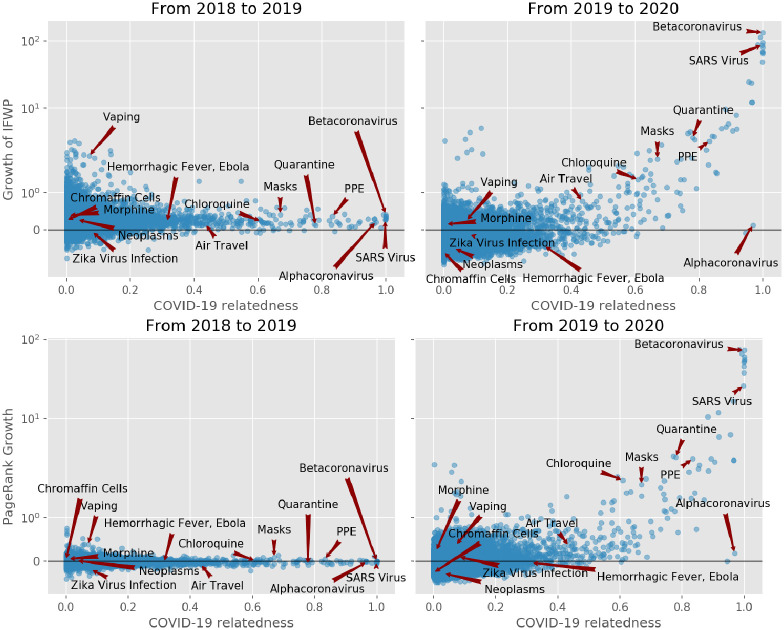
Fig 1
Fig 1. Above: Impact factor weighted publication number (IFWN) growth per MeSH term from 2018 to 2019 and from 2019 to 2020.
Each dot represents, a MeSH term. The y axis (growth) is in symmetric log scale. The x axis shows the COVID-19 relatedness, σ. Note that the position of the dots on the x-axis is the same in the two plots. Below: MeSH term importance gain (PageRank) and their COVID-19 relatedness.
Fig 2
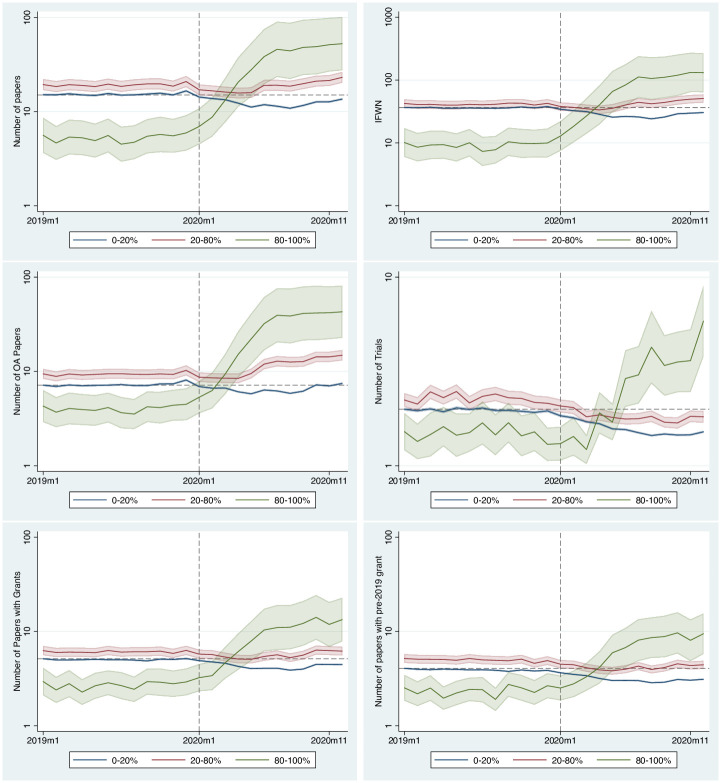
Fig 2. Predicted number of papers, impact factor weighted number of papers, open access papers, papers related to clinical trials, total number of papers with grants and older grants (before 2019) per month.
The y axis is in log scale. The dashed vertical line identifies January 2020. The dashed horizontal line shows the publications in January 2019 for the 0–20% group before the event. This line highlights that the drop happens after the event. The bands around the lines indicate the 95% confidence interval of the predicted values. The results are the output of the Stata margins command.

References

    1. Fraser N, Brierley L, Dey G, Polka JK, Pálfy M, Nanni F, et al. Preprinting the COVID-19 pandemic. bioRxiv. 2020;1. doi: 10.1101/2020.05.22.111294 - DOI
    1. Ruiz-Real JL, Nievas-Soriano BJ, Uribe-Toril J. Has Covid-19 Gone Viral? An Overview of Research by Subject Area. Health Education & Behavior. 2020;47(6):861–869. doi: 10.1177/1090198120958368 - DOI - PubMed
    1. Di Girolamo N, Reynders RM. Characteristics of scientific articles on COVID-19 published during the initial 3 months of the pandemic. Scientometrics. 2020;125(1):795–812. doi: 10.1007/s11192-020-03632-0 - DOI - PMC - PubMed
    1. Bryan K, Lemus J, Marshall G. Innovation During a Crisis: Evidence from Covid-19. SSRN Electronic Journal. 2020;1. doi: 10.2139/ssrn.3587973 - DOI
    1. Callaway E, Ledford H, Viglione G, Watson T, Witze A. COVID and 2020: An extraordinary year for science. Nature. 2020;588(7839):550–552. doi: 10.1038/d41586-020-03437-4 - DOI - PubMed