


Excess mortality caused by the COVID-19 pandemic negatively impacts birth numbers in European countries
- PMID: 35139195
- PMCID: PMC8903380
- DOI: 10.1093/humrep/deac031
Excess mortality caused by the COVID-19 pandemic negatively impacts birth numbers in European countries
Abstract
Study question: How did the coronavirus disease 2019 (COVID-19) pandemic affect live birth numbers in Europe?
Summary answer: In 14 European countries with validated datasets on live birth numbers during the ongoing COVID-19 pandemic, excess mortality was inversely correlated with live birth numbers.
What is known already: Since March 2020, in order to minimize spread of severe acute respiratory syndrome coronavirus 2 and reducing strain on the health care systems, many national authorities have imposed containments and restricted both indoor and outdoor recreational activities. Historical events, such as electricity blackouts, have repeatedly been shown to exert incremental effects on birth numbers.
Study design, size, duration: We evaluated the effect of the COVID-19 pandemic and the containments on reproduction and birth numbers in 14 European countries with complete and validated datasets, until March 2021.
Participants/materials, setting, methods: The national demographic offices of 20 European countries were requested to provide the monthly birth numbers from 2015 to March 2021. Among them, 14 countries provided those data. Taking into account seasonal variations, the live birth numbers were compared with excess mortality at two different time intervals during the pandemic.
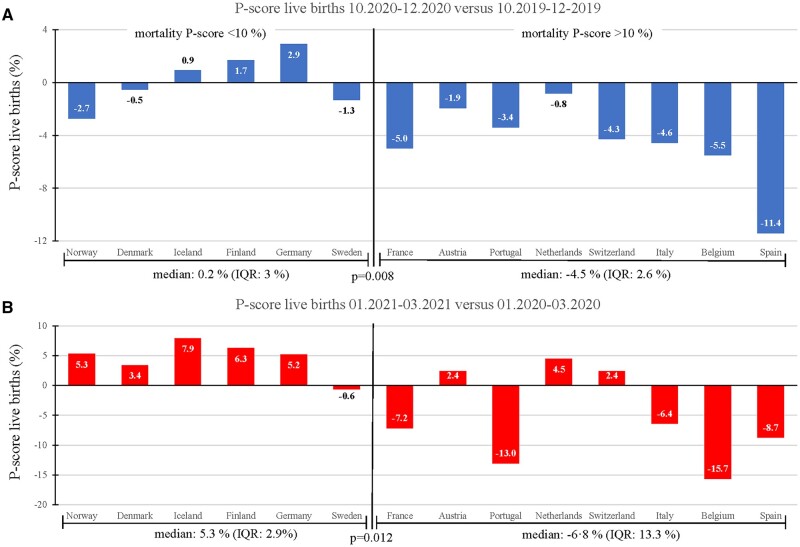
Main results and the role of chance: At 9 months after the initiation of containments in many European countries, 11 of 14 European countries (78.5%) experienced a decline in live birth numbers, ranging between -0.5% and -11.4%. The decline in live birth numbers was most pronounced in eight European countries with the highest degree of excess mortality. From January to March 2021, live birth numbers continued to decline in 5 of 8 European countries with high excess mortality, whereas live births started to recover in 8 of 14 countries (57.1%).
Limitations, reasons for caution: The live birth numbers of some key European countries were not available.
Wider implications of the findings: The demographic changes linked to the COVID-19 pandemic may add to the overall socio-economic consequences, most particularly in those countries with pre-existing reduced reproduction rates.
Study funding/competing interest(s): This study did not receive specific funding. The authors have no conflicts of interest to declare.
Trial registration number: N/A.
Keywords: COVID-19; containment; contraception; family planning; fertility; live birth numbers; mortality; pandemic; reproduction; seasonality.
© The Author(s) 2022. Published by Oxford University Press on behalf of European Society of Human Reproduction and Embryology. All rights reserved. For permissions, please email: journals.permissions@oup.com.
Figures

References
MeSH terms
LinkOut - more resources
Full Text Sources
Medical
Research Materials
