


Regional-based within-year seasonal variations in influenza-related health outcomes across mainland China: a systematic review and spatio-temporal analysis
- PMID: 35139857
- PMCID: PMC8830135
- DOI: 10.1186/s12916-022-02269-5
Regional-based within-year seasonal variations in influenza-related health outcomes across mainland China: a systematic review and spatio-temporal analysis
Abstract
Background: China experiences large variations in influenza seasonal activity. We aim to update and improve the current understanding of regional-based within-year variations of influenza activity across mainland China to provide evidence for the planning and optimisation of healthcare strategies.
Methods: We conducted a systematic review and spatio-temporal meta-analysis to assess regional-based within-year variations of ILI outpatient consultation rates, influenza test positivity rates amongst both ILI outpatients and SARI inpatients, and influenza-associated excess mortality rates. We searched English and Chinese databases for articles reporting time-series data on the four influenza-related outcomes at the sub-national and sub-annual level. After synthesising the data, we reported on the mean monthly rate, epidemic onset, duration, peak and intensity.
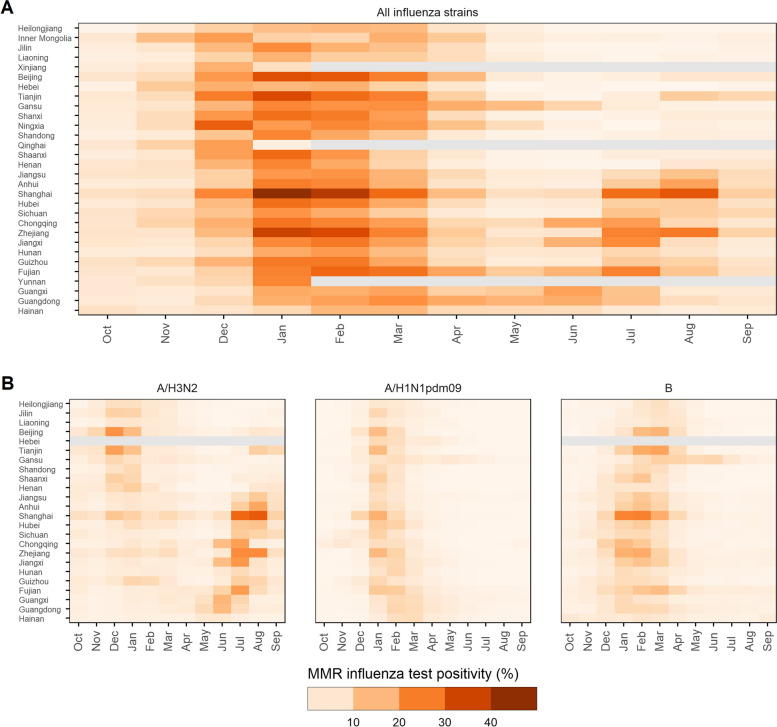
Results: We included 247 (7.7%) eligible studies in the analysis. We found within-year influenza patterns to vary across mainland China in relation to latitude and geographic location. High-latitude provinces were characterised by having short and intense annual winter epidemics, whilst most mid-latitude and low-latitude provinces experience semi-annual epidemics or year-round activity. Subtype activity varied across the country, with A/H1N1pdm09 and influenza B occurring predominantly in the winter, whereas A/H3N2 activity exhibited a latitudinal divide with high-latitude regions experiencing a winter peak, whilst mid and low-latitude regions experienced a summer epidemic. Epidemic onsets and peaks also varied, occurring first in the north and later in the southeast. We found positive associations between all influenza health outcomes. In addition, seasonal patterns at the prefecture and county-level broadly resembled their wider province.
Conclusions: This is the first systematic review to simultaneously examine the seasonal variation of multiple influenza-related health outcomes at multiple spatial scales across mainland China. The seasonality information provided here has important implications for the planning and optimisation of immunisation programmes and healthcare provision, supporting the need for regional-based approaches to address variations in local epidemiology.
Keywords: China; Influenza; Seasonality; Spatio-temporal; Systematic review.
© 2022. The Author(s).
Conflict of interest statement
MJ is a Board Member for the Journal.
Figures



References
-
- Lafond KE, Porter RM, Whaley MJ, Suizan Z, Ran Z, Aleem MA, et al. Global burden of influenza-associated lower respiratory tract infections and hospitalizations among adults: a systematic review and meta-analysis. PLOS Med. 2021;18(3):e1003550. doi: 10.1371/journal.pmed.1003550. - DOI - PMC - PubMed
Publication types
MeSH terms
Grants and funding
LinkOut - more resources
Full Text Sources
Medical
