. 2022 Feb 9;13(1):774.
doi: 10.1038/s41467-022-28437-y.

Development and validation of a prognostic and predictive 32-gene signature for gastric cancer

Affiliations

Development and validation of a prognostic and predictive 32-gene signature for gastric cancer

Jae-Ho Cheong et al. Nat Commun. .

Abstract

Genomic profiling can provide prognostic and predictive information to guide clinical care. Biomarkers that reliably predict patient response to chemotherapy and immune checkpoint inhibition in gastric cancer are lacking. In this retrospective analysis, we use our machine learning algorithm NTriPath to identify a gastric-cancer specific 32-gene signature. Using unsupervised clustering on expression levels of these 32 genes in tumors from 567 patients, we identify four molecular subtypes that are prognostic for survival. We then built a support vector machine with linear kernel to generate a risk score that is prognostic for five-year overall survival and validate the risk score using three independent datasets. We also find that the molecular subtypes predict response to adjuvant 5-fluorouracil and platinum therapy after gastrectomy and to immune checkpoint inhibitors in patients with metastatic or recurrent disease. In sum, we show that the 32-gene signature is a promising prognostic and predictive biomarker to guide the clinical care of gastric cancer patients and should be validated using large patient cohorts in a prospective manner.


Conflict of interest statement

J.C., S.C.W., S.P., S.H.L., and T.H.H. are co-inventors of a patent for the 32 gene signature which is currently under consideration (PCT/KR2021/018966). All other authors declare no competing interests.

Figures
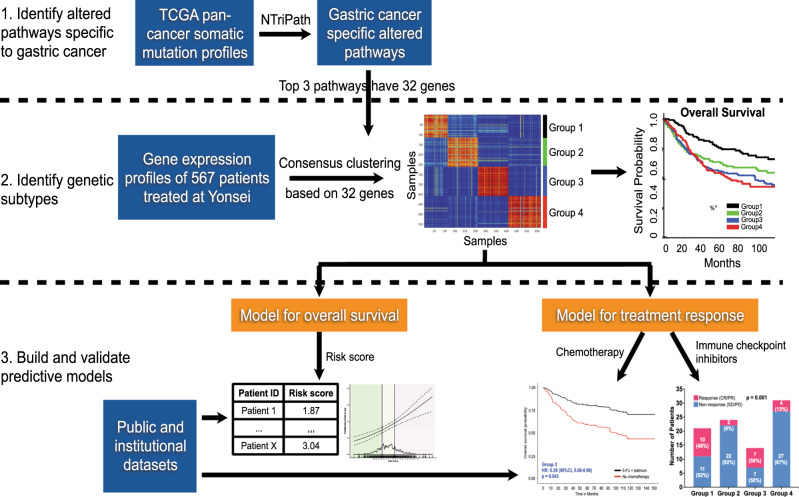
Fig. 1
Fig. 1. Workflow of the current study.
The somatic mutation profiles of 6681 patients from 19 different cancers from TCGA were inputted into NTriPath to identify pathways that were altered specifically in gastric cancer. Microarray-based mRNA expression profiles of 567 gastric cancer patients were generated and inputted into NTriPath. Unsupervised clustering based on the expression of 32 member genes that comprised the top three altered pathways were used to identify molecular subtypes. The prognostic and predictive capability of the molecular subtypes were tested in multiple independent cohorts. TCGA The Cancer Genome Atlas.
Fig. 2
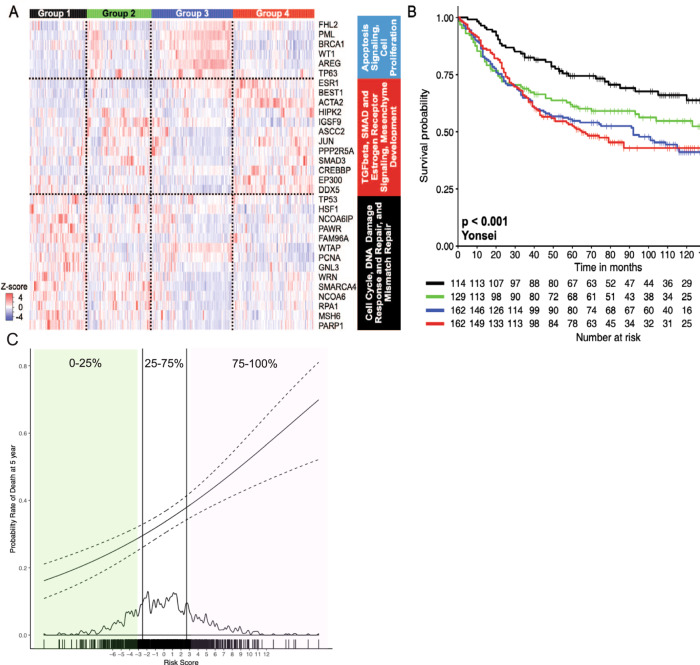
Fig. 2. The molecular subtypes were prognostic for overall survival.
A Unsupervised consensus clustering using 32-gene signature identified four molecular subtypes in the Yonsei cohort. B Kaplan–Meier survival analysis of the four molecular subtypes in the Yonsei cohort. Survival was compared using the log-rank test. C The risk score was applied to the Asian Cancer Research Group (ACRG), Sohn et al., and The Cancer Genome Atlas (TCGA) cohorts as a combined group. The dashed curves indicate the 95% confidence interval. The rug plot on top of the x-axis shows the risk score for individual patients. The green region represents patients with scores below the 25th percentile, the white area includes patients with scores from the 25th to 75th percentile, and the purple region includes patients with scores above the 75th percentile. Source data are provided as a source data file.
Fig. 3
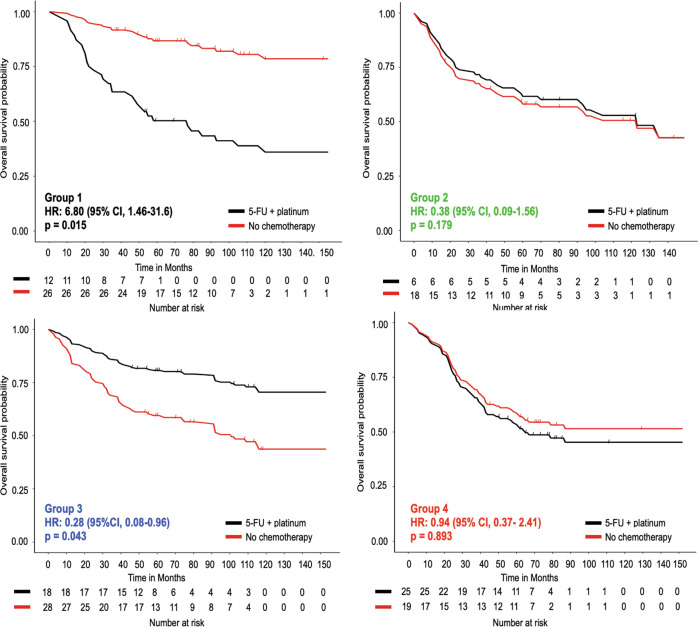
Fig. 3. The molecular subtypes are associated with response to adjuvant 5-fluorouracil (5-FU) and platinum chemotherapy.
Kaplan–Meier curves for overall survival for patients treated at Yonsei University, stratified by molecular subtype. Patients who underwent surgery with no adjuvant chemotherapy are compared to ones who received surgery and adjuvant 5-FU and platinum. The log-rank test was used to test statistical significance. Source data are provided as a source data file.
Fig. 4
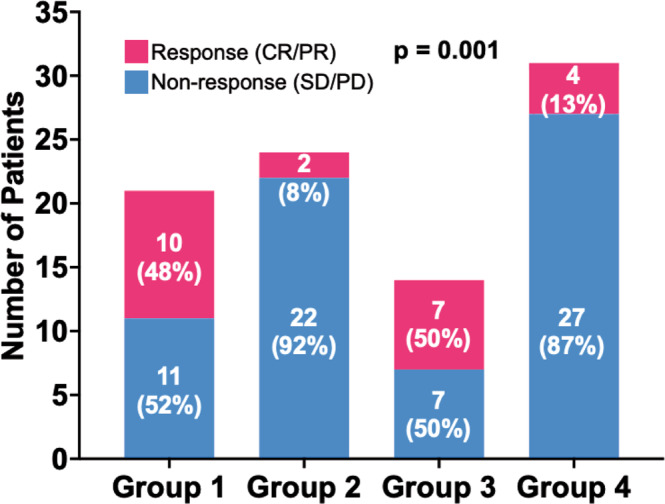
Fig. 4. The molecular subtypes are associated with response to immune checkpoint inhibitors.
Patients with advanced gastric cancer who were treated with immune checkpoint blockade were stratified by molecular subtypes. Response is defined by complete response (CR) or partial response (PR). Non-response is defined as stable disease (SD) or progressive disease (PD). The chi-square test was used to compare groups. Source data are provided as a source data file.

References

    1. Paik S, et al. A multigene assay to predict recurrence of tamoxifen-treated, node-negative breast cancer. N. Engl. J. Med. 2004;351:2817–2826. doi: 10.1056/NEJMoa041588. - DOI - PubMed
    1. Sparano JA, et al. Adjuvant chemotherapy guided by a 21-gene expression assay in breast cancer. N. Engl. J. Med. 2018;379:111–121. doi: 10.1056/NEJMoa1804710. - DOI - PMC - PubMed
    1. Karapetis CS, et al. K-ras mutations and benefit from cetuximab in advanced colorectal cancer. N. Engl. J. Med. 2008;359:1757–1765. doi: 10.1056/NEJMoa0804385. - DOI - PubMed
    1. Hoshida Y, et al. Gene expression in fixed tissues and outcome in hepatocellular carcinoma. N. Engl. J. Med. 2008;359:1995–2004. doi: 10.1056/NEJMoa0804525. - DOI - PMC - PubMed
    1. Silvestri GA, et al. A bronchial genomic classifier for the diagnostic evaluation of lung cancer. N. Engl. J. Med. 2015;373:243–251. doi: 10.1056/NEJMoa1504601. - DOI - PMC - PubMed

Publication types