. 2022 Feb 9;13(1):769.
doi: 10.1038/s41467-022-28335-3.

Immune signature of acute pharyngitis in a Streptococcus pyogenes human challenge trial

Affiliations

Immune signature of acute pharyngitis in a Streptococcus pyogenes human challenge trial

Jeremy Anderson et al. Nat Commun. .

Abstract

Streptococcus pyogenes causes at least 750 million infections and more than 500,000 deaths each year. No vaccine is currently available for S. pyogenes and the use of human challenge models offer unique and exciting opportunities to interrogate the immune response to infectious diseases. Here, we use high-dimensional flow cytometric analysis and multiplex cytokine and chemokine assays to study serial blood and saliva samples collected during the early immune response in human participants following challenge with S. pyogenes. We find an immune signature of experimental human pharyngitis characterised by: 1) elevation of serum IL-1Ra, IL-6, IFN-γ, IP-10 and IL-18; 2) increases in peripheral blood innate dendritic cell and monocyte populations; 3) reduced circulation of B cells and CD4+ T cell subsets (Th1, Th17, Treg, TFH) during the acute phase; and 4) activation of unconventional T cell subsets, γδTCR + Vδ2+ T cells and MAIT cells. These findings demonstrate that S. pyogenes infection generates a robust early immune response, which may be important for host protection. Together, these data will help advance research to establish correlates of immune protection and focus the evaluation of vaccines.


Conflict of interest statement

The authors declare no competing interests.

Figures
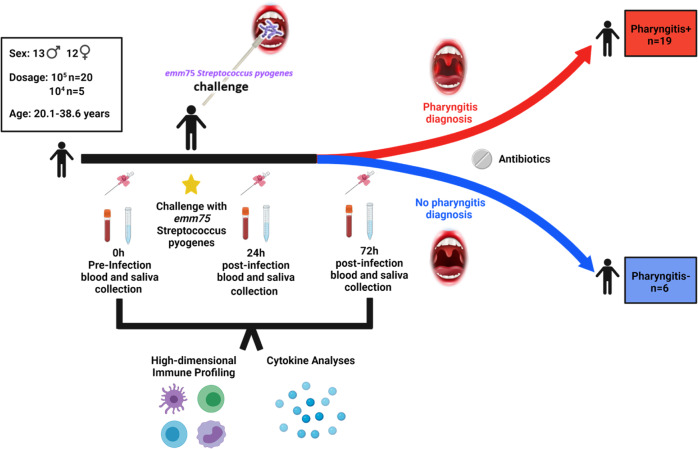
Fig. 1
Fig. 1. Human challenge with Streptococcuspyogenes.
Schematic of Streptococcus pyogenes human-challenge model. Details participant demographics, timepoints, outcomes and analyses performed. Figure created with BioRender.com.
Fig. 2
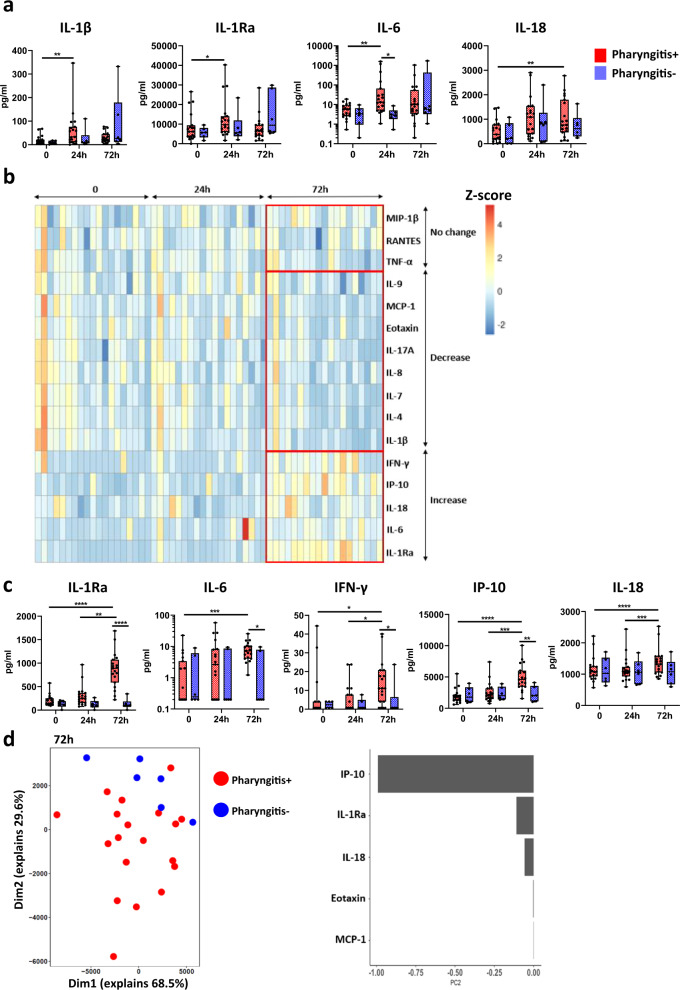
Fig. 2. Distinct cytokine profiles in participants that developed pharyngitis.
a Saliva cytokines and chemokines at timepoint 0 h (pre-infection) 24 h post-infection (24 h) and 72 h post-infection (72 h) between pharyngitis positive (n = 19, red) and negative (n = 6, blue) participants. b Heatmap summary of serum cytokines and chemokines analysed with normalized Z-score. c Serum cytokines and chemokines that had increased during infection. d Unsupervised PCA analysis of serum cytokines and chemokines between pharyngitis positive and negative participants at 72 h post-infection and the top 5 factors contributing to differences. Data presented as boxplots show median ± IQR with min–max whiskers. A Friedman’s test was used to compare responses over time in P+ and P− groups, while a Mann–Whitney U-test was performed to compare differences between P+ and P− groups. All tests performed were two-tailed and a p-value <0.05 was considered significant; *p < 0.05, **p < 0.01, ***p < 0.001, ****p < 0.0001.
Fig. 3
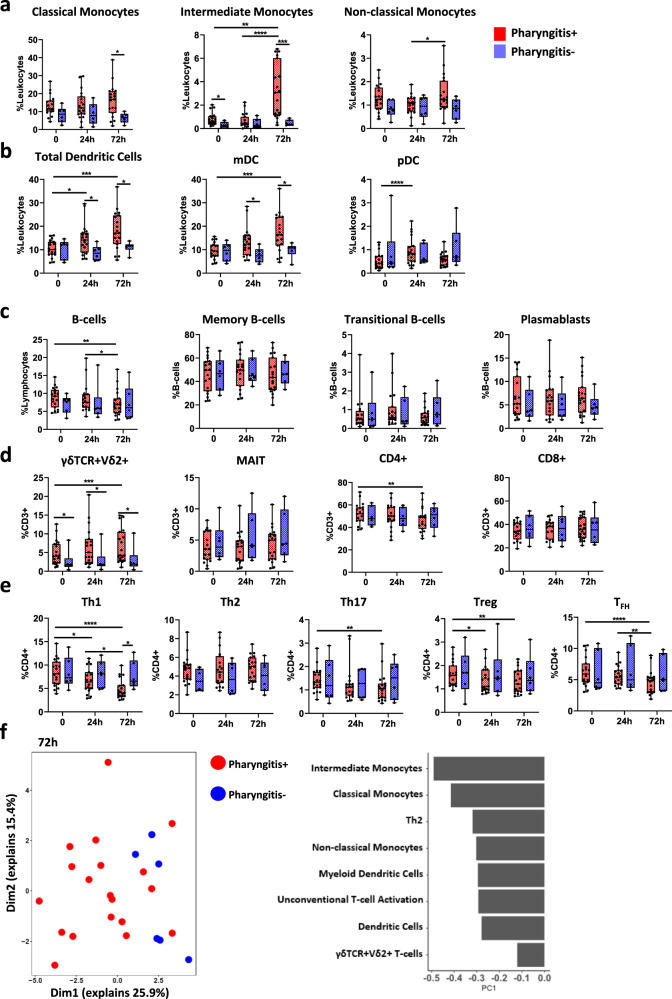
Fig. 3. Unique cellular profiles in participants that developed pharyngitis.
a Differences in monocyte subsets at timepoint 0 h (pre-infection) 24 h post-infection (24 h) and 72 h post-infection (72 h) between pharyngitis positive (n = 19, red) and negative (n = 6, blue) participants. b Dendritic cell subsets. c B cells and B-cell subsets. d γδTCR + Vδ2+ T cells, MAIT cells, CD4+ T cells and CD8+ T cells. e CD4+ T cell subsets. f Unsupervised PCA analysis of cellular subsets between pharyngitis positive and negative individuals at 72 h post-infection and the top 8 factors contributing to differences. Data presented as boxplots show median ± IQR with min–max whiskers. A Friedman’s test was used to compare responses over time in P+ and P− groups, while a Mann–Whitney U-test was performed to compare differences between P+ and P− groups. All tests performed were two-tailed and a p-value <0.05 was considered significant; *p < 0.05, **p < 0.01, ***p < 0.001, ****p < 0.0001.
Fig. 4
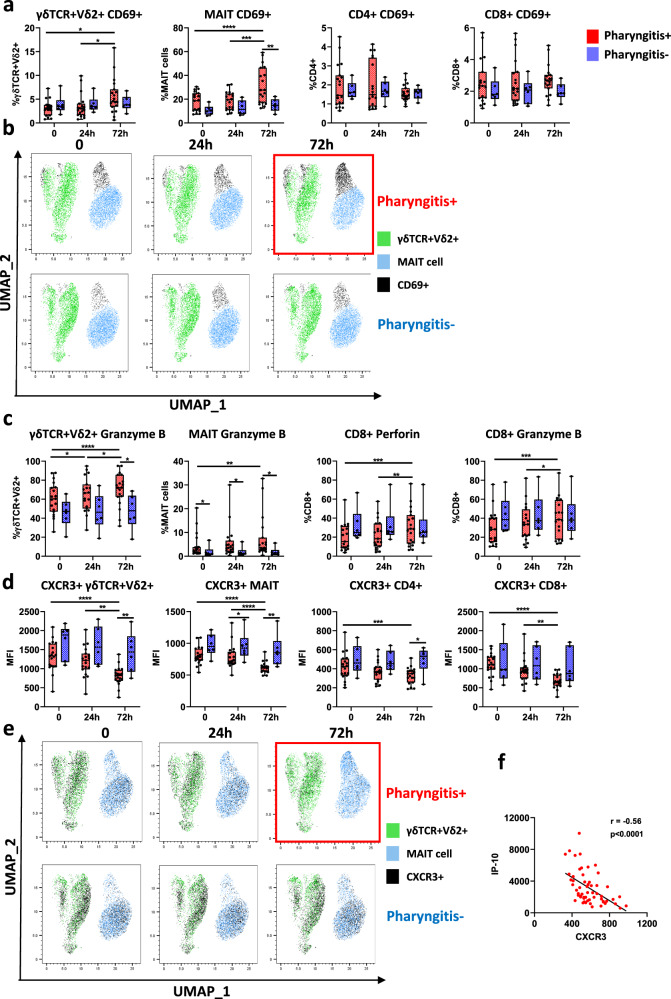
Fig. 4. Activation and migration of T cell subsets during acute pharyngitis.
a CD69+ activation on T cell subsets timepoint 0 h (pre-infection), 24 h post-infection (24 h) and 72 h post-infection (72 h) between pharyngitis positive (n = 19, red) and negative (n = 6, blue) participants. b Unsupervised UMAP analysis of CD69+ expression (black) on unconventional T cell subsets. c Differences in expression of cytotoxic markers (perforin and Granzyme-B) in γδTCR + Vδ2+ T cells, MAIT cells and CD8+ T cells. d Changes in T cell CXCR3+ median fluorescence intensity (MFI) over time. e Unsupervised UMAP analysis of CXCR3+ expression (black) on unconventional T cell subsets. f Spearman’s correlation between CXCR3 expression and IP-10 secretion. Data presented as boxplots show median ± IQR with min–max whiskers. A Friedman’s test was used to compare responses over time in P+ and P− groups, while a Mann–Whitney U-test was performed to compare differences between P+ and P− groups. All tests performed were two-tailed and a p-value <0.05 was considered significant; *p < 0.05, **p < 0.01, ***p < 0.001, ****p < 0.0001.

References

    1. Carapetis JR, Steer AC, Mulholland EK, Weber M. The global burden of group A streptococcal diseases. Lancet Infect. Dis. 2005;5:685–694. - PubMed
    1. Steer AC, Lamagni T, Curtis N, Carapetis JR. Invasive group a streptococcal disease: epidemiology, pathogenesis and management. Drugs. 2012;72:1213–1227. - PMC - PubMed
    1. Cannon JW, Bennett J, Baker MG, Carapetis JR. Time to address the neglected burden of group A Streptococcus. Med J. Aust. 2021;215:94–94.e91. - PubMed
    1. Bisno AL. Acute pharyngitis. N. Engl. J. Med. 2001;344:205–211. - PubMed
    1. Osowicki J, et al. WHO/IVI global stakeholder consultation on group A Streptococcus vaccine development: report from a meeting held on 12–13 December 2016. Vaccine. 2018;36:3397–3405. - PubMed

Publication types