


Cost Efficacy of Rapid Whole Genome Sequencing in the Pediatric Intensive Care Unit
- PMID: 35141181
- PMCID: PMC8818891
- DOI: 10.3389/fped.2021.809536
Cost Efficacy of Rapid Whole Genome Sequencing in the Pediatric Intensive Care Unit
Abstract
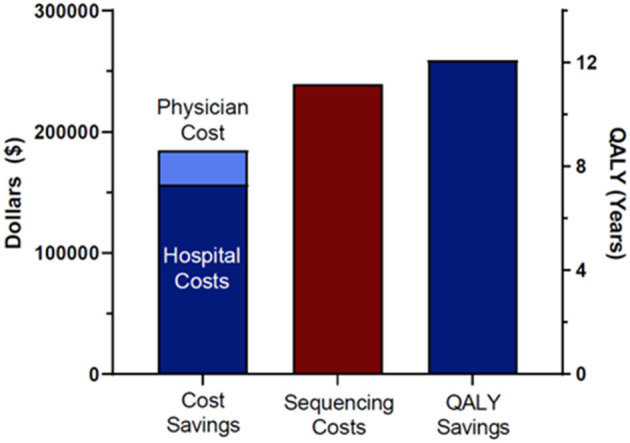
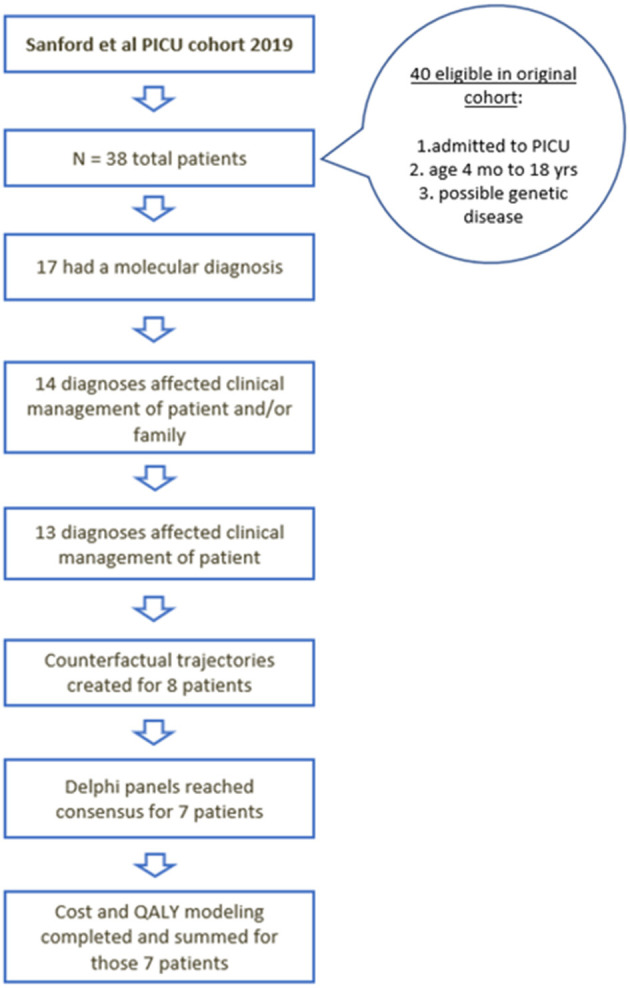
The diagnostic and clinical utility of rapid whole genome sequencing (rWGS) for critically ill children in the intensive care unit (ICU) has been substantiated by multiple studies, but comprehensive cost-effectiveness evaluation of rWGS in the ICU outside of the neonatal age group is lacking. In this study, we examined cost data retrospectively for a cohort of 38 children in a regional pediatric ICU (PICU) who received rWGS. We identified seven of 17 patients who received molecular diagnoses by rWGS and had resultant changes in clinical management with sufficient clarity to permit cost and quality adjusted life years (QALY) modeling. Cost of PICU care was estimated to be reduced by $184,846 and a total of 12.1 QALYs were gained among these seven patients. The total cost of rWGS for patients and families for the entire cohort (38 probands) was $239,400. Thus, the net cost of rWGS was $54,554, representing $4,509 per QALY gained. This quantitative, retrospective examination of healthcare utilization associated with rWGS-informed medicine interventions in the PICU revealed approximately one-third of a QALY gained per patient tested at a cost per QALY that was approximately one-tenth of that typically sought for cost-effective new medical interventions. This evidence suggests that performance of rWGS as a first-tier test in selected PICU children with diseases of unknown etiology is associated with acceptable cost-per-QALY gained.
Keywords: cost analysis; critical care; genomic sequencing; health economics; pediatric intensive care; quality adjusted life year (QALY); rapid whole genome sequencing.
Copyright © 2022 Sanford Kobayashi, Waldman, Engorn, Perofsky, Allred, Briggs, Gatcliffe, Ramchandar, Gold, Doshi, Ingulli, Thornburg, Benson, Farnaes, Chowdhury, Rego, Hobbs, Kingsmore, Dimmock and Coufal.
Conflict of interest statement
BW is a salaried employee for Invitae with stock holdings. EA work has been funded by NIH T32 DK 104717-5. BB disclosed that he is employed by the U.S. Navy. SR is an employee of Exact Sciences Inc. and owns stock in the company. DD reports previous consulting fees from Audentes, Biomarin, Ichorion, and Complete Genomics. DD reports having a patent, Methods and Apparatus of Identification of Disease Associated Mutations, US8718950B2, licensed to HudsonAlpha Institute for Biotechnology. The remaining authors declare that the research was conducted in the absence of any commercial or financial relationships that could be construed as a potential conflict of interest.
Figures
References
-
- Willig LK, Petrikin JE, Smith LD, Saunders CJ, Thiffault I, Miller NA, et al. . Whole-genome sequencing for identification of Mendelian disorders in critically ill infants: a retrospective analysis of diagnostic and clinical findings. Lancet Resp Med. (2015) 3:377–87. 10.1016/S2213-2600(15)00139-3 - DOI - PMC - PubMed
