


Prevalent, persistent, and impairing: Longitudinal course and impact of apathy in Alzheimer's disease
- PMID: 35141391
- PMCID: PMC8817116
- DOI: 10.1002/dad2.12169
Prevalent, persistent, and impairing: Longitudinal course and impact of apathy in Alzheimer's disease
Abstract
Introduction: Understanding of the natural history of apathy and its impact on patient function is limited. This study examines, in a large, national sample of Alzheimer's disease (AD) patients with long follow-ups: (1) prevalence, incidence, and persistence of apathy, and (2) impact of apathy on function across dementia severity.
Methods: A longitudinal study of 9823 well-characterized AD patients in the National Alzheimer's Coordinating Center Uniform Data Set.
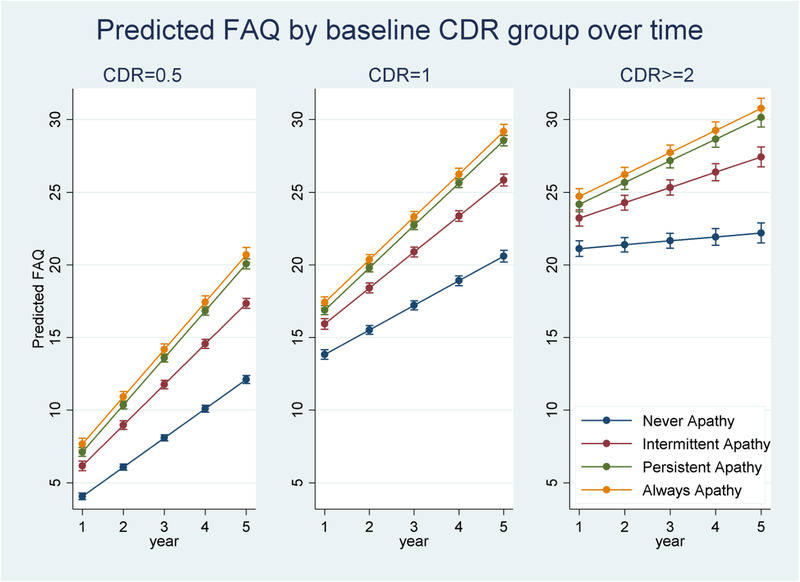
Results: Apathy was highly prevalent across disease severity with cumulative prevalence of 48%, 74%, and 82% in Clinical Dementia Rating (CDR) 0.5, 1.0, and 2.0, respectively. Persistence of apathy from clinician judgment varied from visit to visit at earlier disease stages but remained high at moderate dementia. Independent of cognition, persistent apathy was strongly associated with accelerated rate of functional decline.
Discussion: Findings point to important targets for the treatment and management of apathy, include functional outcomes, and study designs that account for variable persistence of the apathy syndrome.
Keywords: apathy; dementia; function; longitudinal studies; mild cognitive impairment.
© 2021 The Authors. Alzheimer's & Dementia: Diagnosis, Assessment & Disease Monitoring published by Wiley Periodicals, LLC on behalf of Alzheimer's Association.
Conflict of interest statement
The authors have no conflicts of interest to declare. The sponsor played no role in the design, methods, participant recruitment, data collections, analysis, and preparation of the article.
Figures
References
-
- Boyle PA, Malloy PF, Salloway S, Cahn‐Weiner DA, Cohen R, Cummings JL. Executive dysfunction and apathy predict functional impairment in Alzheimer disease. Am J Geriatr Psychiatry. 2003;11(2):214‐221. - PubMed
-
- Lam LC, Tam CW, Chiu HF, Lui VW. Depression and apathy affect functioning in community active subjects with questionable dementia and mild Alzheimer's disease. Int J Geriatr Psychiatry. 2007;22(5):431‐437. - PubMed
-
- Landes AM, Sperry SD, Strauss ME. Prevalence of apathy, dysphoria, and depression in relation to dementia severity in Alzheimer's disease. J Neuropsychiatry Clin Neurosci. 2005;17(3):342‐349. - PubMed
-
- Lechowski L, Benoit M, Chassagne P, et al. Persistent apathy in Alzheimer's disease as an independent factor of rapid functional decline: the REAL Longitudinal Cohort Study. Int J Geriatr Psychiatry. 2009;24(4):341‐346. - PubMed
-
- Onyike CU, Sheppard JM, Tschanz JT, et al. Epidemiology of apathy in older adults: the Cache County Study. Am J Geriatr Psychiatry. 2007;15(5):365‐375. - PubMed
Grants and funding
LinkOut - more resources
Full Text Sources