


Regulating Together: Emotion Dysregulation Group Treatment for ASD Youth and Their Caregivers
- PMID: 35141815
- PMCID: PMC10126211
- DOI: 10.1007/s10803-022-05461-x
Regulating Together: Emotion Dysregulation Group Treatment for ASD Youth and Their Caregivers
Abstract
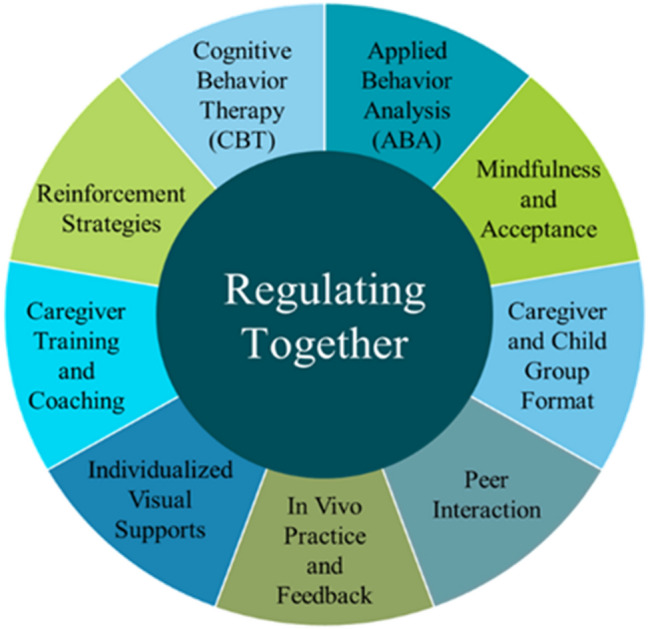
Individuals with autism spectrum disorder (ASD) experience behavioral and emotional symptoms hypothesized to arise from emotion dysregulation (ED), difficulty modulating emotional experience, expression, and intensity in an acceptable and contextually appropriate manner. We developed Regulating Together (RT)-an intensive-outpatient, caregiver-assisted group program to meet the ASD + ED intervention critical need. A within-subjects trial was conducted (5-week-control lead-in period, 5-week-treatment, and 5-and 10-weeks-post-treatment follow-ups). Forty-four youth with ASD + ED (25 8-12, 19 13-18 yr-olds, 88% male, mean FSIQ of 96) participated. Improvements were found in reactivity, emotion regulation knowledge, and flexibility post-treatment and 10-weeks post-treatment. A reduction in inpatient hospitalization rates by 16% from the 12 months pre-RT to 12 months post-RT was observed. RT shows promise to reduce ED in ASD.
Keywords: Autism; Autism spectrum disorder; Emotion dysregulation; Emotion regulation; Group therapy; Mindfulness; Reactivity.
© 2022. The Author(s), under exclusive licence to Springer Science+Business Media, LLC, part of Springer Nature.
Conflict of interest statement
Rebecca Shaffer and Lauren Schmitt are authors of the Regulating Together curriculum and receive compensation for Regulating Together training to clinicians. All other authors have no conflicts of interest related to this manuscript.
Figures


References
-
- Afshari A, Neshat-Doost HT, Maracy MR, Ahmady MK, Amiri S. The effective comparison between emotion-focused cognitive behavioral group therapy and cognitive behavioral group therapy in children with separation anxiety disorder. Journal of Research in Medical Sciences: THe Official Journal of Isfahan University of Medical Sciences. 2014;19(3):221–227. - PMC - PubMed
-
- Afshari, B., Omidi, A., & Ahmadvand, A. (2020). Effects of Dialectical Behavior Therapy on Executive Functions, Emotion Regulation, and Mindfulness in Bipolar Disorder. Journal of Contemporary Psychotherapy, 50.
-
- Aman, M., & Singh, N. N. (2017). Aberrant Behavior Scale- Second Edition. Slosson.
-
- Aman MG, McDougle CJ, Scahill L, Handen BL, Arnold LE, Johnson CR, Stigler KA, Bearss K, Butter E, Swiezy NA, Sukhodolsky DG, Ramada Y, Pozdol SL, Nikolov R, Lecavalier L, Kohn AE, Koenig K, Hollway JA, Korzekwa P, Gavaletz A, Mulick JA, Hall KL, Dziura J, Ritz L, Trollinger S, Yu S, Vitiello B, Wagner A, RUOPPA Network Medication and parent training in children with pervasive developmental disorders and serious behavior problems: Results from a randomized clinical trial. Journal of American Academy of Child and Adolescent Psychiatry. 2009;48(12):1143–1154. doi: 10.1097/CHI.0b013e3181bfd669. - DOI - PMC - PubMed
