


Neuropathological lesions and their contribution to dementia and cognitive impairment in a heterogeneous clinical population
- PMID: 35142102
- PMCID: PMC9360193
- DOI: 10.1002/alz.12516
Neuropathological lesions and their contribution to dementia and cognitive impairment in a heterogeneous clinical population
Abstract
Introduction: Alzheimer disease (AD) and related dementias are characterized by damage caused by neuropathological lesions in the brain. These include AD lesions (plaques and tangles) and non-AD lesions such as vascular injury or Lewy bodies. We report here an assessment of lesion association to dementia in a large clinic-based population.
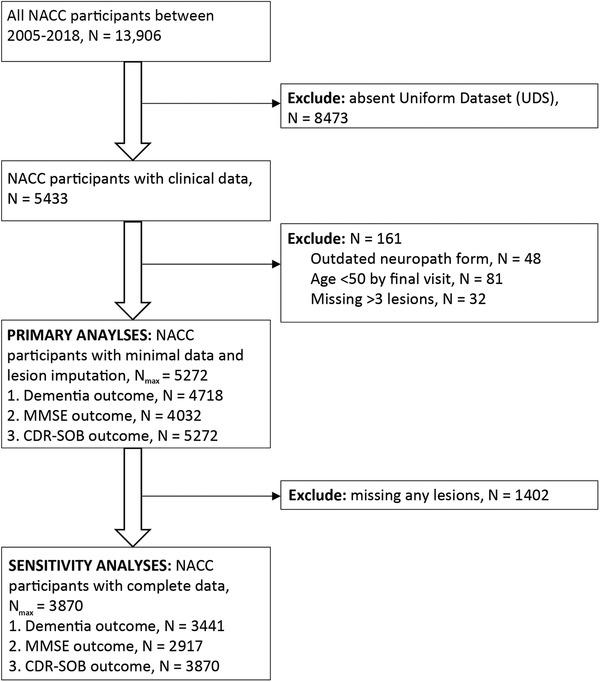
Methods: We identified 5272 individuals with neuropathological data from the National Alzheimer's Coordinating Center. Individual lesions, as well as a neuropathological composite score (NPCS) were tested for association with dementia, and both functional and neurocognitive impairment using regression models.
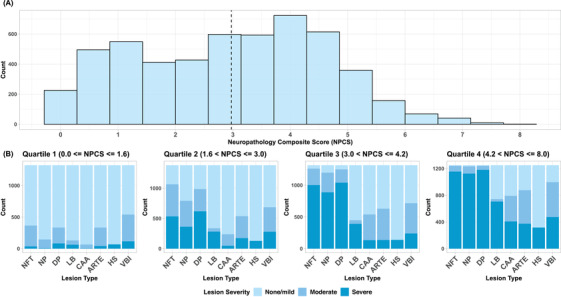
Results: Most individuals exhibited mixed pathologies, especially AD lesions in combination with non-AD lesions. All lesion types were associated with one or more clinical outcomes; most even while controlling for AD pathology. The NPCS was also associated with clinical outcomes.
Discussion: These data suggest mixed-type pathologies are extremely common in a clinic-based population and may contribute to dementia and cognitive impairment.
Keywords: Alzheimer disease; Lewy bodies; amyloid angiopathy; cognitive decline; dementia; hippocampal sclerosis; neuritic plaques; neurofibrillary; neuropathology; tangles; vascular dementia.
© 2021 The Authors. Alzheimer's & Dementia published by Wiley Periodicals LLC on behalf of Alzheimer's Association.
Conflict of interest statement
MC reports no conflicts of interest.
ERM, MAPV, and GWB report grant funding through the NIH.
GS reports grant funding through the NIH and an honorarium from the BrightFocus Foundation for grant review.
WKS reports grant funding through the NIH and an honorarium from the University of Chicago for speaking at a seminar.
WK reports grant funding through the NIH, honoraria for serving on external advisory committees (Boston U ADRC, USC ADRC, UCI ADR, Mt. Sinai ADRC), honoraria for grant review (NIH: NIA/CSR), and travel support from the Alzheimer Association for participation in a symposium.
TM reports grant funding through the NIH and Farmer Family Foundation, royalty payments from UpToDate, honoraria and travel support for invited lectures, and has patents pending on novel chemical matter for treatment or imaging of neurodegenerative diseases.
DG is an unpaid member of the American Society for Human Genetics career development committee.
Figures
References
-
- Fleming R, Zeisel J, Bennett K. 2020. World Alzheimer Report 2020: Design Dignity Dementia: Dementia‐related Design and the Built Environment. Vol 1. London, England: Alzheimer's Disease International; 2020.
-
- Wolf DS, Gearing M, Snowdon DA, Mori H, Markesbery WR, Mirra SS. Progression of regional neuropathology in Alzheimer disease and normal elderly: findings from the Nun Study. Alzheimer Dis Assoc Disord. 1999;13(4):226‐231. - PubMed
-
- Mirra SS, Hart MN, Terry RD. Making the diagnosis of Alzheimer's disease: a primer for practicing pathologists. Arch Pathol Lab Med. 1993;117:132‐144. - PubMed
Publication types
MeSH terms
Grants and funding
- P30 AG010133/AG/NIA NIH HHS/United States
- U01 AG032984/AG/NIA NIH HHS/United States
- P30 AG008017/AG/NIA NIH HHS/United States
- P30 AG010161/AG/NIA NIH HHS/United States
- P50 AG025688/AG/NIA NIH HHS/United States
- P30 AG062422-01/AG/NIA NIH HHS/United States
- P50 AG005138/AG/NIA NIH HHS/United States
- P30 AG062428-01/AG/NIA NIH HHS/United States
- P30 AG019610/AG/NIA NIH HHS/United States
- R01 AG062695/AG/NIA NIH HHS/United States
- P30 AG028383/AG/NIA NIH HHS/United States
- P30 AG062421-01/AG/NIA NIH HHS/United States
- P30 AG013854/AG/NIA NIH HHS/United States
- P30 AG053760/AG/NIA NIH HHS/United States
- P30 AG072975/AG/NIA NIH HHS/United States
- P30 AG062428/AG/NIA NIH HHS/United States
- P30 AG010124/AG/NIA NIH HHS/United States
- P50 AG023501/AG/NIA NIH HHS/United States
- P50 AG005142/AG/NIA NIH HHS/United States
- U01 AG079850/AG/NIA NIH HHS/United States
- P50 AG005146/AG/NIA NIH HHS/United States
- U24 AG072122/AG/NIA NIH HHS/United States
- P30 AG062421/AG/NIA NIH HHS/United States
- P30 AG035982/AG/NIA NIH HHS/United States
- P50 AG008702/AG/NIA NIH HHS/United States
- U01 AG016976/AG/NIA NIH HHS/United States
- P30 AG062715-01/AG/NIA NIH HHS/United States
- P30 AG008051/AG/NIA NIH HHS/United States
- P50 AG005681/AG/NIA NIH HHS/United States
- P30 AG013846/AG/NIA NIH HHS/United States
- P50 AG047270/AG/NIA NIH HHS/United States
- P30 AG062429/AG/NIA NIH HHS/United States
- P50 AG005136/AG/NIA NIH HHS/United States
- P30 AG049638/AG/NIA NIH HHS/United States
- P30 AG062422/AG/NIA NIH HHS/United States
- P50 AG016573/AG/NIA NIH HHS/United States
- P50 AG047266/AG/NIA NIH HHS/United States
- P30 AG062429-01/AG/NIA NIH HHS/United States
- R01 MH120794/MH/NIMH NIH HHS/United States
- P50 AG005133/AG/NIA NIH HHS/United States
- P30 AG066509/AG/NIA NIH HHS/United States
- P50 AG047366/AG/NIA NIH HHS/United States
- R01 AG062268/AG/NIA NIH HHS/United States
- P30 AG062715/AG/NIA NIH HHS/United States
- P30 AG072976/AG/NIA NIH HHS/United States
- P30 AG010129/AG/NIA NIH HHS/United States
LinkOut - more resources
Full Text Sources
Medical
