. 2022 May 1;128(9):1775-1786.
doi: 10.1002/cncr.34136. Epub 2022 Feb 10.

Cyclin-dependent kinase 5 promotes the growth of tongue squamous cell carcinoma through the microRNA 513c-5p/cell division cycle 25B pathway and is associated with a poor prognosis

Affiliations

Cyclin-dependent kinase 5 promotes the growth of tongue squamous cell carcinoma through the microRNA 513c-5p/cell division cycle 25B pathway and is associated with a poor prognosis

Yixuan Li et al. Cancer. .

Abstract

Background: The objective of this study was to investigate the role and molecular mechanism of cyclin-dependent kinase 5 (CDK5) in regulating the growth of tongue squamous cell carcinoma (TSCC).

Methods: The authors used multiple methods to detect the levels of CDK5 expression in samples of TSCC and to explore the relation between CDK5 expression and various clinicopathologic factors. In vivo and in vitro cell experiments were performed to detect the proliferation, invasion, and migration of TSCC cells with CDK5 knockdown or overexpression. These studies verified that CDK5 regulates the occurrence and development of TSCC cells through the microRNA 513c-5p/cell division cycle 25B pathway.

Results: An elevated level of CDK5 expression in TSCC tissues was identified as an independent risk factor affecting TSCC growth and patient prognosis. Patients who had TSCC with low levels of CDK5 expression had a higher survival rate than those with high levels. Knockdown of CDK5 reduced the proliferation, migration, and invasion of TSCC cells both in vitro and in vivo. In addition, the authors observed that CDK5 regulated the growth of TSCC through the microRNA 513c-5p/cell division cycle C25B pathway.

Conclusions: CDK5 functions as an oncogene in TSCC and might serve as a molecular marker for use in the diagnosis and treatment of TSCC.

Lay summary: Tongue squamous cell carcinoma (TSCC) is 1 of the most common malignant tumors of the head and neck, and the survival rate of patients with tongue cancer has been very low. Therefore, it is important to study the molecular mechanism of TSCC progression to identify biomarkers that can be used to improve its clinical diagnosis and treatment. Cyclin-dependent kinase 5 (CDK5) is an atypical member of the cyclin-dependent kinase family and is involved in regulating the cell cycle. Changes in the cell cycle are of great significance for the occurrence and development of tumor cells; and, in recent years, increasing evidence has suggested that CDK5 exists in a disordered state in cancer cells. In this study, the authors demonstrate that CDK5 functions as an oncogene in TSCC and might serve as a molecular marker for use in the diagnosis and treatment of TSCC.

Keywords: cell division cycle 25 B (CDC25B); cyclin-dependent kinase 5 (CDK5); microRNA 513c-5p (miR513c-5p); tongue cancer.


Conflict of interest statement

The authors made no disclosures.

Figures
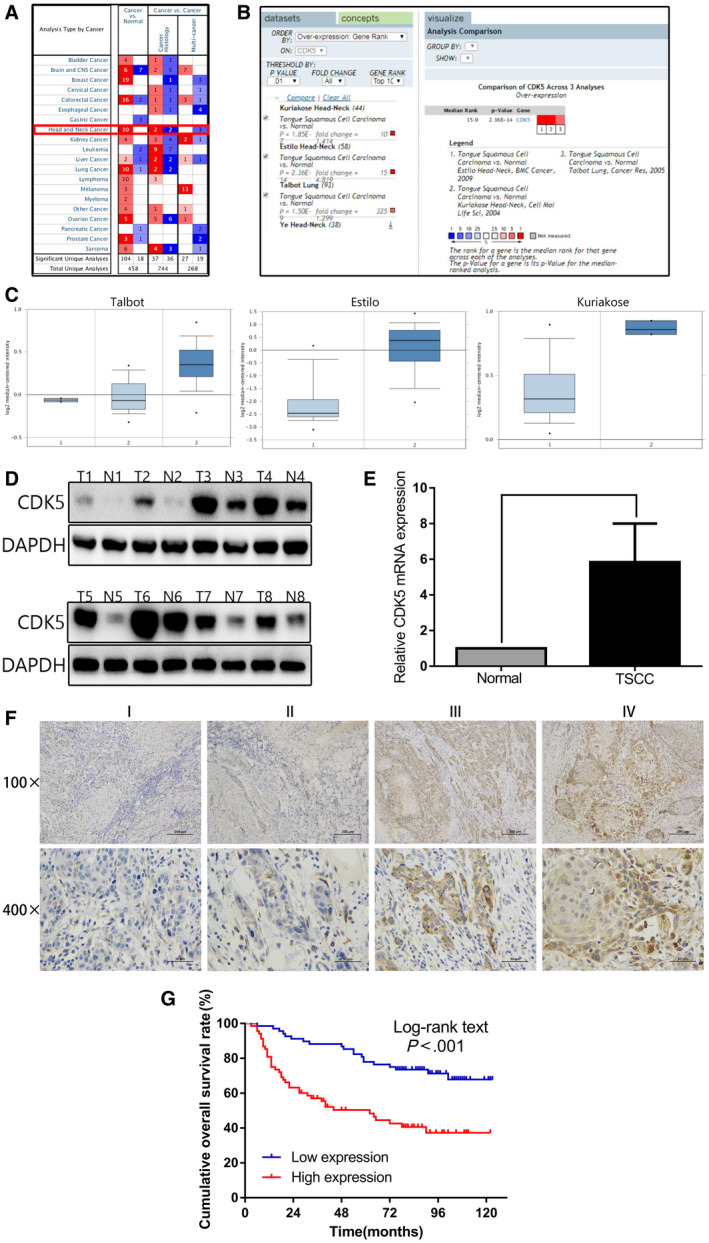
Figure 1
Figure 1
Cyclin‐dependent kinase 5 (CDK5) is overexpressed in tongue squamous cell carcinoma (TSCC) tissue and is associated with a poor prognosis. (A‐C) The levels of CDK5 in TSCC and adjacent normal tissue (ANT) were determined using the iOncomine database. CNS indicates central nervous system. (D) CDK5 protein expression in TSCC tissue and ANT was determined by Western blot analysis. Glyceraldehyde 3‐phosphate dehydrogenase (GAPDH) served as a reference standard. (E) Polymerase chain reaction detection of CDK5 messenger RNA levels in 8 pairs of TSCC tissue and ANT is shown. (F) Representative images illustrate immunohistochemical results for 136 TSCC samples. (G) Kaplan‐Meier analysis of overall survival is illustrated in 136 patients with TSCC stratified according to CDK5 expression.
Figure 2
Figure 2
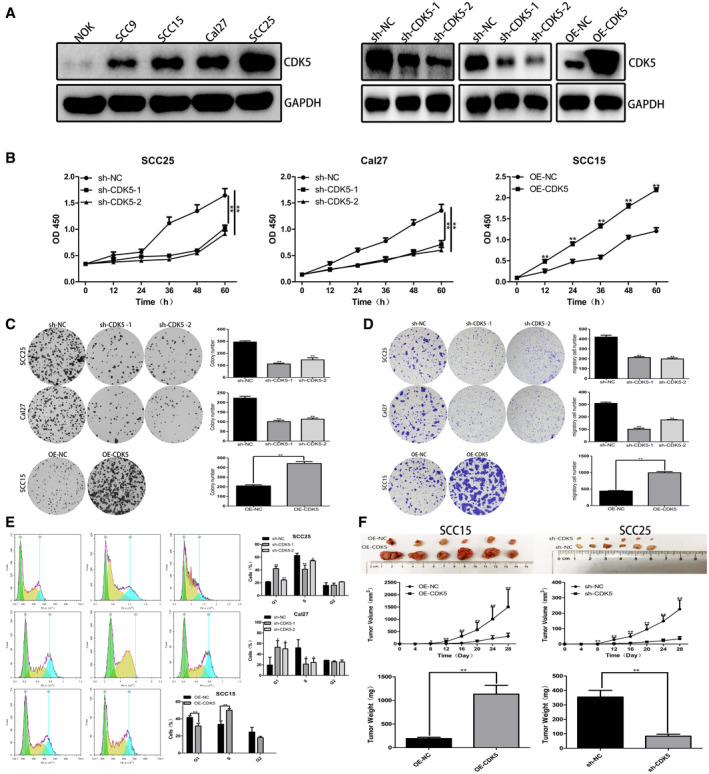
Cyclin‐dependent kinase 5 (CDK5) promotes tongue squamous cell carcinoma (TSCC) cell proliferation. (A) Right: Western blot analysis was used to detect CDK5 expression in TSCC cell lines and in a normal oral epithelial cell line. Glyceraldehyde 3‐phosphate dehydrogenase (GAPDH) served as a control. Left: Western blot analysis revealed that CDK5 protein expression was downregulated in SCC25 and Cal27 cells and upregulated in SCC15 cells. GAPDH served as a control. sh‐NC indicates short hairpin negative control. (B) Cholecystokinin‐8 (CCK8) assays performed to detect TSCC cell proliferation revealed the absorbance at different time points at 450 nm (optical density [OD] 450). (C) Cell cloning experiments demonstrated that CDK5 overexpression promoted clone formation. (D) Cell migration experiments demonstrated that CDK5 overexpression promoted cell migration. (E) Flow cytometry analyses of the cell cycles of overexpressing CDK5 (OE‐CDK5)–treated and sh‐CDK5–treated cells and their respective negative control cells are illustrated. PE‐A indicates phycoerythrin assay; PI‐A, propidium iodide assay. (F) Xenograft tumors in nude mice after 28 days are shown. The mean volume and weight of xenograft tumors formed by OE‐CDK5 and sh‐CDK5 cells and their respective negative control cells are indicated. All data are expressed as mean ± standard deviation values. A single asterisk indicates P < .05; double asterisks, P < .01.
Figure 3
Figure 3
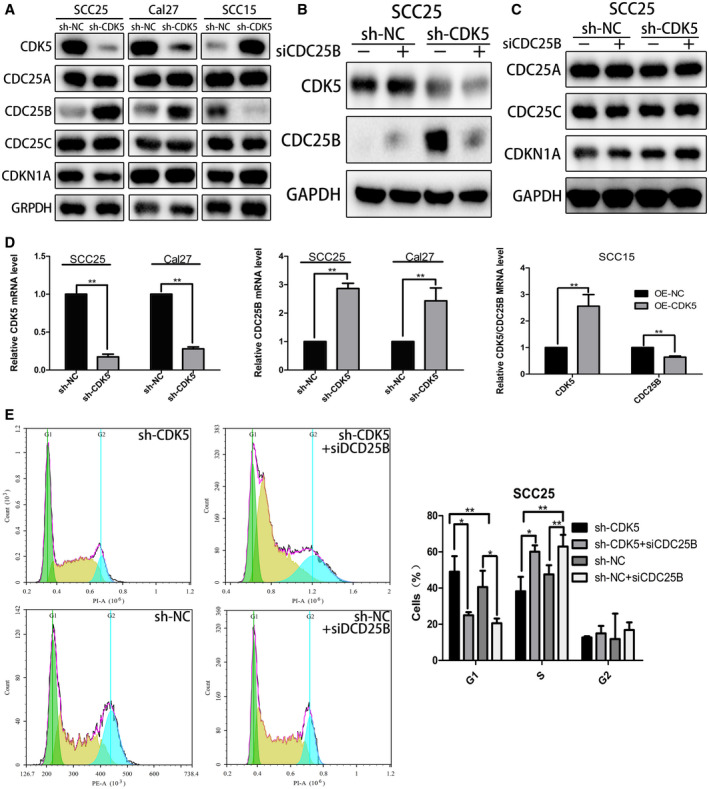
Cell division cycle 25B (CDC25B) is a downstream gene affected by cyclin‐dependent kinase 5 (CDK5). (A) Western blot analysis of key genes related to the cell cycle is illustrated. Glyceraldehyde 3‐phosphate dehydrogenase (GAPDH) served as a control. sh‐NC indicates short hairpin negative control. (B) Western blot analysis was used to detect CDK5 and CDC25B protein expression in SCC25‐shCDK5 cells after knock‐down of CDC25B. GAPDH served as a control. si‐CDC25B indicates small interfering CDC25B; TSCC, tongue squamous cell carcinoma. (C) Western blot analysis was used to detect the expression of proteins related to the cell cycle in SCC25‐shCDK5 cells. GAPDH served as a control. Mut indicates mutant; WT, wild type. (D) Polymerase chain reaction analysis of CDK5 and CDC25B messenger RNA expression is illustrated in overexpressing CDK5 (OE‐CDK5) and sh‐CDK5 cells and their respective negative control cells. (E) After transfection with si‐CDC25B or negative control (si‐NC), the cell cycle of SCC25‐shCDK5 cells was analyzed by flow cytometry. PE‐A indicates phycoerythrin assay; PI‐A, propidium iodide assay. All data points represent mean ± standard deviation values. A single asterisk indicates P < .05; double asterisks, P < .01.
Figure 4
Figure 4
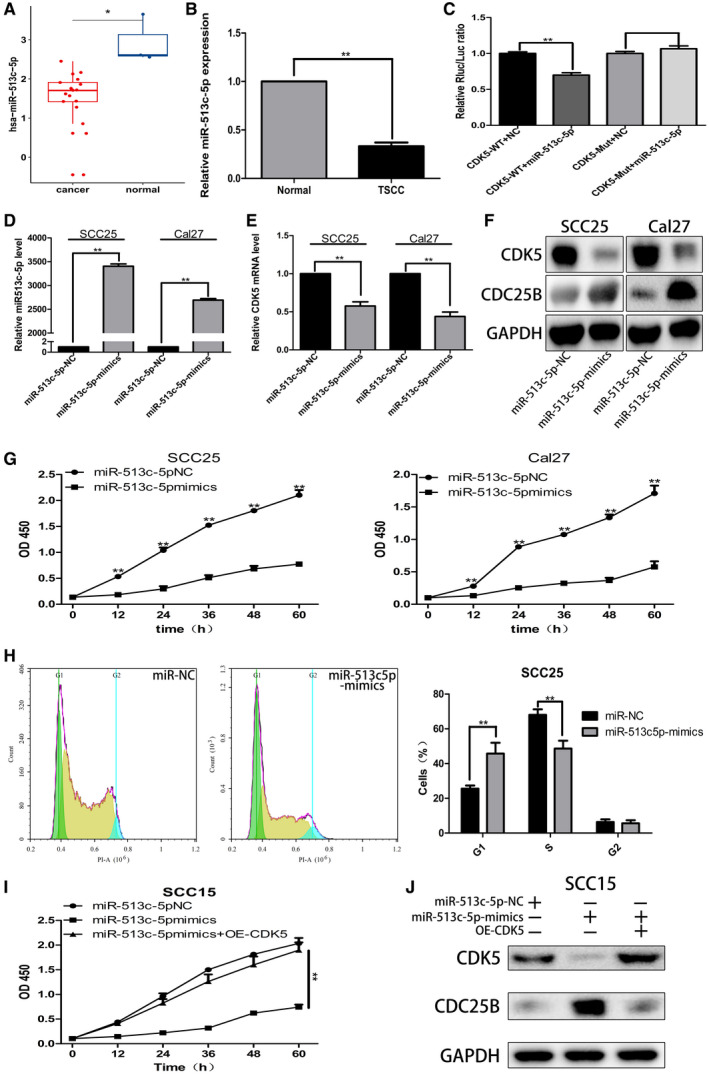
Cyclin‐dependent kinase 5 (CDK5) was identified as the downstream target gene of microRNA 513c‐5p (miR‐513c‐5p). (A) A bioinformatics query of miR513c‐5p expression in tongue squamous cell carcinoma (TSCC) tissues is illustrated. (B) Polymerase chain reaction (PCR) analysis was used to verify the expression of miR513c‐5p in TSCC tissues. (C) Results of a dual luciferase (Luc) reporter experiment are illustrated. Mut indicates mutation; NC, negative control; Rluc, Renilla luciferin; WT, wild type. (D,E) PCR was used to detect miR513c‐5p and CDK5 expression in TSCC cells transfected with miR513c‐5p mimics. (F) Western blot analysis was used to detect CDK5 and cell division cycle 25B (CDC25B) protein expression in TSCC cells transfected with miR513c‐5p mimics. (G) Cholecystokinin‐8 (CCK8) assays were performed to detect the effect of miR513c‐5p on the growth of TSCC cells. OD 450 indicates an optical density of 450 nm. (H) Flow cytometry was used to detect the effect of miR513c‐5p on the cell cycle of SCC25 cells. PI‐A indicates propidium iodide assay. (I) The miR513c‐5p mimics and a CDK5 overexpression lentivirus were simultaneously transfected into SCC15 cells that were used for CCK8 assays. (J) Western blot analysis was performed to detect the levels of CDK5 and CDC25B proteins in SCC15 cells that had been transfected with miR513c‐5p mimics and the CDK5 overexpression lentivirus separately or at the same time. All data points represent mean ± standard deviation values. A single asterisk indicates P < .05; double asterisks, P < .01.

References

    1. Tang M, Dai W, Wu H, et al. Transcriptome analysis of tongue cancer based on high‐throughput sequencing. Oncol Rep. 2020;43:2004‐2016. - PMC - PubMed
    1. Shetty SS, Kudpaje A, Jayaraj R, Rao V, Shah PK. Tongue cancer: a discrete oral cavity subsite. Oral Oncol. 2019;99:104348. - PubMed
    1. Ansarin M, Bruschini R, Navach V, et al. Classification of GLOSSECTOMIES: proposal for tongue cancer resections. Head Neck. 2019;41:821‐827. - PMC - PubMed
    1. Do PA, Lee CH. The role of CDK5 in tumours and tumour microenvironments. Cancers (Basel). 2020;13:101. - PMC - PubMed
    1. Sang Y, Li Y, Zhang Y, et al. CDK5‐dependent phosphorylation and nuclear translocation of TRIM59 promotes macroH2A1 ubiquitination and tumorigenicity. Nat Commun. 2019;10:4013. - PMC - PubMed

Publication types

MeSH terms