. 2022 Apr 1;132(7):e152069.
doi: 10.1172/JCI152069.

Direct cellular reprogramming enables development of viral T antigen-driven Merkel cell carcinoma in mice

Affiliations

Direct cellular reprogramming enables development of viral T antigen-driven Merkel cell carcinoma in mice

Monique E Verhaegen et al. J Clin Invest. .

Abstract

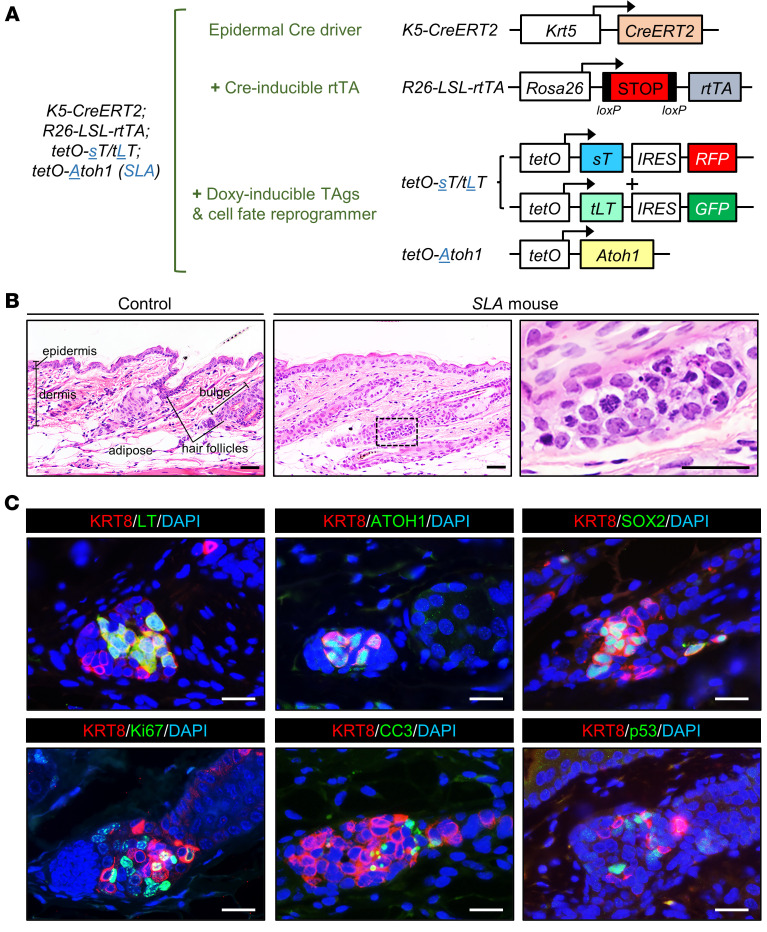
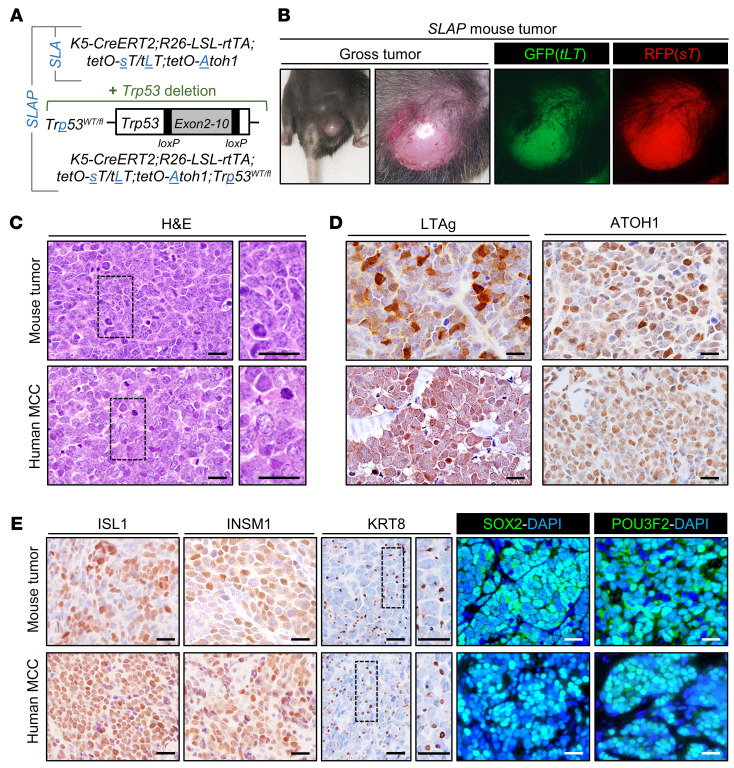
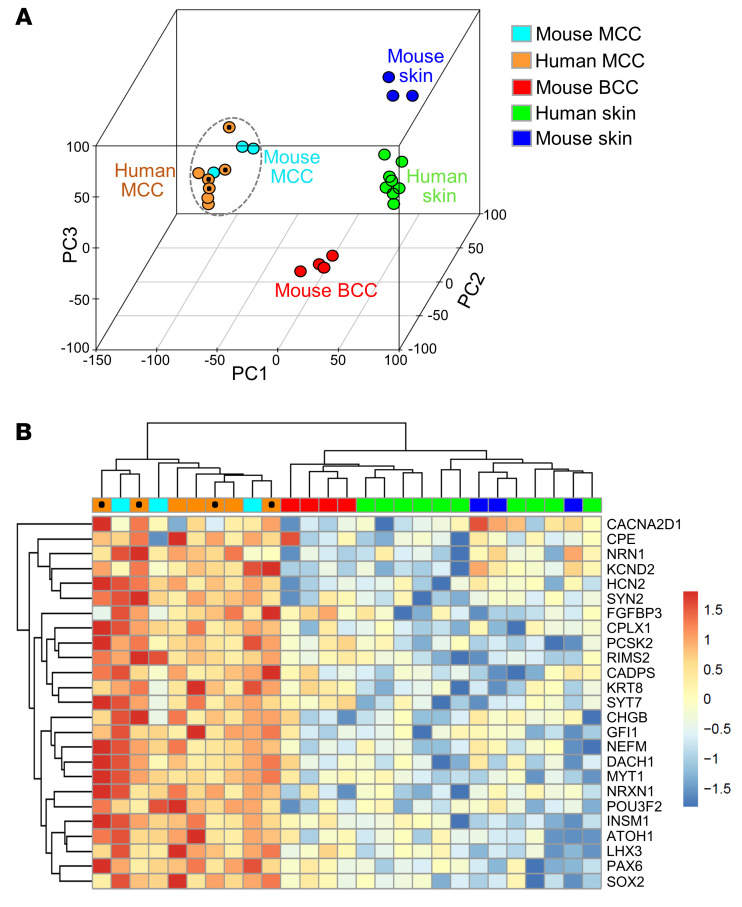
Merkel cell carcinoma (MCC) is an aggressive neuroendocrine skin cancer that frequently carries an integrated Merkel cell polyomavirus (MCPyV) genome and expresses viral transforming antigens (TAgs). MCC tumor cells also express signature genes detected in skin-resident, postmitotic Merkel cells, including atonal bHLH transcription factor 1 (ATOH1), which is required for Merkel cell development from epidermal progenitors. We now report the use of in vivo cellular reprogramming, using ATOH1, to drive MCC development from murine epidermis. We generated mice that conditionally expressed MCPyV TAgs and ATOH1 in epidermal cells, yielding microscopic collections of proliferating MCC-like cells arising from hair follicles. Immunostaining of these nascent tumors revealed p53 accumulation and apoptosis, and targeted deletion of transformation related protein 53 (Trp53) led to development of gross skin tumors with classic MCC histology and marker expression. Global transcriptome analysis confirmed the close similarity of mouse and human MCCs, and hierarchical clustering showed conserved upregulation of signature genes. Our data establish that expression of MCPyV TAgs in ATOH1-reprogrammed epidermal cells and their neuroendocrine progeny initiates hair follicle-derived MCC tumorigenesis in adult mice. Moreover, progression to full-blown MCC in this model requires loss of p53, mimicking the functional inhibition of p53 reported in human MCPyV-positive MCCs.

Keywords: Dermatology; Mouse models; Oncogenes; Oncology; Skin cancer.


Conflict of interest statement

Conflict of interest: The authors have declared that no conflict of interests exist.

Figures

Figure 1
Figure 1. In vivo reprogramming using ATOH1 enables initiation of murine MCC development in mice.
(A) Combination of mouse strains used to generate SLA mice, expressing MCPyV sTAg, tLTAg, and ATOH1, in Krt5-expressing cells and their progeny. (B) Nascent tumors arising from hair follicle epithelium in SLA mice. Scale bars: 50 μm. (C) Immunostaining for the indicated markers. Scale bars: 25 μm.
Figure 2
Figure 2. In vivo reprogramming using ATOH1 in p53-deficient cells enables development of full-blown murine MCC.
(A) Addition of conditional Trp53 allele to generate SLAP mice expressing MCPyV sTAg, tLTAg, and ATOH1, which are also deficient in p53, in Krt5-expressing cells and their progeny. (B) Gross tumor arising in SLAP mouse 4 months after transgene induction. (C) Similar histopathology of SLAP mouse tumor and human MCC. Immunostaining for (D) transgene expression and (E) MCC marker expression. Scale bars: 25 μm.
Figure 3
Figure 3. Cross-species transcriptome analysis of MCC.
(A) Principal component analysis plot of global transcriptomes showing similarity of mouse (n = 3) and human (n = 7) MCCs, with a well-defined separation from normal mouse (n = 3) and human (n = 10) skin as well as mouse BCCs (n = 4). (B) Hierarchical clustering of transcripts enriched in normal mouse Merkel cells shows similar expression patterns in mouse and human MCCs. Data from MCPyV-positive human MCCs are marked with black circles.

References

    1. Harms KL, et al. Analysis of prognostic factors from 9387 merkel cell carcinoma cases forms the basis for the New 8th Edition AJCC staging system. Ann Surg Oncol. 2016;23(11):3564–3571. doi: 10.1245/s10434-016-5266-4. - DOI - PMC - PubMed
    1. Colunga A, et al. Merkel cell carcinoma in the age of immunotherapy: facts and hopes. Clin Cancer Res. 2018;24(9):2035–2043. doi: 10.1158/1078-0432.CCR-17-0439. - DOI - PMC - PubMed
    1. Feng H, et al. Clonal integration of a polyomavirus in human Merkel cell carcinoma. Science. 2008;319(5866):1096–1100. doi: 10.1126/science.1152586. - DOI - PMC - PubMed
    1. Harms PW, et al. The biology and treatment of Merkel cell carcinoma: current understanding and research priorities. Nat Rev Clin Oncol. 2018;15(12):763–776. doi: 10.1038/s41571-018-0103-2. - DOI - PMC - PubMed
    1. Becker JC, et al. Merkel cell carcinoma. Nat Rev Dis Primers. 2017;3:17077. doi: 10.1038/nrdp.2017.77. - DOI - PMC - PubMed

Publication types

MeSH terms