. 2022 Feb 10;12(1):2281.
doi: 10.1038/s41598-022-05697-8.

Raster plots machine learning to predict the seizure liability of drugs and to identify drugs

Affiliations

Raster plots machine learning to predict the seizure liability of drugs and to identify drugs

N Matsuda et al. Sci Rep. .

Abstract

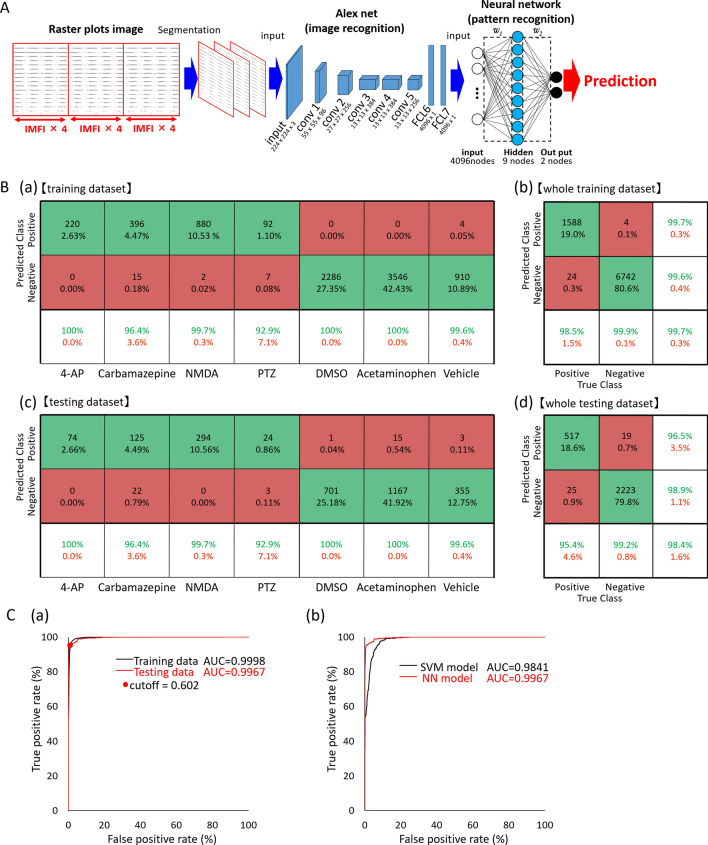
In vitro microelectrode array (MEA) assessment using human induced pluripotent stem cell (iPSC)-derived neurons holds promise as a method of seizure and toxicity evaluation. However, there are still issues surrounding the analysis methods used to predict seizure and toxicity liability as well as drug mechanisms of action. In the present study, we developed an artificial intelligence (AI) capable of predicting the seizure liability of drugs and identifying drugs using deep learning based on raster plots of neural network activity. The seizure liability prediction AI had a prediction accuracy of 98.4% for the drugs used to train it, classifying them correctly based on their responses as either seizure-causing compounds or seizure-free compounds. The AI also made concentration-dependent judgments of the seizure liability of drugs that it was not trained on. In addition, the drug identification AI implemented using the leave-one-sample-out scheme could distinguish among 13 seizure-causing compounds as well as seizure-free compound responses, with a mean accuracy of 99.9 ± 0.1% for all drugs. These AI prediction models are able to identify seizure liability concentration-dependence, rank the level of seizure liability based on the seizure liability probability, and identify the mechanism of the action of compounds. This holds promise for the future of in vitro MEA assessment as a powerful, high-accuracy new seizure liability prediction method.


Conflict of interest statement

The authors declare no competing interests.

Figures

Figure 1
Figure 1
MEA data from a cultured human iPSC-derived neural network. (A) (a) Phase-contrast image of neurons on an MEA chip at 81 days in vitro (DIV). (b) Typical action potential waveform in a spontaneous recording. (c) Upper graph shows the action potential waveform acquired with a single electrode and the voltage threshold for spike detection (red line). Raster plots of detected spikes (black circles) are shown under the graph. (B) Concentration-dependent Raster plot images of typical mechanisms of action (a) 4-AP, (b) carbamazepine, (c) NMDA, (d) PTZ, (e) acetaminophen, (f) DMSO. (C) Schematic diagram of analysis parameters.
Figure 2
Figure 2
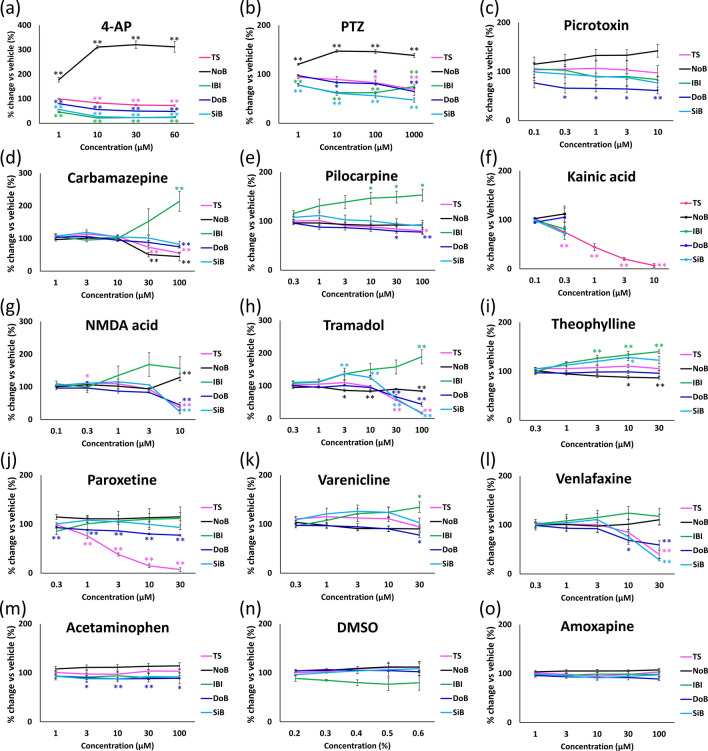
Concentration-dependent changes of 15 compounds in five parameters: TS (pink), NoB (black), IBI (green), DoB (blue), SiB (cyan). Parameters were depicted as the average % change of control (vehicle control set to 100%) ± SEM from n = 3–4 wells. Data were analyzed using one-way ANOVA followed by post hoc Dunnett's test (*p < 0.05, **p < 0.01 vs. vehicle).
Figure 3
Figure 3
Creation of seizure risk prediction AI using raster plot images and evaluation of the prediction model. (A) Data flow and architecture of seizure risk prediction model. w1 is the weight between the input layer and the hidden layer, w2 is the weight between the hidden layer and the output layer. (B) (a) Confusion matrix for each compound used for training, (b) confusion matrix for the entire training dataset, (c) confusion matrix for each compound used for the test, (d) confusion matrix for the entire test dataset. The test dataset used the data of the wells not used for training dataset. Vehicle in the confusion matrix indicates vehicle data in four seizure-causing compounds. (C) (a) Receiver operating characteristic (ROC) curve after classification of training and testing data in a neural network model (black line: training data; red line: testing data; red dot: optimum operating point). (b) Comparison of ROC curves after classification of the same testing data in NN and SVM models (black line: SVM model; red line: NN model).
Figure 4
Figure 4
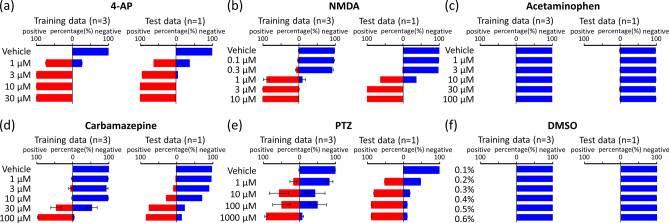
Concentration-dependent prediction of seizure risk in learning drugs by AI. AI predicted the negative probabilities (blue bar) and seizure risk (red bar) at each concentration of training data (left) and test data (right). (a) 4-AP, (b) NMDA, (c) acetaminophen, (d) carbamazepine, (e) PTZ, (f) DMSO.
Figure 5
Figure 5
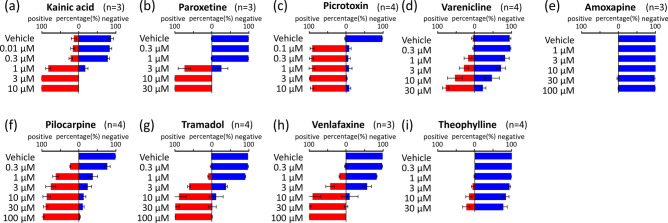
Concentration-dependent prediction of seizure risk in non-training drugs by AI. AI predicted the negative probabilities (blue bar) and seizure risk (red bar) at each concentration. (a) Kainic acid, (b) paroxetine, (c) picrotoxin, (d) varenicline, (e) amoxapine, (f) pilocarpine, (g) tramadol, (h) venlafaxine, (i) theophylline.
Figure 6
Figure 6
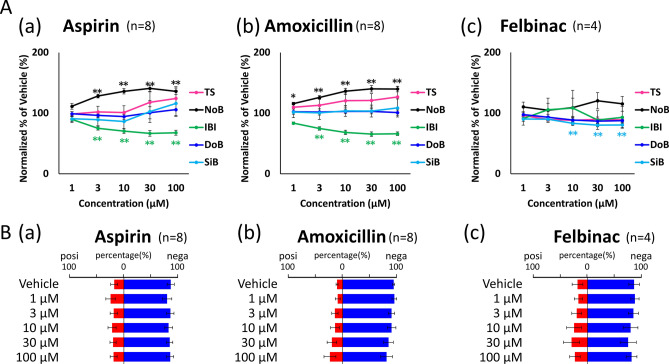
Prediction of seizure risk in non-training negative compounds by AI. (A) Concentration-dependent changes of 3 negative compounds in five parameters: TS (pink), NoB (black), IBI (green), DoB (blue), SiB (cyan). (a) Aspirin, (b) amoxicillin, (c) felbinac, (B) AI predicted the negative probabilities (blue bar) and seizure risk (red bar) at each concentration.
Figure 7
Figure 7
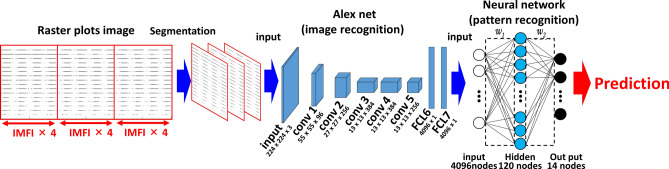
Creation of drug name prediction AI using raster plot images. Data flow and architecture of drug name prediction model. w1 is the weight between the input layer and the hidden layer; w2 is the weight between the hidden layer and the output layer.

References

    1. Harrison RK. Phase II and phase III failures: 2013–2015. Nat. Rev. Drug Discov. 2016;15:817. doi: 10.1038/nrd.2016.184. - DOI - PubMed
    1. Cook D, et al. Lessons learned from the fate of AstraZeneca's drug pipeline: a five-dimensional framework. Nat. Rev. Drug Discov. 2014;13:419–431. doi: 10.1038/nrd4309. - DOI - PubMed
    1. Watkins P. Drug safety sciences and the bottleneck in drug development. Clin. Pharmacol. Ther. 2011;89:788–790. doi: 10.1038/clpt.2011.63. - DOI - PubMed
    1. Authier S, et al. Safety pharmacology investigations on the nervous system: An industry survey. J. Pharmacol. Toxicol. Methods. 2016;81:37–46. doi: 10.1016/j.vascn.2016.06.001. - DOI - PubMed
    1. Grainger AI, et al. In vitro models for seizure-liability testing using induced pluripotent stem cells. Front. Neurosci. 2018;12:590. doi: 10.3389/fnins.2018.00590. - DOI - PMC - PubMed

Publication types

Substances