


Prevalence and predictors of adequate treatment of overt hypothyroidism - a population-based study
- PMID: 35145368
- PMCID: PMC8822305
- DOI: 10.17179/excli2021-4291
Prevalence and predictors of adequate treatment of overt hypothyroidism - a population-based study
Abstract
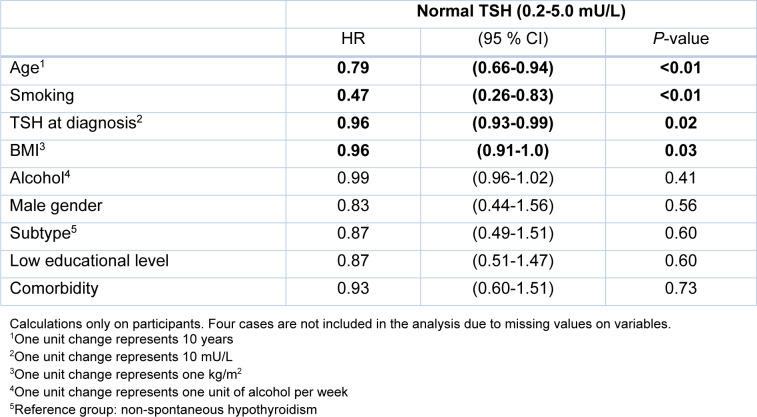
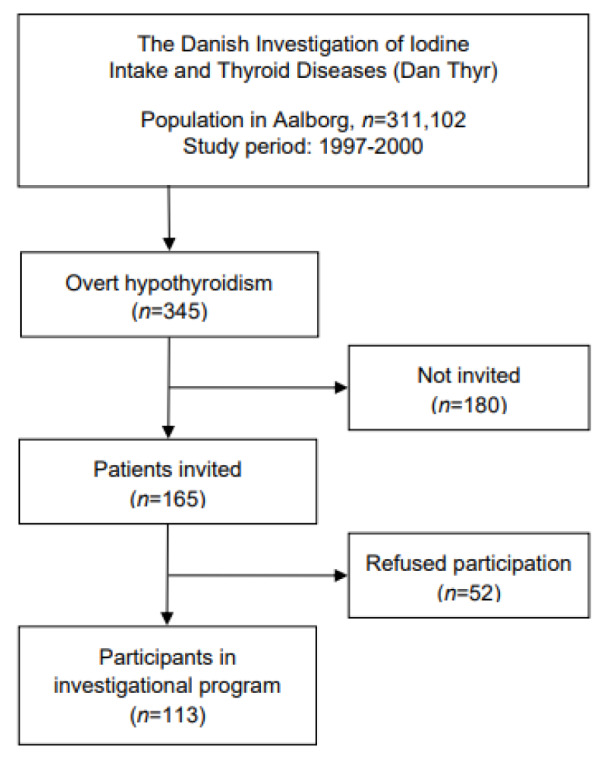
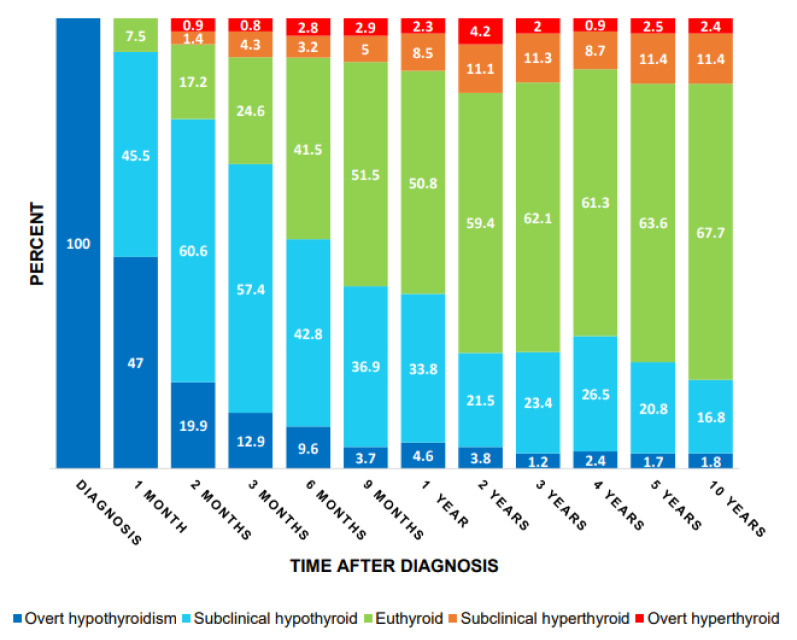
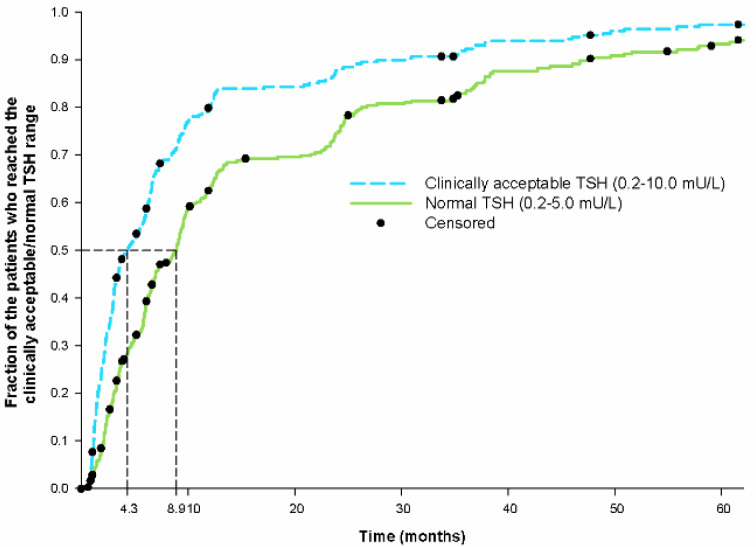
The aim of this study is to evaluate the adequacy of treatment, and to identify factors influencing treatment of hypothyroidism. Patients newly diagnosed with overt hypothyroidism (n=345) were identified via a register linked to a laboratory database. In selected periods with staff available, 165 patients were invited, and 113 (68.5 %) accepted participating in a comprehensive program including blood tests and completion of questionnaires. We performed a longitudinal follow-up on thyroid function tests 10 years after the diagnosis. Time to reach a serum TSH level of 0.2-10 mU/L (termed as clinically acceptable) and biochemical normalization (TSH: 0.2-5.0 mU/L), respectively, were analyzed using Kaplan Meier survival analysis. Predictors for longer duration to reach the normal TSH range were identified using cox proportional hazards regression. Only 67.7 % of the patients were in the euthyroid range on the long term after diagnosis of overt hypothyroidism (2 years: 59.4 %; 10 years: 67.7 %). Median time to the first normal TSH was 8.9 months (95 % CI: 7.6-10.2 months). The factors associated with longer duration until normalization of TSH after multivariate analysis were age (HR 0.79 per 10 years; 95 % CI: 0.66-0.94; P = <0.01), smoking (HR 0.47; 95 % CI: 0.26-0.83; P = <0.01), serum TSH at diagnosis (HR 0.96 per 10 mU/L; 95 % CI: 0.93-0.99; P = 0.02) and BMI (HR 0.96 per kg/m2; 95 % CI: 0.91-0.99; P = 0.03). A considerable number of hypothyroid patients remained inadequately treated. When treating hypothyroid patients, special attention should be addressed to those patients who never or lately obtain euthyroid status.
Keywords: hypothyroidism; overt hypothyroidism; population-based study; treatment.
Copyright © 2022 Lindgård Nielsen et al.
Figures
References
-
- Canaris GJ, Manowitz NR, Mayor G, Ridgway EC. The colorado thyroid disease prevalence study. Arch Intern Med. 2000;160:526–34. - PubMed
-
- Carlé A, Bülow Pedersen I, Knudsen N, Perrild H, Ovesen L, Laurberg P. Gender differences in symptoms of hypothyroidism: A population-based DanThyr study. Clin Endocrinol (Oxf) 2015;83:717–25. - PubMed
-
- Carlé A, Laurberg P, Knudsen N, Perrild H, Ovesen L, Rasmussen LB, et al. Thyroid peroxidase and thyroglobulin auto-antibodies in patients with newly diagnosed overt hypothyroidism. Autoimmunity. 2006;39:497–503. - PubMed
-
- Carlé A, Laurberg P, Pedersen IB, Knudsen N, Perrild H, Ovesen L, et al. Epidemiology of subtypes of hypothyroidism in Denmark. Eur J Endocrinol. 2006;154:21–8. - PubMed
-
- Carlé A, Laurberg P, Pedersen IB, Knudsen N, Perrild H, Ovesen L, et al. Mainly the younger hypothyroid patients are referred to hospital - Evidence for referral bias. J Clin Epidemiol. 2009;62:446–51. - PubMed
LinkOut - more resources
Full Text Sources
Research Materials