


Intestinal Barrier Function and Immune Homeostasis Are Missing Links in Obesity and Type 2 Diabetes Development
- PMID: 35145486
- PMCID: PMC8821109
- DOI: 10.3389/fendo.2021.833544
Intestinal Barrier Function and Immune Homeostasis Are Missing Links in Obesity and Type 2 Diabetes Development
Abstract
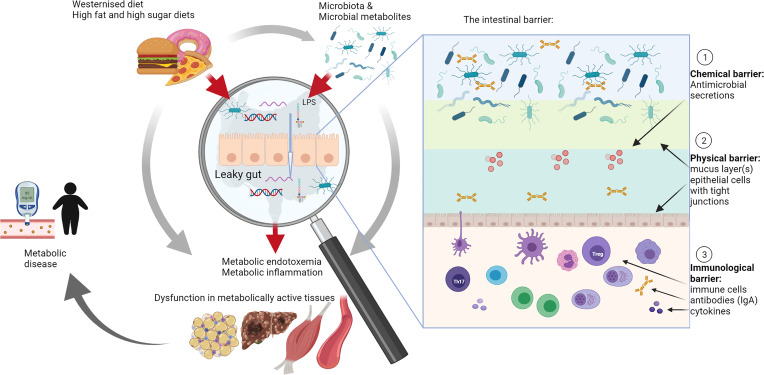
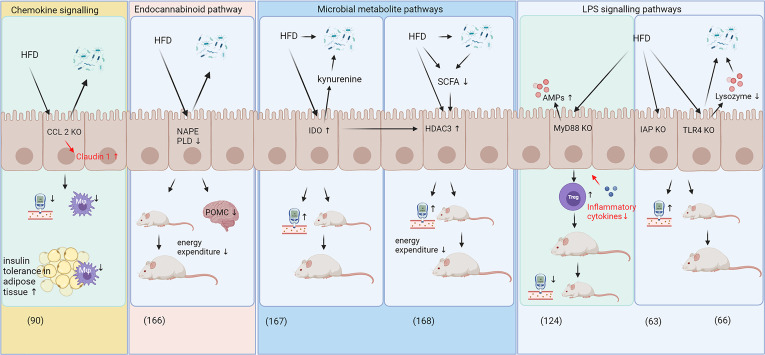
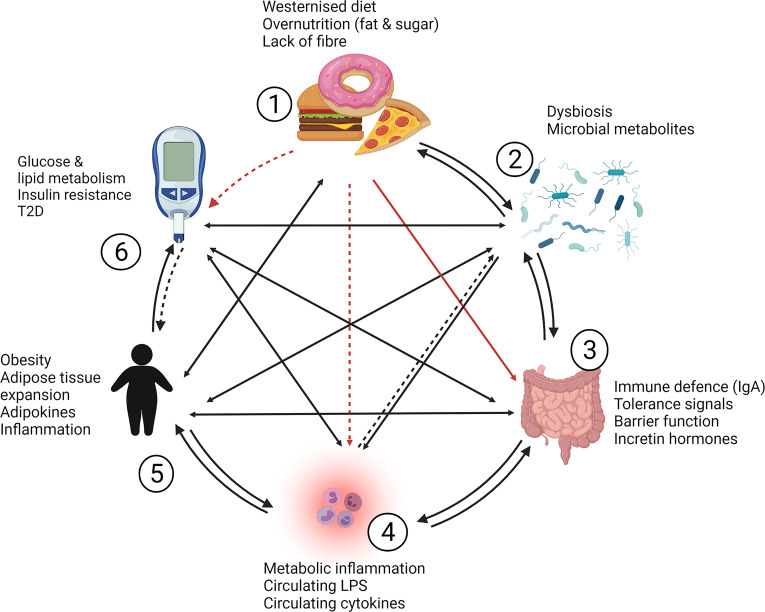
Noncommunicable diseases, such as type 2 diabetes (T2D), place a burden on healthcare systems worldwide. The rising prevalence of obesity, a major risk factor for T2D, is mainly attributed to the adoption of Westernized diets and lifestyle, which cause metabolic dysfunction and insulin resistance. Moreover, diet may also induce changes in the microbiota composition, thereby affecting intestinal immunity. The critical role of intestinal immunity and intestinal barrier function in the development of T2D is increasingly acknowledged, however, limited studies have investigated the link between intestinal function and metabolic disease. In this review, studies reporting specific roles of the intestinal immune system and intestinal epithelial cells (IECs) in metabolic disease are highlighted. Innate chemokine signaling, eosinophils, immunoglobulin A (IgA), T helper (Th) 17 cells and their cytokines were associated with obesity and/or dysregulated glucose homeostasis. Intestinal epithelial cells (IECs) emerged as critical modulators of obesity and glucose homeostasis through their effect on lipopolysaccharide (LPS) signaling and decontamination. Furthermore, IECs create a link between microbial metabolites and whole-body metabolic function. Future in depth studies of the intestinal immune system and IECs may provide new opportunities and targets to develop treatments and prevention strategies for obesity and T2D.
Keywords: intestinal barrier function; intestinal epithelial cells; intestinal immune system; leaky gut; obesity; type 2 diabetes.
Copyright © 2022 Riedel, Pheiffer, Johnson, Louw and Muller.
Conflict of interest statement
The authors declare that the research was conducted in the absence of any commercial or financial relationships that could be construed as a potential conflict of interest.
Figures
Comment in
-
Commentary: Intestinal barrier function and immune homeostasis are missing links in obesity and type 2 diabetes development.Front Endocrinol (Lausanne). 2022 Aug 10;13:939703. doi: 10.3389/fendo.2022.939703. eCollection 2022. Front Endocrinol (Lausanne). 2022. PMID: 36034429 Free PMC article. No abstract available.
References
-
- WHO . WHO | World Health Statistics 2018. Geneva: WHO; (2018). Available at: https://www.who.int/gho/publications/world_health_statistics/2018/en/.
-
- International Diabetes Federation . IDF Diabetes Atlas. 9th Edition. Brussels, Belgium: International Diabetes Federation; (2019). Available at: https://www.diabetesatlas.org/en/.
-
- CulinaryLore . Who First Said “You Are What You Eat? (2016). Available at: https://culinarylore.com/food-history:who-first-said-youare-what-you-eat/ [Accessed October 6, 2021].
-
- Anon . Physiologie Du Goût, Ou Méditations De Gastronomie Transcendante, Ouvrage Théorique, Historique Et À L’ordre Du Jour, Dédié Aux Gastronomes Parisiens Par Un Professeur, Membre De Plusieurs Sociétés Littéraires Et Savantes. Paris: A. Sautelet et Cie; (1826).
Publication types
MeSH terms
LinkOut - more resources
Full Text Sources
Medical
Miscellaneous
