


Confirmed Foodborne Hepatitis A in Saudi Arabia, 2005-2015
- PMID: 35145785
- PMCID: PMC8806597
- DOI: 10.7759/cureus.20878
Confirmed Foodborne Hepatitis A in Saudi Arabia, 2005-2015
Abstract
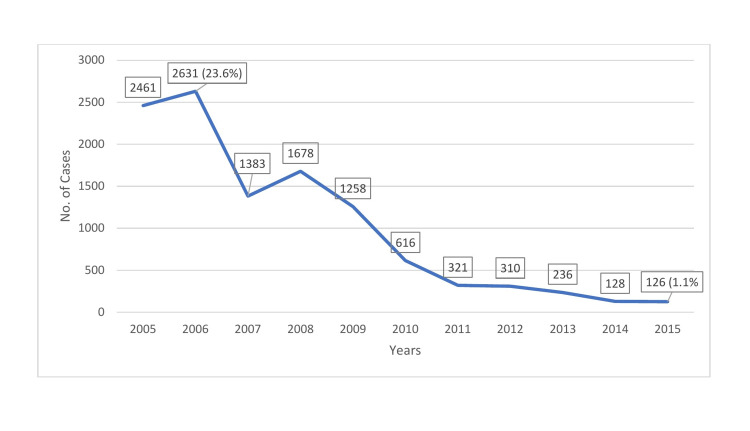
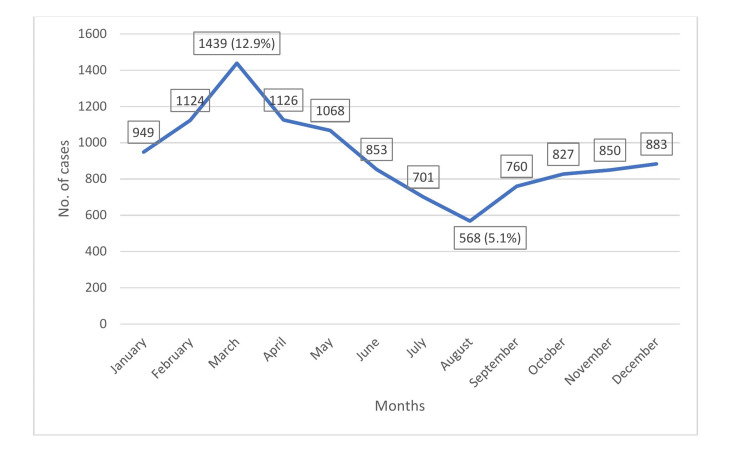
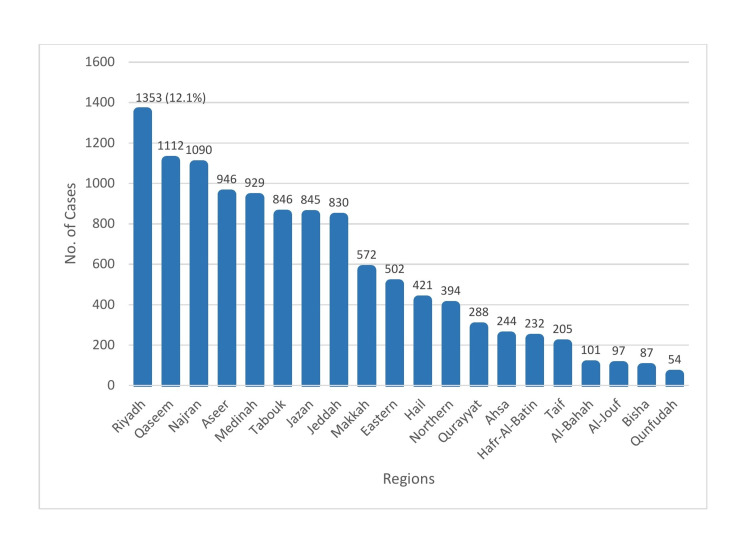
Background Foodborne hepatitis A has major health and economic impacts. Pathogen-specific surveillance based on laboratory findings is conducted to detect and confirm cases of foodborne hepatitis A. Foodborne hepatitis A is on the priority list of diseases in the Kingdom of Saudi Arabia (KSA). Objectives This study aimed to describe the characteristics of confirmed foodborne hepatitis A in the KSA from 2005 to 2015. Methods A cross-sectional study of confirmed foodborne hepatitis A in the KSA from 2005 to 2015 was conducted, and data collection was through retrospective chart review. Results The number of hepatitis A cases that have been confirmed and reported to the Ministry of Health during the study period was 11148, and the Riyadh health region had more reported cases (1353 cases; 12.1%) than any other region. The highest number of cases (2631 cases; 23.6%) was recorded in 2006, and the incidence of foodborne hepatitis A was found to be highest in the month of March (1439; 12.9%). Further, the incidence of foodborne hepatitis A was highest in the five-to-14-years age group, in male individuals, and in Saudi nationals at 59% (6556 cases), 55% (6076 cases), and 88% (9775 cases), respectively. Conclusion The characteristics of foodborne hepatitis A vary according to time, place, and person. These variations may reflect differences in reporting systems and in preventive measures between health regions, seasons, and habits of the Saudi population.
Keywords: cross-sectional studies; food hygiene; food-borne; saudi arabia; viral hepatitis a.
Copyright © 2022, Sharaheeli et al.
Conflict of interest statement
The authors have declared that no competing interests exist.
Figures
References
-
- The surveillance of infectious diseases. Thacker SB, Choi K, Brachman PS. JAMA. 1983;249:1181–1185. - PubMed
-
- World Health Organization: WHO surveillance programme for control of foodborne infection and intoxications in Europe. [ Jan; 2022 ];https://agris.fao.org/agris-search/search.do?recordID=XF19820818133 1981
-
- Lynch M, Painter J, Woodruff R, Braden C. MMWR Surveill Summ. Vol. 55. 55: 2006; 2006. Surveillance for foodborne-disease outbreaks--United States, 1998-2002; pp. 1–42. - PubMed
-
- World Health Organization: WHO initiative to estimate the global burden of foodborne diseases. [ Jan; 2022 ];https://apps.who.int/iris/bitstream/handle/10665/339290/WHO-HSE-FOS-09.4... 2008 - PubMed
-
- Epidemiology of viral hepatitis in Saudi Arabia: are we off the hook? Abdo AA, Sanai FM, Al-Faleh FZ. https://www.ncbi.nlm.nih.gov/pmc/articles/pmc3530988/ Saudi J Gastroenterol. 2012;18:349–357. - PMC - PubMed
LinkOut - more resources
Full Text Sources