Two-Photon Cell and Tissue Level Laser Ablation Methods to Study Morphogenetic Biomechanics
- PMID: 35147945
- PMCID: PMC7614166
- DOI: 10.1007/978-1-0716-2035-9_14
Two-Photon Cell and Tissue Level Laser Ablation Methods to Study Morphogenetic Biomechanics
Abstract
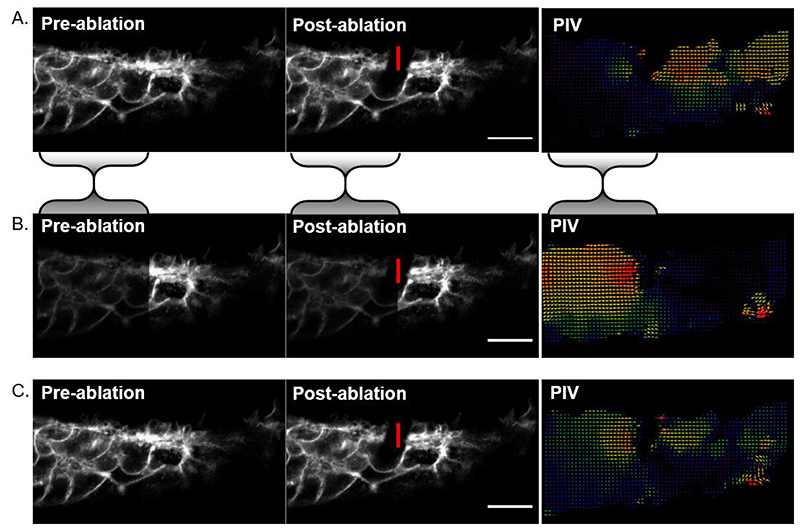
Laser ablation is routinely performed to infer mechanical tension in cells and tissues. Here we describe our method of two-photon laser ablation at the cellular and tissue level in mouse embryos. The primary outcome of these experiments is initial retraction following ablation, which correlates with, and so can be taken as a measure of, the tensile stress that structure was under before ablation. Several experimental variables can affect interpretation of ablation tests. Pre-test factors include differences in physical properties such as viscoelasticity between experimental conditions. Factors relevant during the test include viability of the cells at the point of ablation, image acquisition rate and the potential for overzealous ablations to cause air bubbles through heat dissipation. Post-test factors include intensity-biased image registration that can artificially produce apparent directionality. Applied to the closing portion of the mouse spinal neural tube, these methods have demonstrated long-range biomechanical coupling of the embryonic structure and have identified highly contractile cell populations involved in its closure process.
Keywords: Biomechanics; Laser ablation; Mouse; Neural tube; Two photon.
© 2022. Springer Science+Business Media, LLC, part of Springer Nature.
Figures
References
-
- Zulueta-Coarasa T, Fernandez-Gonzalez R. Tension (re)builds: Biophysical mechanisms of embryonic wound repair. Mech Dev. 2017;144:43–52. - PubMed
Publication types
MeSH terms
Grants and funding
LinkOut - more resources
Full Text Sources