


Practice and determinants of emergency contraceptive utilization among women seeking termination of pregnancy in Northwest Ethiopia-A mixed quantitative and qualitative study
- PMID: 35148342
- PMCID: PMC8836300
- DOI: 10.1371/journal.pone.0263776
Practice and determinants of emergency contraceptive utilization among women seeking termination of pregnancy in Northwest Ethiopia-A mixed quantitative and qualitative study
Abstract
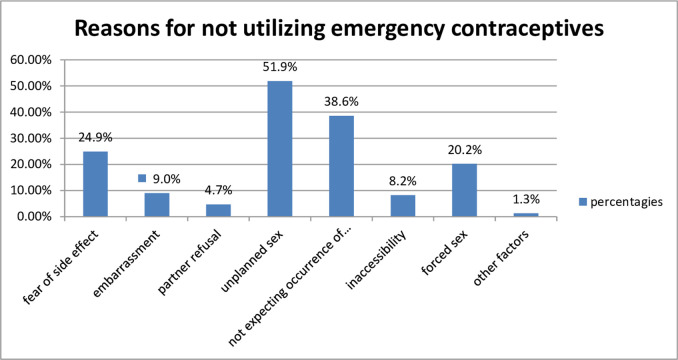
Background: Emergency contraceptives are used within 72 hours after unprotected sexual intercourse to prevent unwanted pregnancy. Although emergency contraceptives are widely available in Ethiopia, termination of pregnancy remains a public health problem indicating low uptake of emergency contraceptives after unprotected sexual intercourse. This study aimed to assess utilization and determinants of emergency contraceptives among women seeking termination of pregnancy in Northwest Ethiopia.
Methods: An institutional-based cross-sectional study was carried out, supplemented by phenomenologically approached in-depth interviews. Systematic random sampling was used to select study participants. A structured questionnaire and an in-depth interview guide were used to collect data. Data were entered by EPI-info and analyzed through SPSS version 23 to conduct logistic regressions. Thematic analysis was used to conduct qualitative interpretation.
Results: Almost one-fifth (78; 19.2%) of the study participants used emergency contraceptives to prevent their index pregnancy. Women who had secondary education (aOR 3.28; 95% CI 1.59, 6.79) and women who had no living children (aOR 4.52; 95% CI 1.40, 14.57) had a positive significant association with emergency contraceptive utilization. On the other hand, women who did not discuss contraceptives with their sexual partner (aOR 0.49; 95% CI 0.27-0.91) and women without a history of abortion (aOR 0.45; 95% CI 0.24-0.97) had a negative significant association with emergency contraceptive utilization.
Conclusion and recommendation: There is relatively low utilization of emergency contraception among pregnancy terminating women. Reproductive health programs should encourage women discussion with their partners about emergency contraceptives to decrease occurrence of unwanted pregnancy and termination of pregnancy.
Conflict of interest statement
The authors have declared that no competing interests exist.
Figures
References
-
- Anteneh A., Knowledge, attitudes, practices and barriers to use emergency contraception among women with unsafe abortion in Jimma Marie Stopes Clinic, South West Ethiopia. Ethiop J Reprod Health, 2009. 3: p. 16–23.
-
- Raymond E., Emergency Contraceptive Pills: Medical and Service Delivery Guidelines Second Edition, 2004, The International Consortium for Emergency Contraception; Washington: ^ eDC DC.
MeSH terms
Substances
LinkOut - more resources
Full Text Sources
