


Immediate voluntary activation deficits following submaximal eccentric contractions of knee extensors are associated with alterations of the sense of movement
- PMID: 35149737
- PMCID: PMC8837602
- DOI: 10.1038/s41598-022-06081-2
Immediate voluntary activation deficits following submaximal eccentric contractions of knee extensors are associated with alterations of the sense of movement
Abstract
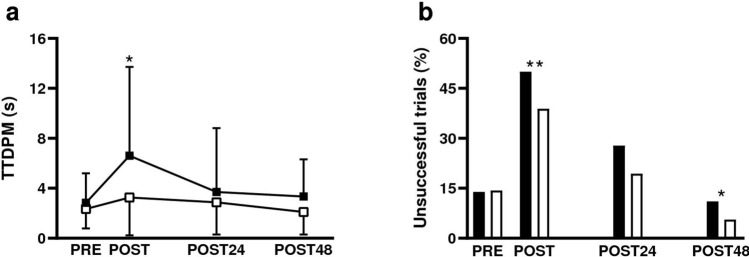
The mechanisms underlying movement sense alterations following repeated eccentric contractions remain unclear. This study concomitantly investigated the effects of unilateral eccentric contractions on movement sense and on neuromuscular function at the knee before, immediately after (POST), 24 (POST24) and 48 (POST48) h after the exercise. Twelve participants performed sets of submaximal knee extensors (KE) eccentric contractions until a 20% decrease in maximal voluntary isometric contraction (MVIC) torque was reached. Threshold to detect passive movement (TTDPM) tasks were used to assess movement sense during both knee flexion (TTDPMFLEX) and extension (TTDPMEXT). KE fatigability was assessed using the interpolated twitch technique. TTDPM values expressed in seconds and the percentage of unsuccessful trials only increased at POST during TTDPMFLEX and TTDPMEXT. The 20%-MVIC decrease was associated with significant decreases in voluntary activation level (- 12.7%, p < 0.01) and potentiated doublet torque at 100 Hz (- 18.1%, p < 0.001). At POST24, despite persistent reductions of maximal voluntary and electrically evoked torques associated with increased perceived muscle soreness, TTDPM values and the percentage of unsuccessful trials returned to baseline values. Consequently, movement sense alterations were only observed in the presence of voluntary activation deficits, suggesting that some exercise-induced central alterations may affect the somatosensory function.
© 2022. The Author(s).
Conflict of interest statement
The authors declare no competing interests.
Figures


References
-
- Gandevia S. Spinal and supraspinal factors in human muscle fatigue. Physiol. Rev. 2001;81:1725–1789. - PubMed
-
- Swart J, Robert Lindsay T, Ian Lambert M, Craig Brown J, David Noakes T. Perceptual cues in the regulation of exercise performance-physical sensations of exercise and awareness of effort interact as separate cues. Br. J. Sports Med. 2012;46:42–48. - PubMed
MeSH terms
LinkOut - more resources
Full Text Sources
Medical
