


Altered reward and effort processing in children with maltreatment experience: a potential indicator of mental health vulnerability
- PMID: 35149765
- PMCID: PMC8832084
- DOI: 10.1038/s41386-022-01284-7
Altered reward and effort processing in children with maltreatment experience: a potential indicator of mental health vulnerability
Abstract
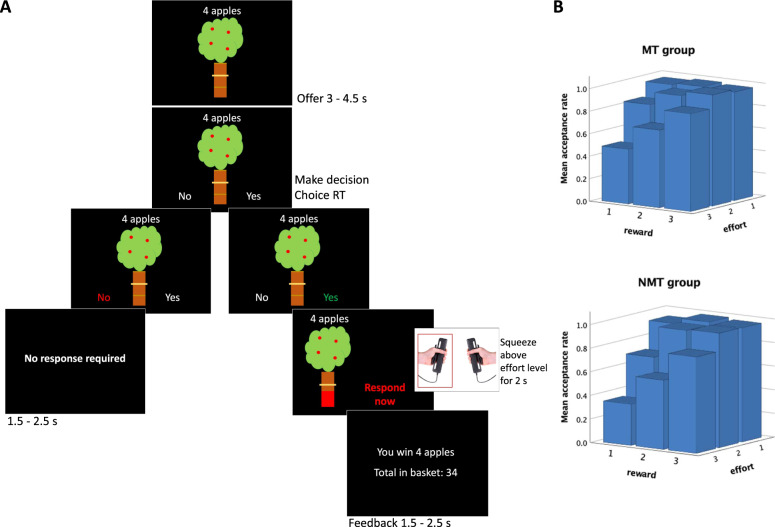
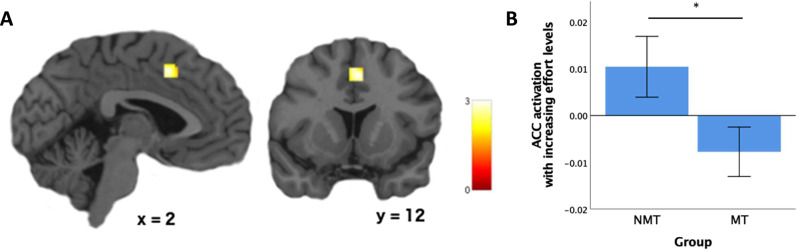
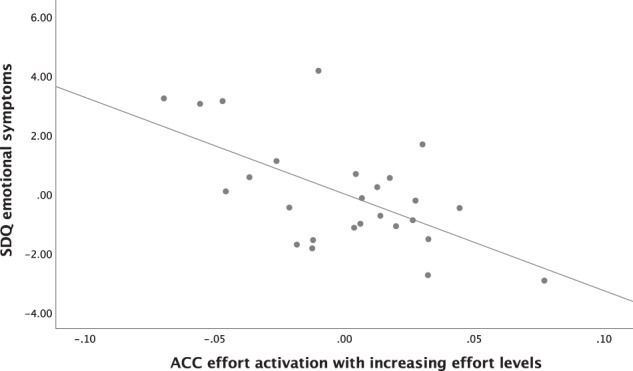
In this longitudinal study of children and adolescents with a documented history of maltreatment, we investigated the impact of maltreatment on behavioral and neural indices of effort-based decision making for reward and examined their associations with future internalizing symptoms. Thirty-seven children with a documented history of maltreatment (MT group) and a carefully matched group of 33 non-maltreated children (NMT group) aged 10-16, completed an effort-based decision-making task during functional magnetic resonance imaging (fMRI). Internalizing symptoms were assessed at baseline and again 18 months later. Computational models were implemented to extract individual estimates of reward and effort sensitivity, and neural signals during decision-making about different levels of reward and effort were analyzed. These were used to predict internalizing symptoms at follow-up. We identified lower effort-related activation in the anterior cingulate cortex (ACC), a prespecified region-of-interest, in the MT relative to the NMT group. No group differences were observed in the striatum, or in behavioral indices of reward and effort processing. Lower effort-related ACC activation significantly predicted elevated internalizing symptoms at follow-up in the MT group. These findings suggest that disrupted effort-related activation may index latent vulnerability to mental illness in children who have experienced maltreatment.
© 2022. The Author(s).
Conflict of interest statement
The authors declare no competing interests.
Figures
References
-
- McCrory EJ, Puetz VB, Maguire EA, Mechelli A, Palmer A, Gerin MI, et al. Autobiographical memory: a candidate latent vulnerability mechanism for psychiatric disorder following childhood maltreatment. Br J Psychiatry: J Ment Sci. 2017;211:216–22. 10.1192/bjp.bp.117.201798. 10.1192/bjp.bp.117.201798. - DOI - PMC - PubMed
-
- Mueller SC, Maheu FS, Dozier M, Peloso E, Mandell D, Leibenluft E, et al. Early-life stress is associated with impairment in cognitive control in adolescence: an fMRI study. Neuropsychologia. 2010;48:3037–44. 10.1016/j.neuropsychologia.2010.06.013. 10.1016/j.neuropsychologia.2010.06.013. - DOI - PMC - PubMed
Publication types
MeSH terms
Grants and funding
LinkOut - more resources
Full Text Sources
Medical
