


Self-regulation and Psychopathology in Young Children
- PMID: 35149958
- PMCID: PMC9365888
- DOI: 10.1007/s10578-022-01322-x
Self-regulation and Psychopathology in Young Children
Abstract
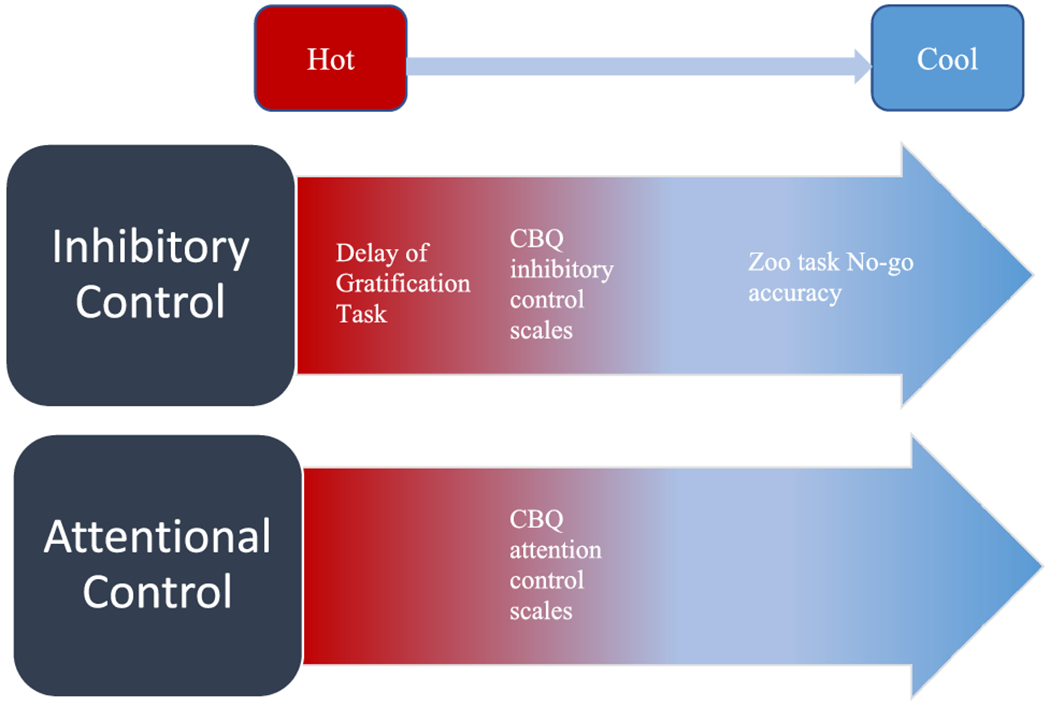
The current study examined concurrent relationships between children's self-regulation, measured behaviorally and by parent-report, and children's internalizing and externalizing symptoms. The aim was to distinguish which components of self-regulation (attention vs. inhibitory control, "hot" vs. "cool" regulation) best predict dimensional symptomatology and clinical disorders in young children. The participants were 120 children, ages 4-8 years old. Results showed that greater parent-reported attention was associated with fewer internalizing and externalizing symptoms. Behaviorally-measured hot inhibitory control related to fewer internalizing symptoms, whereas parent-reported inhibitory control related to fewer externalizing symptoms. Similar patterns emerged for clinical diagnoses, with parent-rated attention most strongly predicting disorders across domains. Results support prior evidence implicating self-regulatory deficits in externalizing problems, while also demonstrating that components of self-regulation are impaired with internalizing symptoms. Further, different sub-components of self-regulation relate to different dimensions of psychopathology in children. Interventions should target these areas in children at-risk for disorders.
Keywords: Attention; Externalizing; Inhibitory control; Internalizing; Self-regulation.
© 2022. The Author(s), under exclusive licence to Springer Science+Business Media, LLC, part of Springer Nature.
Conflict of interest statement
Conflict of Interest: The authors declare that they have no conflict of interest.
Figures
References
-
- Mischel W, Shoda Y, Rodriguez ML (1989) Delay of gratification in children. Science 244(4907):933. - PubMed
-
- Robson DA, Allen MS, Howard SJ (2020) Self-regulation in childhood as a predictor of future outcomes: A meta-analytic review. Psychol Bull 146(4):324–354 - PubMed
-
- Insel T, Cuthbert B, Garvey M, Heinssen R, Pine DS, Quinn K et al. (2010) Research domain criteria (RDoC): Toward a new classification framework for research on mental disorders. Am J Psychiatry 167(7):748–51 - PubMed
MeSH terms
Grants and funding
LinkOut - more resources
Full Text Sources
