


Dietary PUFAs drive diverse system-level changes in lipid metabolism
- PMID: 35150907
- PMCID: PMC8894240
- DOI: 10.1016/j.molmet.2022.101457
Dietary PUFAs drive diverse system-level changes in lipid metabolism
Abstract
Objective: Polyunsaturated fatty acid (PUFA) supplements have been trialled as a treatment for a number of conditions and produced a variety of results. This variety is ascribed to the supplements, that often comprise a mixture of fatty acids, and to different effects in different organs. In this study, we tested the hypothesis that the supplementation of individual PUFAs has system-level effects that are dependent on the molecular structure of the PUFA.
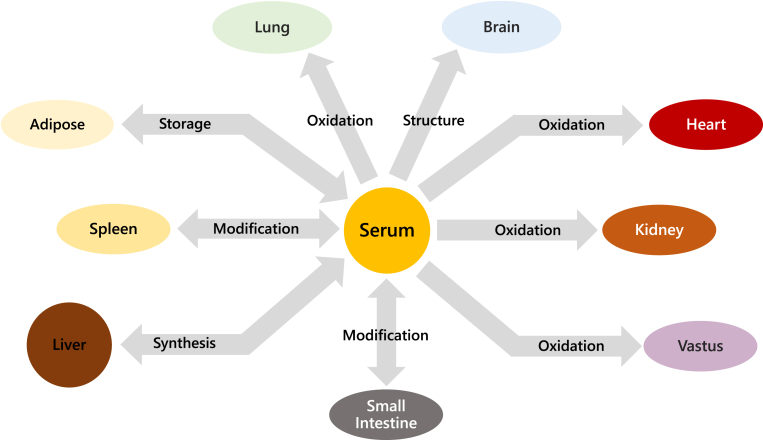
Methods: We undertook a network analysis using Lipid Traffic Analysis to identify both local and system-level changes in lipid metabolism using publicly available lipidomics data from a mouse model of supplementation with FA(20:4n-6), FA(20:5n-3), and FA(22:6n-3); arachidonic acid, eicosapentaenoic acid, and docosahexaenoic acid, respectively. Lipid Traffic Analysis is a new computational/bioinformatics tool that uses the spatial distribution of lipids to pinpoint changes or differences in control of metabolism, thereby suggesting mechanistic reasons for differences in observed lipid metabolism.
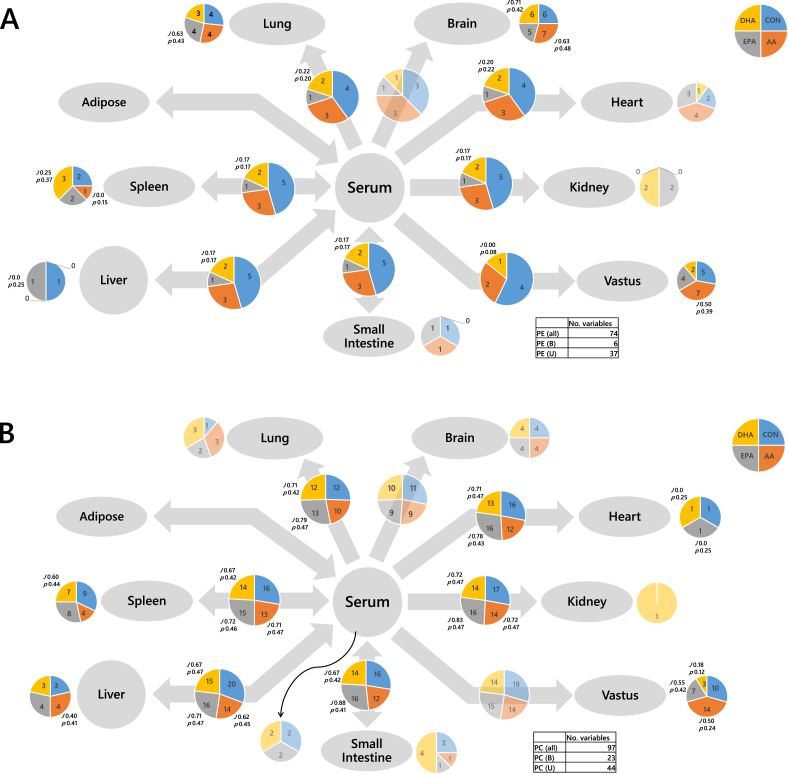
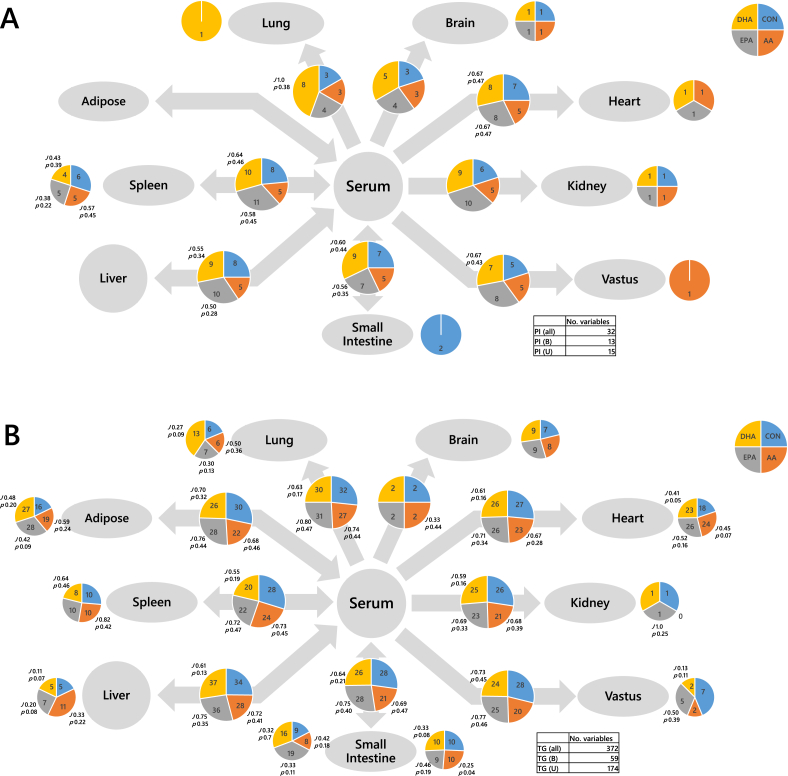
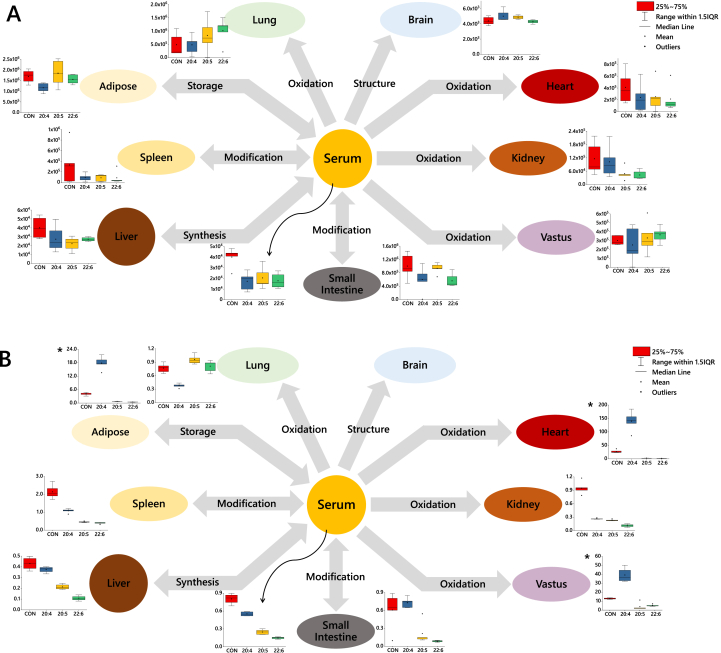
Results: There was strong evidence for changes to lipid metabolism driven by and dependent on the structure of the supplemented PUFA. Phosphatidylcholine and triglycerides showed a change in the variety more than the total number of variables, whereas phosphatidylethanolamine and phosphatidylinositol showed considerable change in both which variables and the number of them, in a highly PUFA-dependent manner. There was also evidence for changes to the endogenous biosynthesis of fatty acids and to both the elongation and desaturation of fatty acids.
Conclusions: These results show that the full biological impact of PUFA supplementation is far wider than any single-organ effect and implies that supplementation and dosing with PUFAs require a system-level assessment.
Keywords: Lipid metabolism; Metabolic network; PUFA supplementation; Traffic analysis.
Copyright © 2022 The Author(s). Published by Elsevier GmbH.. All rights reserved.
Figures
References
-
- Van Le H., Nguyen D.V., Vu Nguyen Q., Malau-Aduli B.S., Nichols P.D., Malau-Aduli A.E.O. Fatty acid profiles of muscle, liver, heart and kidney of Australian prime lambs fed different polyunsaturated fatty acids enriched pellets in a feedlot system. Scientific Reports. 2019;9(1):1238. - PMC - PubMed
-
- Stark K.D., Van Elswyk M.E., Higgins M.R., Weatherford C.A., Salem N. Global survey of the omega-3 fatty acids, docosahexaenoic acid and eicosapentaenoic acid in the blood stream of healthy adults. Progress in Lipid Research. 2016;63:132–152. - PubMed
-
- Piquet M.-A., Roulet M., Nogueira V., Filippi C., Sibille B., Hourmand-Ollivier I., et al. Polyunsaturated fatty acid deficiency reverses effects of alcohol on mitochondrial energy metabolism. Journal of Hepatology. 2004;41(5):721–729. - PubMed
Publication types
MeSH terms
Substances
Grants and funding
- MC_UU_12012/2/MRC_/Medical Research Council/United Kingdom
- MC_UU_00014/5/MRC_/Medical Research Council/United Kingdom
- MC_UU_00014/2/MRC_/Medical Research Council/United Kingdom
- BB/T014210/1/BB_/Biotechnology and Biological Sciences Research Council/United Kingdom
- BB/M027252/1/BB_/Biotechnology and Biological Sciences Research Council/United Kingdom
- MC_G0802535/MRC_/Medical Research Council/United Kingdom
- G0802051/MRC_/Medical Research Council/United Kingdom
- MC_UU_12012/5/MRC_/Medical Research Council/United Kingdom
- G0400192/MRC_/Medical Research Council/United Kingdom
- RG/12/13/29853/BHF_/British Heart Foundation/United Kingdom
- RG/18/7/33636/BHF_/British Heart Foundation/United Kingdom
LinkOut - more resources
Full Text Sources
