Review
. 2022 Feb 12;21(1):47.
doi: 10.1186/s12943-022-01530-y.

Ferroptosis in cancer therapy: a novel approach to reversing drug resistance

Affiliations
Review

Ferroptosis in cancer therapy: a novel approach to reversing drug resistance

Chen Zhang et al. Mol Cancer. .

Abstract

Ferroptosis is an intracellular iron-dependent form of cell death that is distinct from apoptosis, necrosis, and autophagy. Extensive studies suggest that ferroptosis plays a pivotal role in tumor suppression, thus providing new opportunities for cancer therapy. The development of resistance to cancer therapy remains a major challenge. A number of preclinical and clinical studies have focused on overcoming drug resistance. Intriguingly, ferroptosis has been correlated with cancer therapy resistance, and inducing ferroptosis has been demonstrated to reverse drug resistance. Herein, we provide a detailed description of the mechanisms of ferroptosis and the therapeutic role of regulating ferroptosis in reversing the resistance of cancer to common therapies, such as chemotherapy, targeted therapy and immunotherapy. We discuss the prospect and challenge of regulating ferroptosis as a therapeutic strategy for reversing cancer therapy resistance and expect that our review could provide some references for further studies.

Keywords: Chemotherapy; Drug resistance; Ferroptosis; Immunotherapy; Targeted therapy.


Conflict of interest statement

The authors declare that they have no competing interests.

Figures
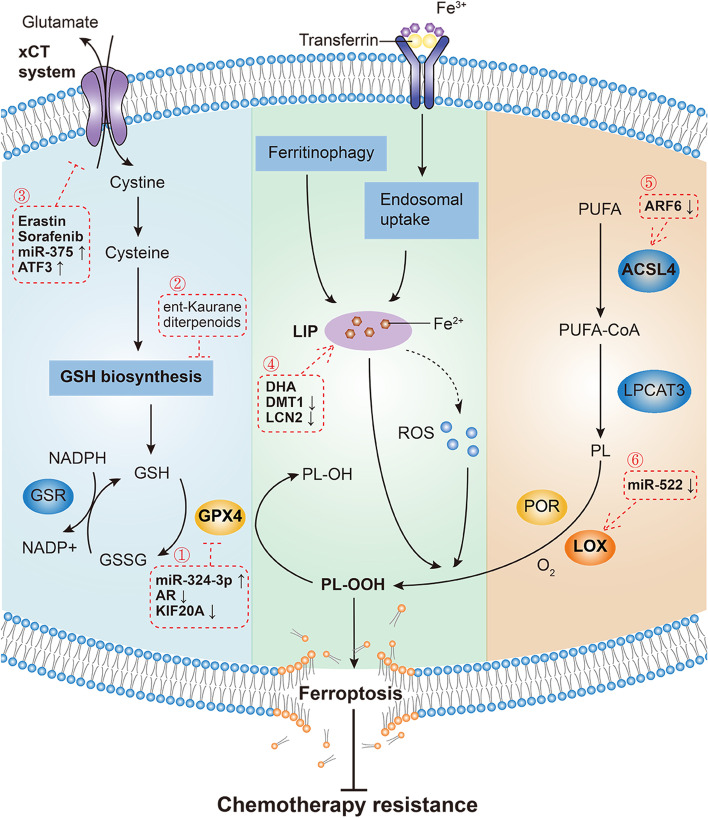
Fig. 1
Fig. 1
Mechanisms governing ferroptosis and reversing chemotherapy resistance. Three pathways initiate the process of ferroptosis and chemotherapy resistance reversal: the canonical GPX4-regulated pathway, iron metabolism pathway and lipid metabolism pathway. Regulation of the canonical GPX4-regulated pathway is as follows: ① Directly inhibit GPX4 by upregulating miR-324-3p or downregulating AR and KIF20A. ② Inhibit GSH biosynthesis by ent-kaurane diterpenoids. ③ Inhibit cystine uptake by erastin and sorafenib or upregulating miR-375 and ATF3. Regulation of the iron metabolism pathway is as follows: ④ Increase cellular LIP by DHA, downregulating DMT1 and LCN2. Regulation of the lipid metabolism pathway is as follows: ⑤ Target ACSL4 by downregulating ARF6. ⑥ Target LOX by downregulating miR-522. xCT: cystine/glutamate antiporter; ATF3: activating transcription factor 3; GSH: glutathione; GPX4: glutathione peroxidase 4; AR: androgen receptor; LIP: labile iron pool; DHA: dihydroartemisinin; DMT1: divalent metal transporter 1; LCN2: lipocalin 2; ROS: reactive oxygen species; PLOH: phospholipid alcohols; PLOOH: phospholipid hydroperoxides; PUFA: polyunsaturated fatty acid; ARF6: ADP ribosylation factor 6; ACSL4: acyl-CoA synthetase long chain family member 4; CoA: coenzyme A; LPCAT: lysophosphatidylcholine acyltransferase; PL: phospholipid; LOX: lipoxygenases; POR: cytochrome P450 oxidoreductase
Fig. 2
Fig. 2
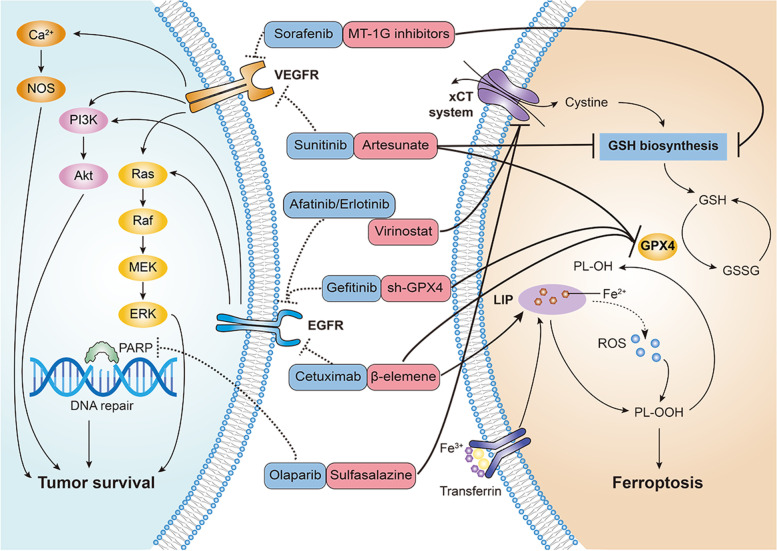
Reversing targeted therapy resistance by inducing ferroptosis. Activation of the downstream pathways of VEGFR, EGFR and PARP facilitates tumor survival and resistance to certain inhibitors (blue). Combination therapy with ferroptosis inducers (red) has been demonstrated to reverse targeted therapy resistance. VEGFR, vascular endothelial growth factor receptor; EGFR, epidermal growth factor receptor; PARP, poly (ADP-ribose) polymerase; xCT: cystine/glutamate antiporter; GSH: glutathione; GPX4: glutathione peroxidase 4; LIP: labile iron pool; ROS: reactive oxygen species; PLOH: phospholipid alcohols; PLOOH: phospholipid hydroperoxides
Fig. 3
Fig. 3
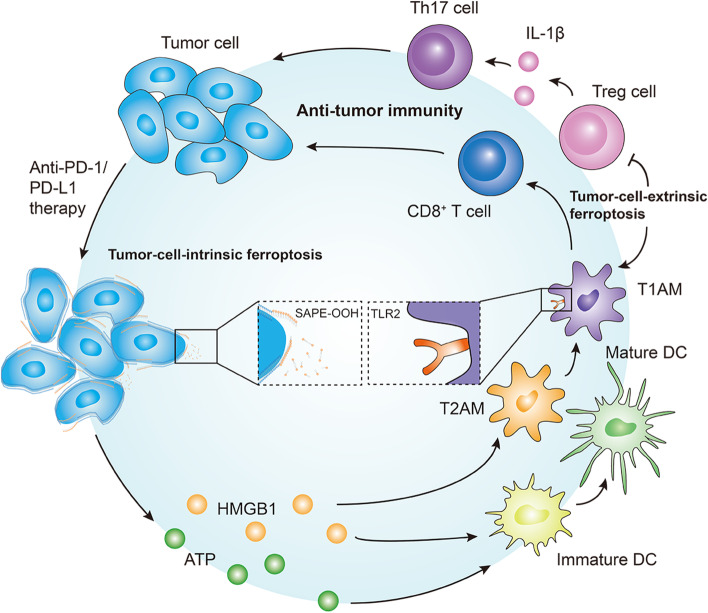
Reversing immunotherapy resistance by inducing ferroptosis. There are two approaches to reversing immunotherapy resistance by inducing ferroptosis: a tumor cell-intrinsic approach that induces ferroptosis in cancer cells to elicit a vaccination-like effect to stimulate antitumor immunity and a tumor cell-extrinsic approach that triggers ferroptosis in the TME to deplete immune suppressor cells. TME, tumor microenvironment; PD-1: programmed cell death 1; PD-L1: programmed death-ligand 1; SAPE-OOH: 1-steaoryl-2-15-HpETE-sn-glycero-3-phosphatidylethanolamine; Tregs: regulatory T cells; TAMs: tumor-associated macrophages; IL-1β: interleukin-1β; Th17: T helper 17; DC: dendritic cell; ATP: adenosine triphosphate; HMGB1: high-mobility group box 1

References

    1. Yagoda N, von Rechenberg M, Zaganjor E, et al. RAS-RAF-MEK-dependent oxidative cell death involving voltage-dependent anion channels. Nature. 2007;447:864–868. - PMC - PubMed
    1. Yang WS, Stockwell BR. Synthetic lethal screening identifies compounds activating iron-dependent, nonapoptotic cell death in oncogenic-RAS-harboring cancer cells. Chem Biol. 2008;15:234–245. - PMC - PubMed
    1. Cheah JH, Kim SF, Hester LD, et al. NMDA receptor-nitric oxide transmission mediates neuronal iron homeostasis via the GTPase Dexras1. Neuron. 2006;51:431–440. - PMC - PubMed
    1. Dixon SJ, Lemberg KM, Lamprecht MR, et al. Ferroptosis: an iron-dependent form of nonapoptotic cell death. Cell. 2012;149:1060–1072. - PMC - PubMed
    1. Dröge W. Free radicals in the physiological control of cell function. Physiol Rev. 2002;82:47–95. - PubMed

Publication types