


Temporal changes in sex- and age-specific incidence profiles of mental disorders-A nationwide study from 1970 to 2016
- PMID: 35152414
- PMCID: PMC9305516
- DOI: 10.1111/acps.13410
Temporal changes in sex- and age-specific incidence profiles of mental disorders-A nationwide study from 1970 to 2016
Abstract
Objective: Information on mental disorders over time is critical for documenting changes in population burden, and aiding understanding of potential causal and non-causal factors. The aim of this study was to provide temporal changes in the sex- and age-specific incidence rates (IR) of mental disorders diagnosed in Danish hospitals during five decades and investigate whether such changes may be attributable to changes in administrative reporting practice.
Methods: This population-based cohort study included all people living in Denmark between 1970 and 2016. Mental disorders diagnoses were obtained from the Danish Psychiatric Central Research Register. We estimated the IR of each mental disorder (all persons, and sex- and age-specific IRs) and examined the impact of two administrative changes.
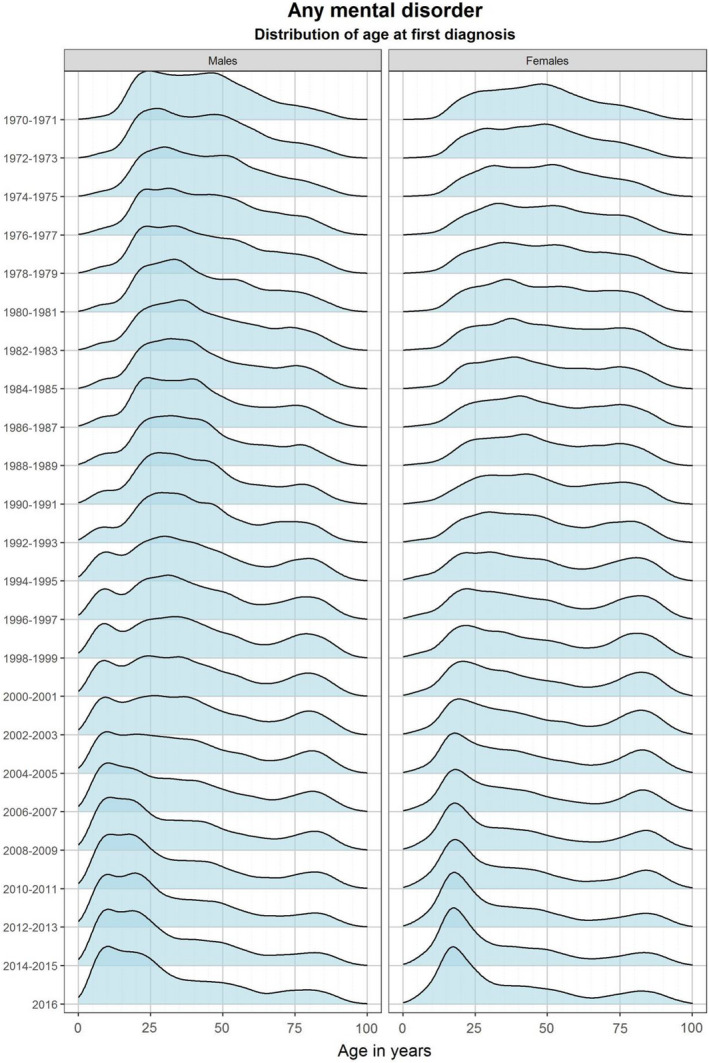
Results: Our study included 9 107 157 people, followed for 233.0 million person-years. During follow-up, 9.5% were diagnosed with at least one mental disorder. The IR for any mental disorder was 39.0 per 10,000 person-years. Despite fluctuations, this increased between 1970-84 and 2005-2016, from 28.9 to 63.0 per 10,000 person-years. Increases were most pronounced for younger age groups. Administrative changes did appear to influence incidence rates.
Conclusion: Mental disorder IRs have increased in Denmark since 1970, with age of diagnosis shifting downwards. Both trends were likely impacted by administrative changes, while the latter is likely to be (partly) attributable to earlier detection and increased reporting of child-onset conditions. Our findings may provide valuable context of the epidemiology of mental disorders across age groups for comparison with other studies and populations.
Keywords: incidence; mental disorders; register-based epidemiology; time trends.
© 2022 The Authors. Acta Psychiatrica Scandinavica published by John Wiley & Sons Ltd.
Conflict of interest statement
The authors declare no conflicts of interest.
Figures


References
-
- Salmon TW. Mental hygiene. In: Rosenau MJ, ed. Preventive Medicine and Hygiene. D. Appleton & Co; 1916:331‐361.
-
- Ødegård Ø. Hospitalized psychoses in Norway: time trends 1926–1965. Social Psychiatry. 1971;6(2):53‐58.
-
- Munk‐Jørgensen P, Mortensen PB. Incidence and other aspects of the epidemiology of Schizophrenia in Denmark, 1971–87. Br J Psychiatry. 1992;161(4):489‐495. - PubMed
-
- Atladottir HO, Parner ET, Schendel D, Dalsgaard S, Thomsen PH, Thorsen P. Time trends in reported diagnoses of childhood neuropsychiatric disorders: a Danish cohort study. Arch Pediatr Adolesc Med. 2007;161(2):193‐198. - PubMed
-
- Jensen CM, Steinhausen HC. Time trends in lifetime incidence rates of first‐time diagnosed bipolar and depressive disorders across 16 years in danish psychiatric hospitals: A Nationwide Study. J Clin Psychiatry. 2016;77(12):e1570‐e1575. - PubMed
Publication types
MeSH terms
LinkOut - more resources
Full Text Sources
Medical
