


The Role of the Oral Microbiota Related to Periodontal Diseases in Anxiety, Mood and Trauma- and Stress-Related Disorders
- PMID: 35153869
- PMCID: PMC8833739
- DOI: 10.3389/fpsyt.2021.814177
The Role of the Oral Microbiota Related to Periodontal Diseases in Anxiety, Mood and Trauma- and Stress-Related Disorders
Abstract
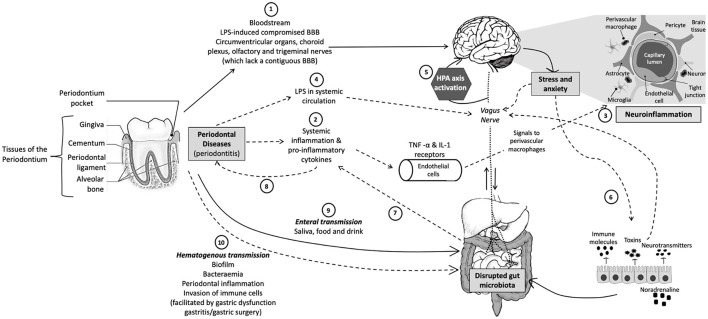
The prevalence of anxiety, mood and trauma- and stress-related disorders are on the rise; however, efforts to develop new and effective treatment strategies have had limited success. To identify novel therapeutic targets, a comprehensive understanding of the disease etiology is needed, especially in the context of the holobiont, i.e., the superorganism consisting of a human and its microbiotas. Much emphasis has been placed on the role of the gut microbiota in the development, exacerbation, and persistence of psychiatric disorders; however, data for the oral microbiota are limited. The oral cavity houses the second most diverse microbial community in the body, with over 700 bacterial species that colonize the soft and hard tissues. Periodontal diseases encompass a group of infectious and inflammatory diseases that affect the periodontium. Among them, periodontitis is defined as a chronic, multi-bacterial infection that elicits low-grade systemic inflammation via the release of pro-inflammatory cytokines, as well as local invasion and long-distance translocation of periodontal pathogens. Periodontitis can also induce or exacerbate other chronic systemic inflammatory diseases such as atherosclerosis and diabetes and can lead to adverse pregnancy outcomes. Recently, periodontal pathogens have been implicated in the etiology and pathophysiology of neuropsychiatric disorders (such as depression and schizophrenia), especially as dysregulation of the immune system also plays an integral role in the etiology and pathophysiology of these disorders. This review will discuss the role of the oral microbiota associated with periodontal diseases in anxiety, mood and trauma- and stress-related disorders. Epidemiological data of periodontal diseases in individuals with these disorders will be presented, followed by a discussion of the microbiological and immunological links between the oral microbiota and the central nervous system. Pre-clinical and clinical findings on the oral microbiota related to periodontal diseases in anxiety, mood and trauma- and stress-related phenotypes will be reviewed, followed by a discussion on the bi-directionality of the oral-brain axis. Lastly, we will focus on the oral microbiota associated with periodontal diseases as a target for future therapeutic interventions to alleviate symptoms of these debilitating psychiatric disorders.
Keywords: Aggregatibacter actinomycetemcomitans; Porphyromonas gingivalis; anxiety disorders; mood disorders; oral microbiota; periodontitis; trauma-related disorders.
Copyright © 2022 Martínez, Postolache, García-Bueno, Leza, Figuero, Lowry and Malan-Müller.
Conflict of interest statement
CL serves on the Scientific Advisory Board of Immodulon Therapeutics, Ltd., and is Cofounder and Chief Scientific Officer of Mycobacteria Therapeutics Corporation. EF reports contracts through University with Dentaid and Lacer, and personal fees for lecturing from Oral-B and Colgate. The remaining authors declare that the research was conducted in the absence of any commercial or financial relationships that could be construed as a potential conflict of interest.
Figures
References
-
- World Health Organization . Depression and Other Common Mental Disorders: Global Health Estimates. Geneva: World Health Organization. Contract No.: Licence: CC BY-NC-SA 3.0 IGO; (2017).
-
- University of Washington (2021) . Available online at: https://vizhub.healthdata.org/gbd-compare/ (accessed November 12, 2021).
Publication types
LinkOut - more resources
Full Text Sources
