


Novel Insights From the Germline Landscape of Breast Cancer in Brazil
- PMID: 35155181
- PMCID: PMC8831886
- DOI: 10.3389/fonc.2021.743231
Novel Insights From the Germline Landscape of Breast Cancer in Brazil
Abstract
Introduction: Breast cancer patients with germline pathogenic variants may benefit from risk-reducing surgeries, intensive screening, and targeted cancer therapies. There is a paucity of data regarding prevalence and distribution of germline pathogenic variants in the Brazilian population. Our primary endpoint was the description of prevalence and distribution of germline pathogenic variants among breast cancer patients who underwent next-generation sequencing (NGS) panel testing. Secondary endpoint was the assessment of predictive factors of a positive test.
Methods: We analyzed NGS results, personal, and family history data from a prospectively collected cohort of breast cancer patients from August 2013 to May 2019. Exact logistic regression was used to perform multivariable analysis.
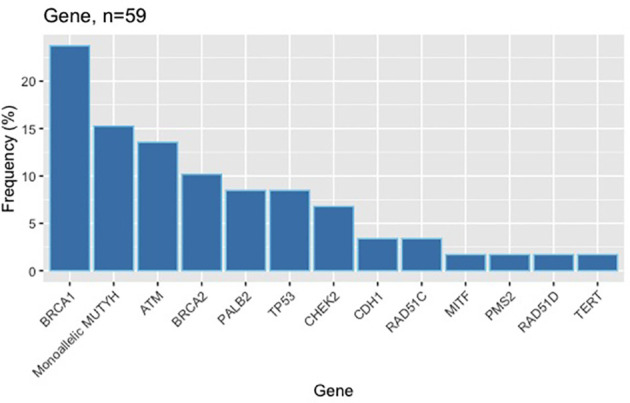
Results: Of 370 breast cancer patients, we found 59 pathogenic variants in 57 (15%) patients. Pathogenic variants were identified in BRCA1 (24%), ATM (14%), BRCA2 (10%), TP53 (8%), PALB2 (8%), CHEK2 (7%), CDH1 (3%), RAD51C (3%), MITF (2%), PMS2 (2%), RAD51D (2%), and TERT (2%). Monoallelic MUTYH pathogenic variants were found in 15%. After multivariable analysis, age of diagnosis (OR 0.89, 95% CI: 0.81-0.95, for each year increase), triple-negative subtype (OR 17.2, 95% CI: 3.74-114.72), and number of breast cancers in the family (OR 2.46, 95% CI 1.57-4.03, for each additional case) were associated with BRCA1 pathogenic variants. In the present study, a quarter of triple-negative breast cancer patients harbored a germline pathogenic variant and two-thirds of those were BRCA1 carriers.
Conclusions: Prevalence and distribution of germline pathogenic variants in this Brazilian sample of breast cancer patients are mostly similar to other populations. However, there is a trend to an overrepresentation of TP53 pathogenic variants that merits confirmation in further studies. Early-onset breast cancer patients should be offered genetic counseling, particularly those with triple-negative subtype.
Keywords: Brazil; breast neoplasms; genetic predictive testing; genetic predisposition to breast cancer; high-throughput nucleotide sequencing.
Copyright © 2022 Barbalho, Sandoval, Santos, Pisani, Quirino, Garicochea, Rossi and Achatz.
Conflict of interest statement
The authors declare that the research was conducted in the absence of any commercial or financial relationships that could be construed as a potential conflict of interest.
Figures
References
-
- De Oliveira Santos M. Estimativa/2020 – Incidência De Câncer No Brasil. Rev Bras Cancerol (2020) 66(1):1. doi: 10.32635/2176-9745.rbc.2020v66n1.927 - DOI
LinkOut - more resources
Full Text Sources
Research Materials
Miscellaneous
