


Acceptability of COVID-19 Vaccine Among Hospital Employees in the Department of Paediatrics, Gynaecology and Obstetrics in the University Hospitals of Geneva, Switzerland
- PMID: 35155344
- PMCID: PMC8830590
- DOI: 10.3389/fpubh.2021.781562
Acceptability of COVID-19 Vaccine Among Hospital Employees in the Department of Paediatrics, Gynaecology and Obstetrics in the University Hospitals of Geneva, Switzerland
Abstract
Background and aims: COVID-19 vaccination has been in the spotlight for almost a year now, both within the scientific community and in the general population. The issue of healthcare workers' (HCWs) hesitancy is particularly salient, given that they are at the forefront of the fight against COVID-19. Not only could unvaccinated HCW spread the disease, but HCWs are also critical messengers in building confidence towards COVID-19 vaccines. The goal of this study was to examine the perception of COVID-19 risk and of its vaccine acceptance among employees (i.e., HCW plus administrative staff) in the Department of Paediatrics, Gynaecology and Obstetrics at the University Hospitals of Geneva, for the purpose of drawing lessons on the determinants of vaccination morale.
Methods: We conducted an anonymous online survey comparing vaccination attitudes among vaccinated and unvaccinated workers in June 2021. It included questions on perception of COVID-19 risks and COVID-19 vaccines. Vaccination was not mandatory in our institution but was strongly recommended.
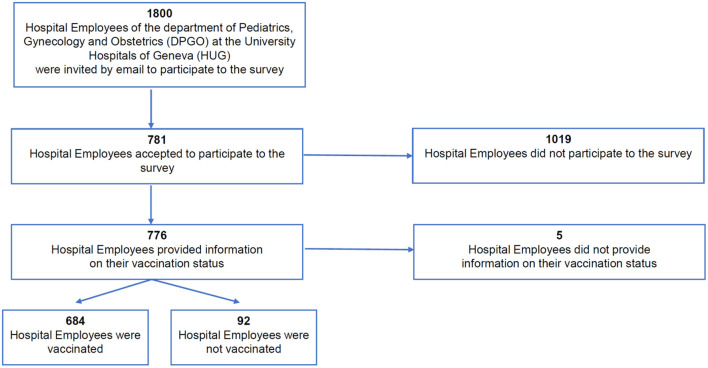
Results: In June 2021, 66% of the 1,800 employees of our department had received two doses of COVID-19 vaccine by the time of the survey. Among the employees, 776 participated (43%) to the survey, and among them 684 (88%) had chosen to be vaccinated. Participants working for longer in a hospital, with a chronic disease and a household contact with chronic disease were more likely to be vaccinated. Doctors were twice as likely to be vaccinated than nurses. Among unvaccinated hospital employees, 48 (52%) responded that they would not change their mind. Further, 35 (38%) were not feeling in danger of contracting severe COVID-19, and 32 (35%) had fears about possible side effects of COVID-19 vaccines that they wanted to discuss with a specialist.
Conclusion: Our study indicates that, while two-third of the employees had been vaccinated, quite many were still hesitant. The unvaccinated explained their choice by not feeling at risk of complicated COVID-19, and because of fear of possible side effects associated with the vaccine. Investments in COVID-19 vaccine education is a critical component for increasing vaccine acceptance among the unvaccinated.
Keywords: COVID-19; Gynaecology; Obstetrics; Paediatrics; health care workers; vaccine.
Copyright © 2022 Peirolo, Posfay-Barbe, Rohner, Wagner and Blanchard-Rohner.
Conflict of interest statement
The authors declare that the research was conducted in the absence of any commercial or financial relationships that could be construed as a potential conflict of interest.
References
-
- OFSP . COVID-?19 en Suisse: Informations sur la situation actuelle, état au 20 juin 2021. (2021). Available online at: https://www.covid19.admin.ch/fr/overview (accessed June 20, 2021).
