


The Efficacy of Platelet-Rich Plasma for Ligament Injuries: A Systematic Review of Basic Science Literature With Protocol Quality Assessment
- PMID: 35155701
- PMCID: PMC8832618
- DOI: 10.1177/23259671211066504
The Efficacy of Platelet-Rich Plasma for Ligament Injuries: A Systematic Review of Basic Science Literature With Protocol Quality Assessment
Abstract
Background: Despite the existence of many clinical studies on platelet-rich plasma (PRP) interventions for ligamentous pathology, basic science consensus regarding the indications, mechanisms, and optimal composition of PRP for treating ligament injuries is lacking.
Purpose: To (1) compare the efficacy of PRP in animal models of ligament injury with placebo and (2) describe the potential variability in PRP preparation using accepted classification systems.
Study design: Systematic review.
Methods: The Cochrane Database of Systematic Reviews, Cochrane Central Register of Controlled Trials, PubMed, Embase, and Ovid MEDLINE were queried in April 2020 for in vivo and in vitro basic science studies regarding PRP use for ligament injury. Study design, results, PRP composition, and analyzed cellular and molecular markers were extracted, and outcomes relative to control models were documented. Bias was assessed using the SYRCLE risk-of-bias tool.
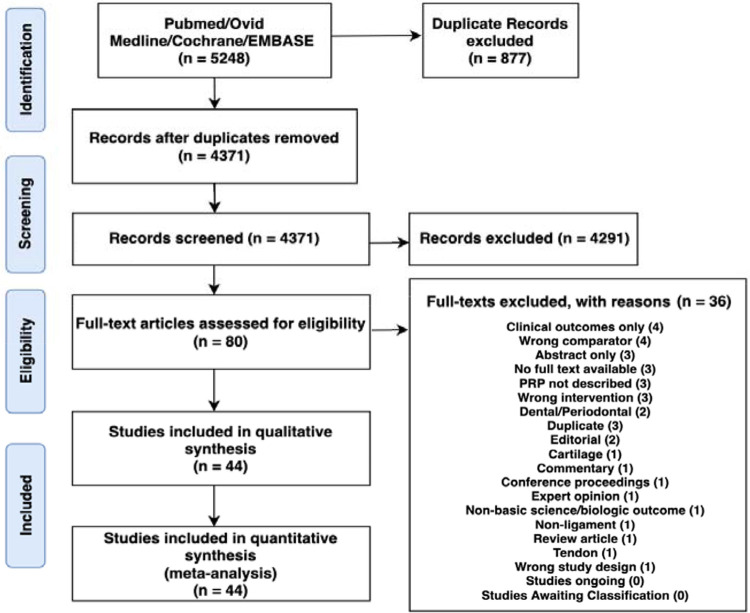
Results: Included were 43 articles (31 in vivo and 12 in vitro studies) investigating the anterior cruciate ligament/cranial cruciate ligament (n = 32), medial collateral ligament (n = 6), suspensory ligament (n = 3), patellar ligament (n = 1), and Hock ligament (n = 1). Platelet concentration was reported in 34 studies (77.3%); leukocyte composition, in 12 (27.3%); and red blood cell counts, in 7 (15.9%). With PRP treatment, 5 of 12 in vitro studies demonstrated significant increases in cell viability, 6 of 12 in gene expression, 14 of 32 in vivo studies reported superior ligament repair via histological evaluation, and 13 in vivo studies reported superior mechanical properties. Variability in PRP preparation methods was observed across all articles, and only 1 study reported all necessary information to be classified by the 4 schemes we used to evaluate reporting. Among the in vivo studies, detection and performance bias were consistently high, whereas selection, attrition, reporting, and other biases were consistently low.
Conclusion: Conflicting data on the cellular and molecular effects of PRP for ligament injuries were observed secondary to the finding that included studies were heterogeneous, limiting interpretation across studies and the ability to draw meaningful conclusions. Clinical trials and any causal relationship between PRP use in ligament injuries and its potential for regeneration and healing should be pursued with caution if based solely on basic science data.
Keywords: PRP; basic science; biologic; cytology; ligaments; platelet-rich plasma.
© The Author(s) 2022.
Conflict of interest statement
One or more of the authors has declared the following potential conflict of interest or source of funding: K.C.P. has received grant support from Acumed and Arthrex, education payments from Smith & Nephew, and hospitality payments from Stryker. J.C. has received grant support from Arthrex; education payments from Arthrex and Smith & Nephew; consulting fees from Arthrex, ConMed Linvatec, DePuy, Ossur, and Smith & Nephew; nonconsulting fees from Arthrex, Linvatec, and Smith & Nephew; and hospitality payments from Medwest and Stryker. AOSSM checks author disclosures against the Open Payments Database (OPD). AOSSM has not conducted an independent investigation on the OPD and disclaims any liability or responsibility relating thereto.
Figures
References
-
- Agir I, Aytekin MN, Kucukdurmaz F, Kocaoglu B, Cetinel S, Karahan M. The effect of platelet-rich plasma in bone-tendon integration. Adv Clin Exp Med. 2017;26(2):193–199. - PubMed
-
- Amar E, Snir N, Sher O, et al. Platelet-rich plasma did not improve early healing of medial collateral ligament in rats. Arch Orthop Trauma Surg. 2015;135(11):1571–1577. - PubMed
-
- Biercevicz AM, Miranda DL, Machan JT, Murray MM, Fleming BC. In situ, noninvasive, T2*-weighted MRI-derived parameters predict ex vivo structural properties of an anterior cruciate ligament reconstruction or bioenhanced primary repair in a porcine model. Am J Sports Med. 2013;41(3):560–566. - PMC - PubMed
-
- Boswell SG, Cole BJ, Sundman EA, Karas V, Fortier LA. Platelet-rich plasma: a milieu of bioactive factors. Arthroscopy. 2012;28(3):429–439. - PubMed
-
- Bozynski CC, Stannard JP, Smith P, et al. Acute management of anterior cruciate ligament injuries using novel canine models. J Knee Surg. 2016;29(7):594–603. - PubMed
Publication types
LinkOut - more resources
Full Text Sources
Research Materials
Miscellaneous
