


Association between skeletal muscle mass and quality of life in adults with cancer: a systematic review and meta-analysis
- PMID: 35156342
- PMCID: PMC8977976
- DOI: 10.1002/jcsm.12928
Association between skeletal muscle mass and quality of life in adults with cancer: a systematic review and meta-analysis
Abstract
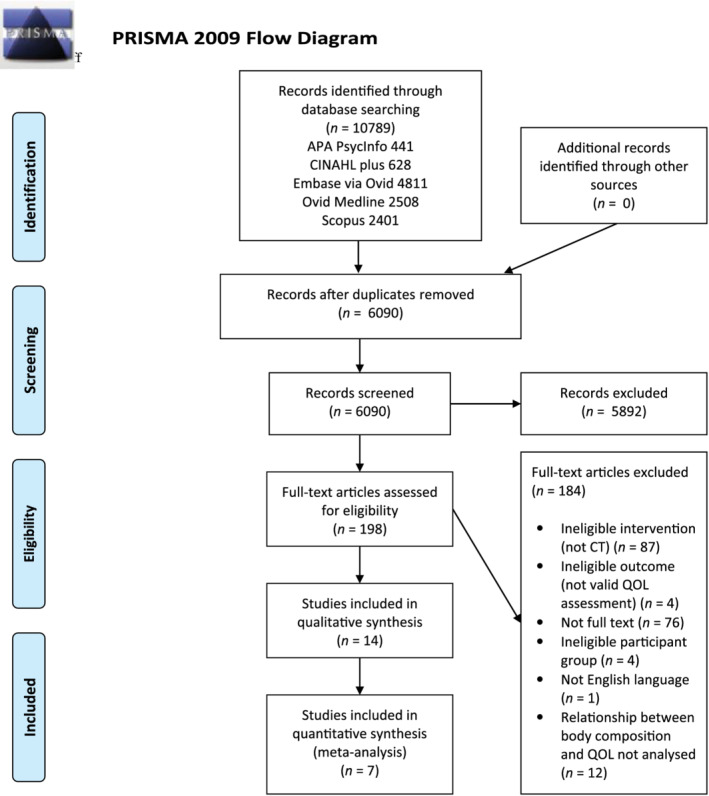
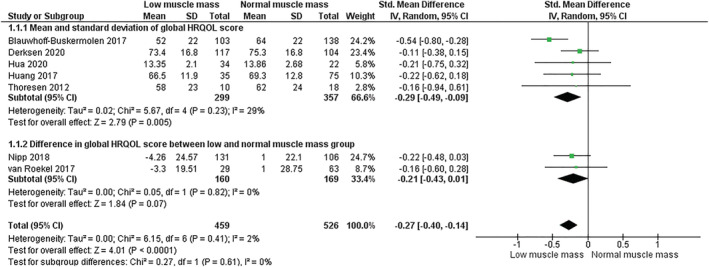
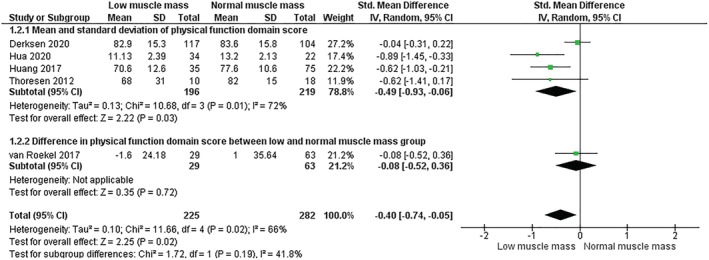
Low skeletal muscle mass is known to be associated with poor morbidity and mortality outcomes in cancer, but evidence of its impact on health-related quality of life (HRQOL) is less established. This systematic review and meta-analysis was performed to investigate the relationship between skeletal muscle mass and HRQOL in adults with cancer. Five databases (Ovid MEDLINE, Embase via Ovid, CINAHL plus, Scopus, and PsycInfo) were systematically searched from 1 January 2007 until 2 September 2020. Studies reporting on the association between measures of skeletal muscle (mass and/or radiodensity) derived from analysis of computed tomography imaging, and a validated measure of HRQOL in adults with cancer, were considered for inclusion. Studies classifying skeletal muscle mass as a categorical variable (low or normal) were combined in a meta-analysis to investigate cross-sectional association with HRQOL. Studies reporting skeletal muscle as a continuous variable were qualitatively synthesized. A total of 14 studies involving 2776 participants were eligible for inclusion. Skeletal muscle mass classified as low or normal was used to dichotomize participants in 10 studies (n = 1375). Five different cut points were used for classification across the 10 studies, with low muscle mass attributed to 58% of participants. Low muscle mass was associated with poorer global HRQOL scores [n = 985 from seven studies, standardized mean difference -0.27, 95% confidence interval (CI) -0.40 to -0.14, P < 0.0001], and poorer physical functioning domain HRQOL scores (n = 507 from five studies, standardized mean difference -0.40, 95% CI -0.74 to -0.05, P = 0.02), but not social, role, emotional, or cognitive functioning domain scores (all P > 0.05). Five studies examined the cross-sectional relationship between HRQOL and skeletal muscle mass as a continuous variable and found little evidence of an association unless non-linear analysis was used. Two studies investigated the relationship between longitudinal changes in both skeletal muscle and HRQOL, reporting that an association exists across several HRQOL domains. Low muscle mass may be associated with lower global and physical functioning HRQOL scores in adults with cancer. The interpretation of this relationship is limited by the varied classification of low muscle mass between studies. There is a need for prospective, longitudinal studies examining the interplay between skeletal muscle mass and HRQOL over time, and data should be made accessible to enable reanalysis according to different cut points. Further research is needed to elucidate the causal pathways between these outcomes.
Keywords: Body composition; Computed tomography; EORTC QLQ-C30; FACT; Oncology; Sarcopenia.
© 2022 The Authors. Journal of Cachexia, Sarcopenia and Muscle published by John Wiley & Sons Ltd on behalf of Society on Sarcopenia, Cachexia and Wasting Disorders.
Conflict of interest statement
None declared.
Figures
References
-
- Martin L, Birdsell L, Macdonald N, Reiman T, Clandinin MT, McCargar LJ, et al. Cancer cachexia in the age of obesity: skeletal muscle depletion is a powerful prognostic factor, independent of body mass index. J Clin Oncol 2013;31:1539–1547. - PubMed
-
- Prado CM, Lieffers JR, McCargar LJ, Reiman T, Sawyer MB, Martin L, et al. Prevalence and clinical implications of sarcopenic obesity in patients with solid tumours of the respiratory and gastrointestinal tracts: a population‐based study. Lancet Oncol 2008;9:629–635. - PubMed
-
- Ninomiya G, Fujii T, Yamada S, Yabusaki N, Suzuki K, Iwata N, et al. Clinical impact of sarcopenia on prognosis in pancreatic ductal adenocarcinoma: a retrospective cohort study. Int J Surg 2017;39:45–51. - PubMed
-
- Shachar SS, Williams GR, Muss HB, Nishijima TF. Prognostic value of sarcopenia in adults with solid tumours: a meta‐analysis and systematic review. Eur J Cancer 2016;57:58–67. - PubMed
Publication types
MeSH terms
Grants and funding
LinkOut - more resources
Full Text Sources
Medical
