Randomized Controlled Trial
. 2022 Apr 1;322(4):F392-F402.
doi: 10.1152/ajprenal.00240.2021. Epub 2022 Feb 14.

High dietary salt intake increases urinary NGAL excretion and creatinine clearance in healthy young adults

Affiliations
Randomized Controlled Trial

High dietary salt intake increases urinary NGAL excretion and creatinine clearance in healthy young adults

Alex M Barnett et al. Am J Physiol Renal Physiol. .

Abstract

In rodents and older patients with elevated blood pressure (BP), high dietary sodium increases excretion of biomarkers of kidney injury, but it is unclear whether this effect occurs in healthy young adults. The purpose of this study was to determine whether short-term high dietary salt increases urinary excretion of the kidney injury biomarkers neutrophil gelatinase-associated lipocalin (NGAL) and kidney injury molecule-1 (KIM-1) in healthy young adults. Twenty participants participated in a double-blind, placebo-controlled, randomized crossover study. For 10 days each, participants were asked to consume salt (3,900 mg sodium) or placebo capsules. We measured BP during each visit, obtained 24-h urine samples for measurements of electrolytes, NGAL, and KIM-1, and assessed creatinine clearance. Compared with placebo, salt loading increased daily urinary sodium excretion (placebo: 130.3 ± 62.4 mmol/24 h vs. salt: 287.2 ± 72.0 mmol/24 h, P < 0.01). There was no difference in mean arterial BP (placebo: 77 ± 7 mmHg vs. salt: 77 ± 6 mmHg, P = 0.83) between conditions. However, salt loading increased the urinary NGAL excretion rate (placebo: 59.8 ± 44.4 ng/min vs. salt: 80.8 ± 49.5 ng/min, P < 0.01) and increased creatinine clearance (placebo: 110.5 ± 32.9 mL/min vs. salt: 145.0 ± 24.9 mL/min, P < 0.01). Urinary KIM-1 excretion was not different between conditions. In conclusion, in healthy young adults 10 days of dietary salt loading increased creatinine clearance and increased urinary excretion of the kidney injury biomarker marker NGAL but not KIM-1.NEW & NOTEWORTHY In healthy young adults, 10 days of dietary salt loading increased creatinine clearance and increased urinary excretion of the kidney injury biomarker marker neutrophil gelatinase-associated lipocalin despite no change in resting blood pressure.

Keywords: clinical trial; creatinine clearance; dietary sodium; kidney injury molecule-1; neutrophil gelatinase-associated lipocalin; sodium chloride.


Conflict of interest statement

No conflicts of interest, financial or otherwise, are declared by the authors.

Figures
None
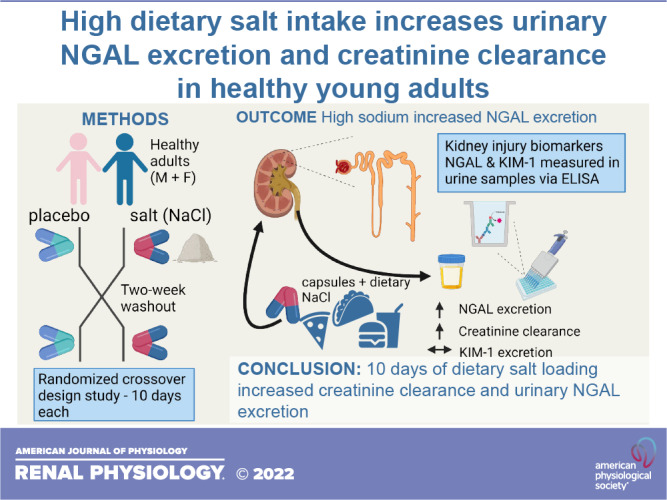
Graphical abstract
Figure 1.
Figure 1.
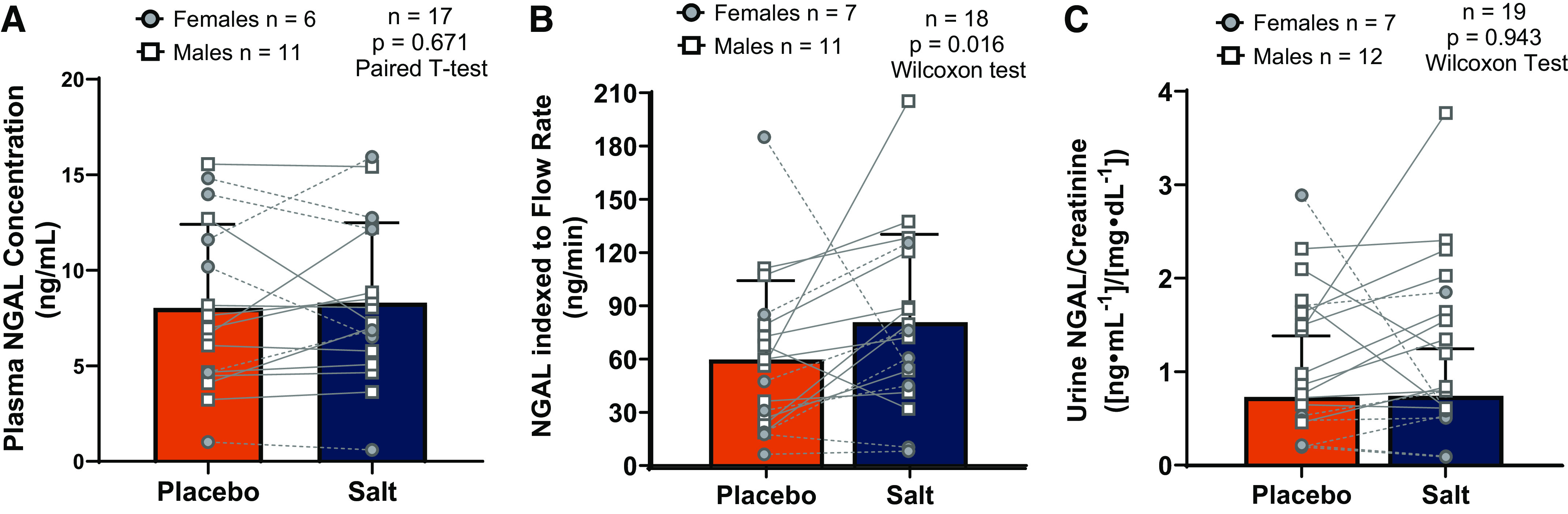
Effects of high dietary salt intake on neutrophil gelatinase-associated lipocalin (NGAL). A: plasma NGAL was not affected by salt loading. B: urine NGAL indexed to urine flow rate was increased after 10 days of dietary salt loading. C: NGAL indexed to creatinine concentration was not affected by salt loading. Sample sizes and statistical tests are reported in each graph. Statistical analyses were completed on all participants, but we have visually depicted females and males separately. All data are presented as individual data points overlaid with means ± SD.
Figure 2.
Figure 2.
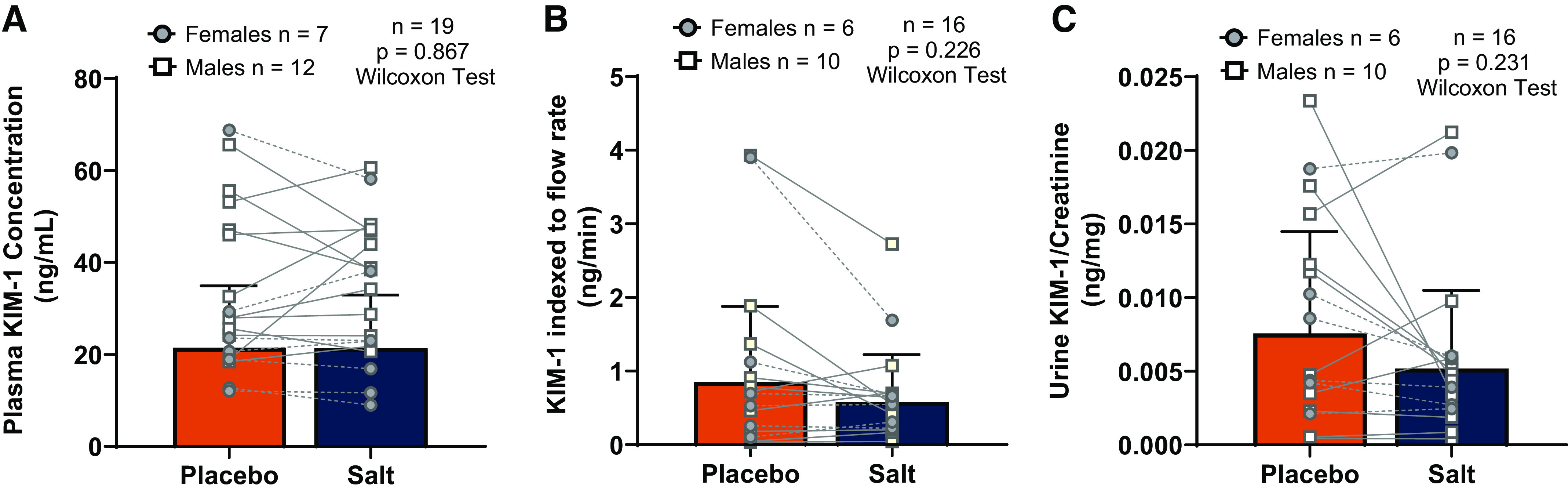
Effects of high dietary salt intake on kidney injury molecule-1 (KIM-1). A: plasma KIM-1 was not affected by salt loading. B and C: urine KIM-1 indexed to urine flow rate (B) and KIM-1 indexed to urine creatinine concentration (C) were not affected by salt loading. Sample sizes and statistical tests are reported in each graph. Statistical analyses were completed on all participants, but we have visually depicted females and males separately. All data are presented as individual data points overlaid with means ± SD.
Figure 3.
Figure 3.
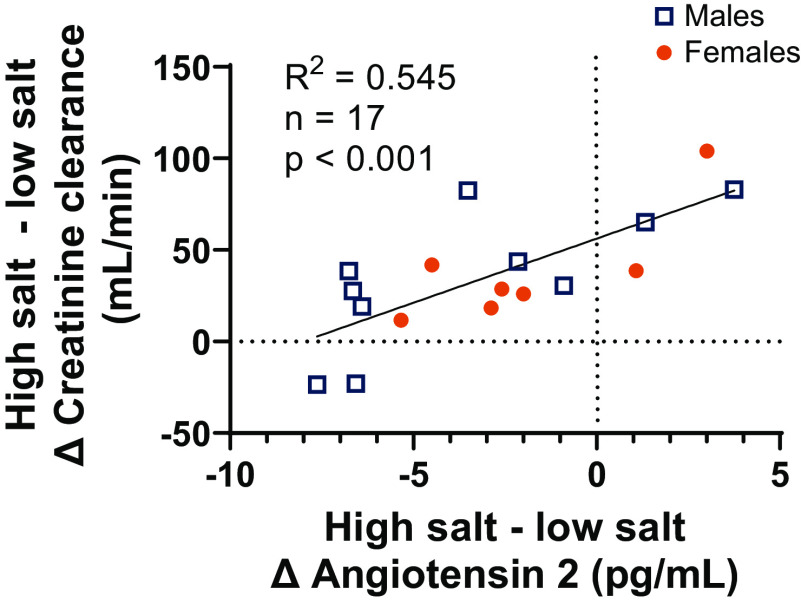
Inverse relation between angiotensin II suppression and high salt-induced elevations in creatinine clearance (glomerular filtration rate). Results from simple bivariate linear regression are shown. Those with greater suppression of angiotensin II had less of a change in creatinine clearance. Statistical analysis was completed on all participants, but we have visually depicted females and males separately.

References

    1. Harnack LJ, Cogswell ME, Shikany JM, Gardner CD, Gillespie C, Loria CM, Zhou X, Yuan K, Steffen LM. Sources of sodium in US adults from 3 geographic regions. Circulation 135: 1775–1783, 2017. doi: 10.1161/CIRCULATIONAHA.116.024446. - DOI - PMC - PubMed
    1. Hu JR, Sahni S, Mukamal KJ, Millar CL, Wu Y, Appel LJ, Juraschek SP. Dietary sodium intake and sodium density in the United States—estimates from NHANES 2005–2006 and 2015–2016. Am J Hypertens 33: 825–830, 2020. doi: 10.1093/ajh/hpaa104. - DOI - PMC - PubMed
    1. Quader Z, Zhao L, Gillespie C, Cogswell M, Terry A, Moshfegh A, Rhodes D. Sodium intake among persons aged ≥2 years—United States, 2013–2014. Morb Mortal Wkly Rep 66: 324–338, 2017. doi: 10.15585/mmwr.mm6612a3. - DOI - PMC - PubMed
    1. Cook NR, He FJ, MacGregor GA, Graudal N. Sodium and health-concordance and controversy. BMJ 369: m2440, 2020. doi: 10.1136/bmj.m2440. - DOI - PMC - PubMed
    1. Cook NR, Appel LJ, Whelton PK. Sodium intake and all-cause mortality over 20 years in the trials of hypertension prevention. J Am Coll Cardiol 68: 1609–1617, 2016. doi: 10.1016/j.jacc.2016.07.745. - DOI - PMC - PubMed

Publication types