Review
. 2022 Jan 20;11(3):342.
doi: 10.3390/cells11030342.

Protective Effects of Curcumin in Cardiovascular Diseases-Impact on Oxidative Stress and Mitochondria

Affiliations
Review

Protective Effects of Curcumin in Cardiovascular Diseases-Impact on Oxidative Stress and Mitochondria

Fiona Frederike Cox et al. Cells. .

Abstract

Cardiovascular diseases (CVDs) contribute to a large part of worldwide mortality. Similarly, two of the major risk factors for these diseases, aging and obesity, are also global problems. Aging, the gradual decline of body functions, is non-modifiable. Obesity, a modifiable risk factor for CVDs, also predisposes to type 2 diabetes mellitus (T2DM). Moreover, it affects not only the vasculature and the heart but also specific fat depots, which themselves have a major impact on the development and progression of CVDs. Common denominators of aging, obesity, and T2DM include oxidative stress, mitochondrial dysfunction, metabolic abnormalities such as altered lipid profiles and glucose metabolism, and inflammation. Several plant substances such as curcumin, the major active compound in turmeric root, have been used for a long time in traditional medicine and for the treatment of CVDs. Newer mechanistic, animal, and human studies provide evidence that curcumin has pleiotropic effects and attenuates numerous parameters which contribute to an increased risk for CVDs in aging as well as in obesity. Thus, curcumin as a nutraceutical could hold promise in the prevention of CVDs, but more standardized clinical trials are required to fully unravel its potential.

Keywords: aging; atherosclerosis; cardiovascular diseases; curcumin; mitochondria; myocardial infarction; obesity; oxidative stress; risk factors.


Conflict of interest statement

The authors declare no conflict of interest.

Figures
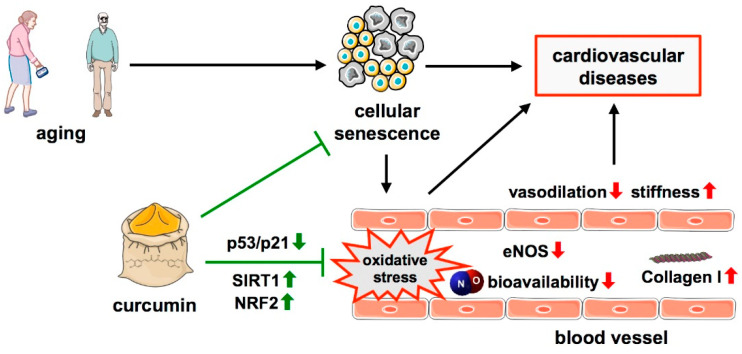
Figure 1
Figure 1
Protective effects of curcumin in age-related cellular senescence. A hallmark of aging, one major risk factor for cardiovascular diseases is cellular senescence which is associated with oxidative stress in blood vessels, along with decreased levels of eNOS, NO bioavailability, reduced vasodilation, and increased vascular stiffness due to increased Collagen I levels. Curcumin antagonizes these effects by the upregulation of SIRT1 and NRF2 and downregulation of the p53/p21 pathway. ↑—increased; ↓—decreased.
Figure 2
Figure 2
Protective effects of curcumin in obesity-induced adipose tissue dysfunction. Obesity is characterized by the expansion of WAT and inflammation therein. Curcumin can inhibit WAT expansion and obesity-induced adipose tissue inflammation. It is also linked to the process of beiging, the formation of beige adipocytes in WAT, which results in BAT-like characteristics of these cells. The underlying mechanisms include the upregulation of PPARγ, PGC1α, and UCP1, resulting in increased mitochondrial biogenesis, improved respiratory chain function, and thermogenesis. Moreover, curcumin induces an increase in Adiponectin levels with a concomitant decrease in Leptin, thereby reducing inflammation. ↑—increased; ↓—decreased.
Figure 3
Figure 3
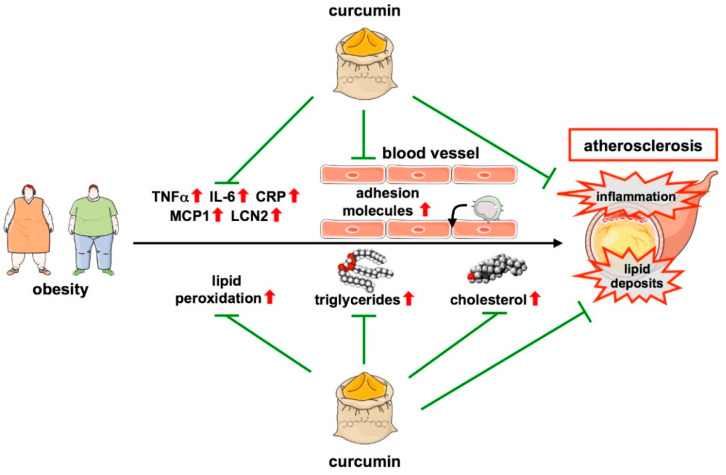
Protective functions of curcumin in atherosclerosis. Obesity is one major risk factor for atherosclerosis development. Atherosclerosis is characterized by low-grade inflammation with an increase in cytokines such as TNFα, IL-6, CRP, MCP1, and LCN2. Moreover, monocytes can infiltrate the vascular wall, another critical step in atherosclerosis development. By downregulating cytokines and reducing macrophage adhesion to the endothelium, curcumin attenuates inflammation. Another feature of atherosclerosis is lipid deposition in areas where atherosclerotic plaques develop, even long before an overt disease. This is fostered by lipid peroxidation as well as increases in serum triglycerides and cholesterol, all of which are attenuated by curcumin, which also leads to a favorable, non-atherogenic lipid profile reducing lipid deposition. ↑—increased; ↓—decreased.
Figure 4
Figure 4
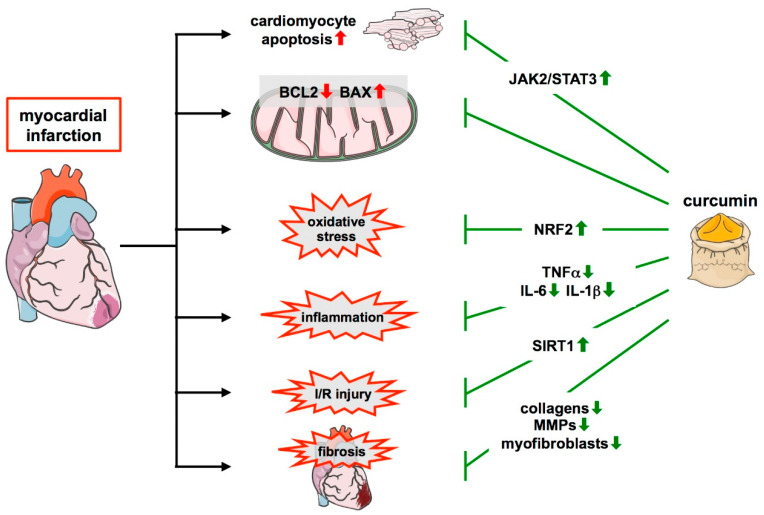
Protective role of curcumin in myocardial infarction and remodeling. During myocardial infarction, multiple changes occur in the infarcted heart which is positively affected by curcumin. This nutraceutical protects cardiomyocytes by activating the JAK2/STAT pathway and attenuates the unfavorable change in the levels of the apoptosis regulator BCL2 and BAX observed upon MI. Furthermore, it reduces oxidative stress via the upregulation of NRF2 and inflammation through the downregulation of cytokines such as TNFα, IL-6, and IL-1β. It also limits I/R injury, and this requires SIRT1. Additionally, it positively affects remodeling after infarction by reducing collagens and MMPs and suppressing myofibroblast overactivation, leading to a stable scar and preventing fibrosis. ↑—increased; ↓—decreased.

References

    1. Mathers C.D., Loncar D. Projections of global mortality and burden of disease from 2002 to 2030. PLoS Med. 2006;3:e442. doi: 10.1371/journal.pmed.0030442. - DOI - PMC - PubMed
    1. World Health Organization . Global Health Risks: Mortality and Burden of Disease Attributable to Selected Major Risks. World Health Organization; Geneva, Switzerland: 2009.
    1. Vogel A., Pelletier J. Examen chimique de la racine de Curcuma. J. De Pharm. 1815;I:289–300.
    1. Vogel A. Curcumin. Justus Liebigs Ann. Chem. 1842;44:297–298.
    1. Miłobȩdzka J., Kostanecki S.V., Lampe V. Zur Kenntnis des Curcumins. Ber. Dtsch. Chem. Ges. 1910;43:2163–2170. doi: 10.1002/cber.191004302168. - DOI

Publication types