Review
. 2022 Jan 26;11(3):429.
doi: 10.3390/cells11030429.

Therapeutic Targeting of Intestinal Fibrosis in Crohn's Disease

Affiliations
Review

Therapeutic Targeting of Intestinal Fibrosis in Crohn's Disease

Giovanni Santacroce et al. Cells. .

Abstract

Intestinal fibrosis is one of the most threatening complications of Crohn's disease. It occurs in more than a third of patients with this condition, is associated with increased morbidity and mortality, and surgery often represents the only available therapeutic option. The mechanisms underlying intestinal fibrosis are partly known. Studies conducted so far have shown a relevant pathogenetic role played by mesenchymal cells (especially myofibroblasts), cytokines (e.g., transforming growth factor-β), growth factors, microRNAs, intestinal microbiome, matrix stiffness, and mesenteric adipocytes. Further studies are still necessary to elucidate all the mechanisms involved in intestinal fibrosis, so that targeted therapies can be developed. Although several pre-clinical studies have been conducted so far, no anti-fibrotic therapy is yet available to prevent or reverse intestinal fibrosis. The aim of this review is to provide an overview of the main therapeutic targets currently identified and the most promising anti-fibrotic therapies, which may be available in the near future.

Keywords: Crohn’s disease; IBD; antifibrotic therapy; intestinal fibrosis; stricture.


Conflict of interest statement

The authors declare no conflict of interest.

Figures
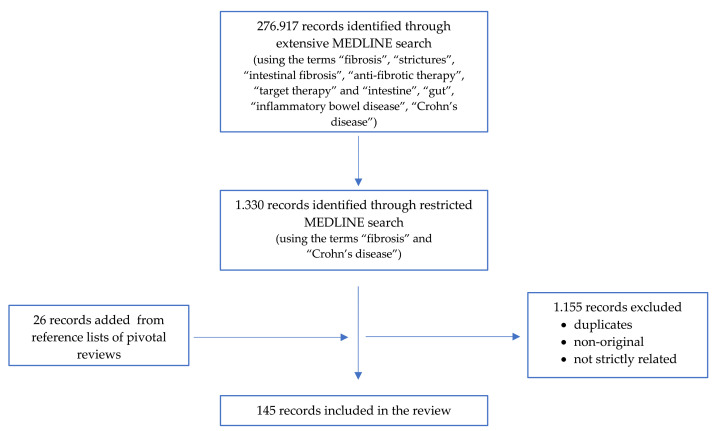
Figure 1
Figure 1
Flow-chart of the search strategy.
Figure 2
Figure 2
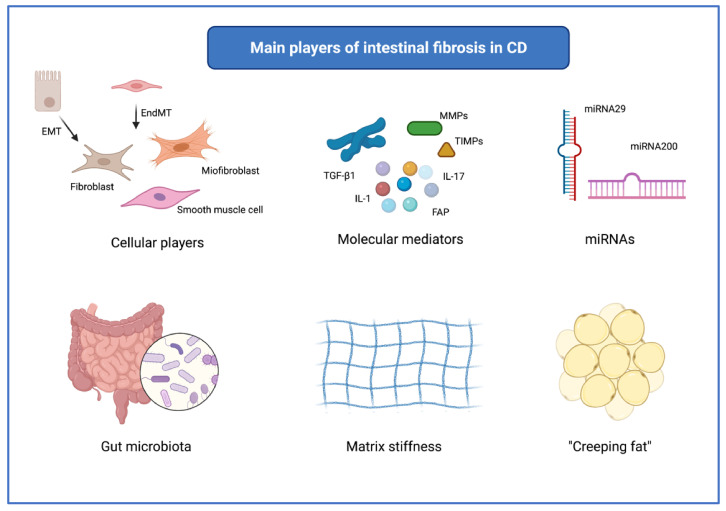
Schematic representation of the main players of intestinal fibrosis in Crohn’s disease. Abbreviations: CD, Crohn’s disease; EMT, epithelial-mesenchymal transition; EndMT, endothelial-mesenchymal transition; FAP, fibroblast activation protein; IL, interleukin; miRNA, micro ribonucleic acid; MMP, matrix metalloproteinase; TGF, transforming growth factor; TIMP, tissue inhibitor of metalloproteinase. Created with “BioRender.com”, 22 December 2021.
Figure 3
Figure 3
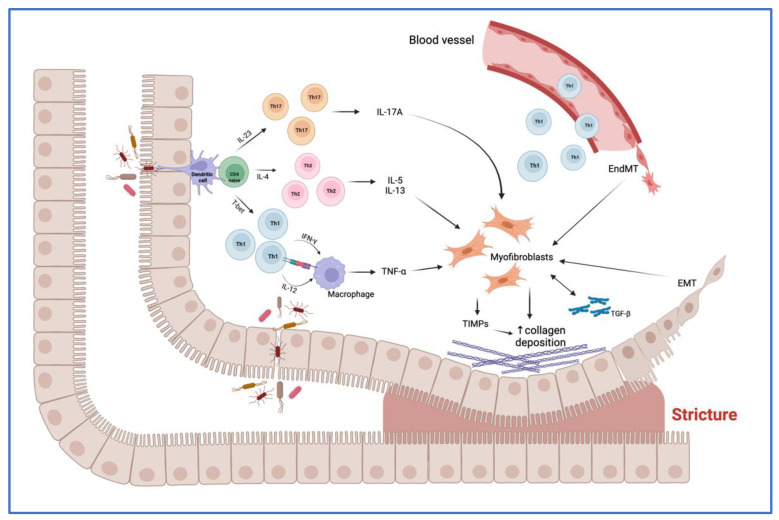
Main molecular and cellular mechanisms, and their interaction, underlying the fibrogenic process leading to stricture formation in Crohn’s disease (CD). Intestinal mucosal infiltration of CD4+ T cells represents a key characteristic of CD. Multiple Th subsets have been identified, with different role in the fibrogenic process. The cross-talk between macrophage and T cells, sustained by Th1 pro-inflammatory cytokines, including interferon (IFN)-ɣ and interleukin (IL)-12, results in the production of tumor necrosis factor (TNF)-α, which promotes myofibroblast production of transforming growth factor (TGF)-β1. The latter inhibits the production of matrix metalloproteinases (MMPs) and favors the production of tissue inhibitor of metalloproteinases (TIMPs), which causes abnormal collagen deposition, with consequent fibrosis and stricture formation. In addition, Th2 and Th17 cells have a pro-fibrotic role through the production of pro-fibrotic cytokines, especially IL-17A, which induces intestinal myofibroblast secretion of collagen and TIMPs and significantly inhibits myofibroblast migration. The fibrotic process is also sustained by epithelial-mesenchymal transition (EMT) and endothelial-mesenchymal transition (EndMT), constantly evolving processes in which epithelial and endothelial cells acquire fibroblast characteristics. Abbreviations: EMT, epithelial-mesenchymal transition; EndMT, endothelial-mesenchymal transition; IL, interleukin; IFN, interferon; T-bet, T-box transcription factor; TGF, transforming growth factor; Th, T helper cell; TIMP, tissue inhibitor of metalloproteinase; TNF, tumor necrosis factor; ↑, increase. Created with “BioRender.com”, 21 January 2022.

References

    1. Baumgart D.C., Sandborn W.J. Chron’s disease. Lancet. 2012;380:1590–1605. doi: 10.1016/S0140-6736(12)60026-9. - DOI - PubMed
    1. Kaplan G. The global burden of IBD: From 2015 to 2025. Nat. Rev. Gastroenterol. Hepatol. 2015;12:720–727. doi: 10.1038/nrgastro.2015.150. - DOI - PubMed
    1. Di Sabatino A., Rovedatti L. Recent advances in understanding Crohn’s disease. Intern. Emerg. Med. 2013;8:101–113. doi: 10.1007/s11739-011-0599-2. - DOI - PubMed
    1. Knowles S.R., Graff L.A. Quality of life in inflammatory bowel disease: A systematic review and meta-analyses-Part I. Inflamm. Bowel Dis. 2018;24:742–751. doi: 10.1093/ibd/izx100. - DOI - PubMed
    1. Rieder F., Fiocchi C. Mechanisms, management, and treatment of fibrosis in patients with inflammatory bowel diseases. Gastroenterology. 2017;152:340–350. doi: 10.1053/j.gastro.2016.09.047. - DOI - PMC - PubMed

Publication types